Queer Places:
92190 Meudon, France
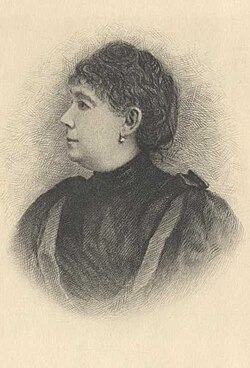 Marie-Thérèse Blanc (September 21, 1840 – February 5, 1907), widely known by her pen name Thérèse Bentzon (or occasionally Théodore Bentzon), was a prominent French
novelist, journalist, and literary critic. She was a pivotal figure in 19th-century French letters, particularly as a cultural mediator between the English-speaking world
and France.
Marie-Thérèse Blanc (September 21, 1840 – February 5, 1907), widely known by her pen name Thérèse Bentzon (or occasionally Théodore Bentzon), was a prominent French
novelist, journalist, and literary critic. She was a pivotal figure in 19th-century French letters, particularly as a cultural mediator between the English-speaking world
and France.
Born in Seine-Port, France, to an aristocratic family of mixed German and Danish heritage, her maternal grandparents were the Marquis and Marquise de Vitry. She received
a comprehensive, multilingual education from tutors at home.
At 16, she was married to a man named Louis Blanc, a union that proved unhappy and ended in divorce after three years. Left with a young son and limited financial
resources, she turned to writing to support herself.
She secured a long-term position at the prestigious Revue des Deux Mondes, where she became a highly influential critic. She was instrumental in introducing French
audiences to American literature, translating and writing about authors such as Mark Twain,
Henry James, and Sarah Orne Jewett.
She was a prolific travel writer, particularly focusing on the lives of women in North America. Her work often explored the intersection of gender, social progress, and
the "future of women" in society. She was also a protégé and friend of the famous French author George Sand. After a family connection
introduced her to Sand, Blanc-Bentzon spent significant time at Nohant. This period was transformative, as Sand helped launch her career by introducing her to the editor of
the Revue des Deux Mondes.
She maintained a deep, lifelong friendship with the British writer Vernon Lee (Violet Paget). Bentzon frequently visited Lee at
her home, Il Palmerino, in Florence, and they shared a professional and personal bond.
The connection between Marie-Thérèse Blanc and Grace Elizabeth King represents one of the most prominent transatlantic
literary and personal relationships in late 19th-century women's literature. In late 1891, as Grace King and her sister
Annie "Nan" King prepared for an extended European tour, Boston salonnière
Annie Adams Fields gave Grace a formal letter of introduction to Marie-Thérèse Blanc. Blanc was already one of France's
leading literary critics for the prestigious Revue des Deux Mondes and was deeply interested in American women writers. When King arrived in Paris, the two women formed an
immediate intellectual and personal connection. Blanc acted as King's primary advocate and translator in Europe: Blanc published glowing essays and reviews of Grace King’s
works in the Revue des Deux Mondes, introducing French readers to Louisiana Creole culture and King's nuanced portrayals of Southern women. When Blanc embarked on her famed
1892–1893 tour of the United States, she traveled to New Orleans specifically to visit King. She documented her stay in her acclaimed travelogue, Les Américaines chez elles
(1896), devoting significant attention to King, her writing, and the unique female-centered social dynamics of New Orleans society. Beyond literary patronage, their dynamic
developed into a deep "romantic friendship"—a 19th-century framework for intense, emotionally centered, and enduring bonds between women: King lived as a guest at Blanc’s
Parisian residence for extended stretches during her visits to France, absorbing the culture of French intellectual salons. In return, Blanc resided with Grace, her mother,
and her sister Nan at their New Orleans home during her American travels. The two maintained a passionate, frequent correspondence spanning over fifteen years until Blanc’s
death in 1907. King frequently noted in her journals and memoirs (Memories of a Southern Woman of Letters) how profoundly Blanc influenced her independence, her
understanding of world literature, and her identity as a woman of letters.
Academic studies, such as those analyzing "literary representations of female homosociality," often group Bentzon alongside other independent women writers of her era.
These women operated within female-dominated literary circles and support systems, which provided them the independence to live outside traditional domestic roles.
In the 19th and early 20th centuries, intense, lifelong female friendships (often termed "romantic friendships") were a common social structure. While modern scholars may
analyze these relationships through the lens of queer theory, there is no specific evidence to suggest that Bentzon’s own personal life was defined by same-sex romantic or
sexual attraction.
In summary, while Bentzon moved in circles that included queer figures like Vernon Lee and championed the independence of women, she is historically categorized as a
professional, prolific female intellectual of the late 19th century who navigated the gender constraints of her time through her work, international travels, and
professional associations.
Marie-Thérèse Blanc passed away in 1907 in Meudon. In her book The Sentimental Traveller: Notes on Places, Vernon Lee reflects on visiting her friend, noting that she lived among her books and souvenirs in a
"boarding-house at Meudon." Lee describes these later living arrangements—characterized by moving from one modest apartment to another—as emblematic of the financial and
personal struggles Blanc-Bentzon faced later in life, despite her high standing in French literary circles.
References:
Other references:
- https://www.palmerino.org/post/madame-th%C3%A9r%C3%A8se-bentzon
- https://www.encyclopedia.com/women/encyclopedias-almanacs-transcripts-and-maps/blanc-marie-therese-1840-1907
- https://jewett.house/topic/pinny-and-fuff/
- https://en.wikipedia.org/wiki/Th%C3%A9r%C3%A8se_Bentzon
- https://search.proquest.com/openview/8002ab956f3219e6b233136bf6e9b46f/1?pq-origsite=gscholar&cbl=51922&diss=y
- https://blue-stocking.org.uk/2024/03/01/a-landmark-in-my-memory-vernon-lee-and-il-palmerino/
Support this project
This website is a passion project researched, developed, and funded entirely by me. If you find the content valuable and would like to help support the ongoing research and hosting costs, any contribution is deeply appreciated.
Thank you for keeping this independent resource alive!
My books on Amazon: Elisa Rolle's books
BACK TO HOME PAGE
