Queer Places:
Cimetière du Montparnasse, 3 Boulevard Edgar Quinet, Paris, Département de Paris, Île-de-France, France
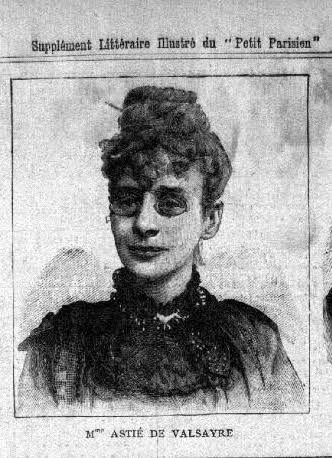 Marie-Rose Astié de Valsayre (born Claire Léonie Ferdinandine Tastayre, September 30, 1846 - June 8, 1915) was one of the most radical, fiercely independent figures of
Belle Époque France. A violinist, composer, nurse, journalist, and militant socialist-feminist, she famously used her sword and her pen to systematically dismantle the
rigid gender expectations of her era.
Marie-Rose Astié de Valsayre (born Claire Léonie Ferdinandine Tastayre, September 30, 1846 - June 8, 1915) was one of the most radical, fiercely independent figures of
Belle Époque France. A violinist, composer, nurse, journalist, and militant socialist-feminist, she famously used her sword and her pen to systematically dismantle the
rigid gender expectations of her era.
While she lived long before modern terminology existed, her subversion of gender presentation and her direct mentorship of queer historical icons tie her
intrinsically to LGBTQ+ and trans-feminist history.
Born in Paris, she grew up in a family financially ruined by the political upheavals of the era. She showed early genius as a musician, becoming a highly accomplished
violinist and a composer of piano pieces and ballads by age 13 under the pseudonym Marie de Valsayre.
Defying traditional expectations for women, she studied medicine and volunteered to serve as a frontline nurse during the Franco-Prussian War (1870).
In the 1880s, she transitioned to journalism and radical politics. She campaigned fiercely alongside labor organizers for "À travail égal, salaire égal" (Equal work,
equal pay), demanded women's absolute access to all professional and academic fields, and ran for municipal office in 1889. She founded the Socialist League of Women and
the League for the Liberation of Women to push these causes.
Infuriated that women were legally and socially barred from the exclusively male "code of honor," Astié became an expert fencer. In March 1886, she famously
challenged an American woman, Miss Shelby, to a fencing duel on the battlefield of Waterloo over a debate regarding the medical capabilities of French vs. American women
doctors. Astié won, lightly wounding her opponent, and used the notoriety to establish the Groupe des escrimeuses (Women's Fencing Group) to teach women self-defense and
martial confidence.
Astié de Valsayre’s legacy intersects profoundly with queer and transgender history through three primary dimensions:
In 1800, Paris enacted a strict law making it illegal for women to "cross-dress" or wear trousers without explicit written permission from the Prefect of Police.
Astié regularly violated this law, adopting masculine tailoring, short hair, and riding bicycles (then considered a scandalous, gender-defying act).
In 1887, she officially petitioned the French Parliament to lift the dress ban, arguing that corsets and heavy skirts were unhygienic, restrictive, and actively fatal
in accidents. Her opponents accused her of attempting the "virilization of women" and trying to erase the distinction between genders completely. In the media, masculine
or highly educated women in her circle were frequently pathologized and slurred as "hermaphrodites" or "gender-inverts."
Astié’s close confidante and co-militant in the League for the Liberation of Women and the fencing group was Gisèle d'Estoc
(Marie-Paule Alice Courbe). D'Estoc was a famously bisexual/queer sculptor and writer who lived an openly gender-nonconforming lifestyle. D'Estoc used a gender-neutral
initial ("G."), wore full male attire, and heavily explored androgyny, famously viewing Joan of Arc as the ultimate "androgynous ideal." Astié championed d'Estoc’s
participation in political circles and female dueling groups.
Astié's rebellion directly forged the path for Madeleine Pelletier, one of the most significant figures in French
queer and trans history. Pelletier, who would later cross-dress permanently, live entirely as a man socially, and develop the concept of "integral feminism," attended
the meetings of Astié de Valsayre’s League.
Pelletier later wrote that witnessing the fierce, trouser-wearing, sword-wielding silhouette of figures like Astié de Valsayre and Gisèle d'Estoc provided her with a
"luminous path of liberation." It proved to Pelletier that gender presentation was a construct that could be rejected entirely.
Marie-Rose Astié de Valsayre is buried in the Montparnasse Cemetery (Cimetière du Montparnasse) in Paris, France. She was laid to rest there following her death in
the 13th arrondissement of Paris on June 8, 1915. Her burial plot rests in a family space that also holds her mother, Claire Rosalie Tastayre, and her firstborn son,
Maxime Gustave Christian, who tragically passed away as an infant in 1867.
- https://en.wikipedia.org/wiki/Marie-Rose_Asti%C3%A9_de_Valsayre
Support this project
This website is a passion project researched, developed, and funded entirely by me. If you find the content valuable and would like to help support the ongoing research and hosting costs, any contribution is deeply appreciated.
Thank you for keeping this independent resource alive!
My books on Amazon: Elisa Rolle's books
BACK TO HOME PAGE