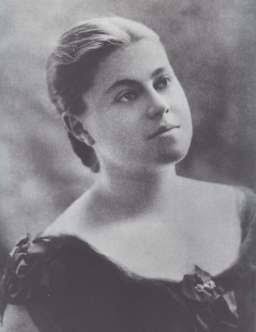
 Maria Bowen Chapin (September 13, 1863 - March 8, 1934) was a pioneering American educator and the visionary founder of The Chapin School, leaving a
profound mark on women's education and leadership.
Maria Bowen Chapin (September 13, 1863 - March 8, 1934) was a pioneering American educator and the visionary founder of The Chapin School, leaving a
profound mark on women's education and leadership.Partner Mary Cecelia Fairfax
Queer Places:
12 W 47th St, New York, NY 10036, USA
32 E 57th St, New York, NY 10022, USA
The Chapin School, 100 East End Ave, New York, NY 10028, United States
236 E 49th St, New York, NY 10017, USA
Swan Point Cemetery, 585 Blackstone Blvd, Providence, RI 02906, United States
Maria Bowen Chapin (September 13, 1863 - March 8, 1934) was a pioneering American educator and the visionary founder of The Chapin School, leaving a
profound mark on women's education and leadership.
Born on September 13, 1863, in Wickford, Rhode Island, she came from one of America's oldest families, with ancestry tracing back to Puritan leader Samuel Chapin—said to be the prototype for the Saint-Gaudens statue The Puritan—as well as maternal and paternal lineages that included Rhode Island Governors Royal Chapin and Ezra Bowen. One of seven children born to Walter Bartlett Chapin and Ann Frances Low Viall Chapin, she traveled extensively during her youth and was primarily tutored at home, save for a single influential year at Miss Abbott’s School in Providence.
When she was 25 years old, Miss Chapin moved to New York City and began teaching, which was then one of the few professional options available to educated women. Firmly believing that girls deserved just as rigorous an education as boys, she initially taught small classes of children in private parlors. In 1894, she partnered with Alice Wetmore to launch primary classes, and after seven years, she borrowed funds to officially open Miss Chapin’s School for Girls in October 1901 at 12 West 47th Street, later relocating to 32 East Fifty-seventh Street before establishing its permanent home at 100 East End Avenue in 1928. Under her leadership, the school educated the daughters of many prominent American families, including the Roosevelts, Vanderbilts, Rockefellers, Morgans, and Pratts.
Described as stern and strict yet wonderfully fair, brilliant, calm, and dignified, Miss Chapin possessed a commanding command of the English language and a deep love for penmanship and calligraphy. She famously wrote an original, affectionate poem for each graduating senior, such as the verse composed for Anne Morrow Lindbergh in 1924. Beyond academics, she was a true agent of change who integrated moral development, self-government, and physical education into her curriculum at a time when most schools neglected girls' athletic health. She and her students would travel by train to Hartsdale, New York, on Saturdays so the girls could run and play field hockey, basketball, and softball. She also designed the school's earliest traditions, including introducing an official uniform in 1912 complete with bloomers for ease of movement, and taught history and the literature of Dante and Shakespeare.
Deeply civic-minded and an ardent feminist, Miss Chapin edited the periodical "Far and Near" to unite working women, served as vice president of the Auxiliary Society of the Association of Working Girls' Societies, and founded the Scholarship Foundation, Inc. She proudly participated in one of the very first women's suffrage parades in 1915, walking over five miles and ninety blocks down Fifth Avenue accompanied by a marching band she personally paid for. When another headmistress warned her that marching would harm her school's reputation, Miss Chapin famously retorted that she did not march as the headmistress of her school, but as Maria Bowen Chapin, reserving the right to express herself freely. Her forward-thinking vision also led her to incorporate the school in 1925 to secure its long-term future.
Regarding her personal life and LGBTQ history, Maria Bowen Chapin shared a long-term domestic and professional partnership with Mary Cecelia Fairfax, the sister of the 12th Baron Fairfax. Fairfax began working closely alongside Chapin as her associate headmistress, residing with her as her partner and housemate starting in 1911. When Chapin retired from her day-to-day headmistress duties in September 1932—though she remained active on the board of trustees and addressed students at commencement—she deliberately relinquished leadership of the school to Fairfax and co-successor Ethel Grey Stringfellow, ensuring that her life partner remained central to the institution's stewardship. Miss Chapin passed away on March 8, 1934, at her home at 236 East Forty-ninth Street following a serious illness at the age of 70. Her funeral service was conducted by Bishop William T. Manning at Trinity Church, attended by older students in uniform and numerous alumnae, prior to her private burial at Swan Point Cemetery in Providence, Rhode Island.
References:
Support this project
This website is a passion project researched, developed, and funded entirely by me. If you find the content valuable and would like to help support the ongoing research and hosting costs, any contribution is deeply appreciated.
Thank you for keeping this independent resource alive!
My books on Amazon: Elisa Rolle's books