Queer Places:
Clifton Hill House, Lower Clifton Hill, Bristol BS8 1BX, Regno Unito
Am Hof, Davos-Platz, 7270 Davos
The Lodge, Wellington College, Duke's Ride, Berkshire, Crowthorne RG45 7PU, United Kingdom
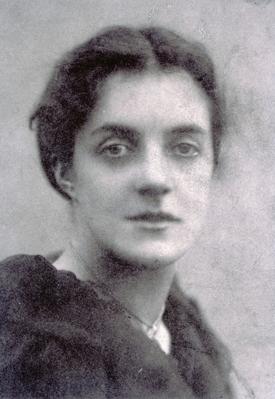 Margaret "Madge" Vaughan (née Symonds; 1869 – December, 1925) was a British writer and a significant figure in the early life and emotional development of
Virginia Woolf. She was probably writer Virginia Woolf's first same-sex crush, though there is no evidence that the feeling
was mutual. Woolf was the cousin of her husband William Wyamar Vaughan.
Margaret "Madge" Vaughan (née Symonds; 1869 – December, 1925) was a British writer and a significant figure in the early life and emotional development of
Virginia Woolf. She was probably writer Virginia Woolf's first same-sex crush, though there is no evidence that the feeling
was mutual. Woolf was the cousin of her husband William Wyamar Vaughan.
Madge was born into a distinguished intellectual family. She was the daughter of the noted writer and critic
John Addington Symonds and Janet Catherine North. Her father was a significant figure in the Victorian era,
particularly known for his writings on the Italian Renaissance and his advocacy for sexual reform.
Madge Symonds became a central figure for a young Virginia Woolf. Their relationship is often cited by scholars as one of Woolf’s earliest intense attachments to
another woman.
Woolf admired Madge for her beauty, her status as a "thoroughly modern" woman, and her career as a writer. Woolf found her enchanting and, during their time
together, developed strong romantic feelings for her.
Madge’s influence on Woolf’s life extended into her fiction. Most notably, she is widely considered to be the primary inspiration for the character Sally Seton in
Woolf’s novel Mrs. Dalloway. Sally Seton represents a free-spirited, rebellious, and captivating influence—traits that Woolf associated with the young Madge.
Madge married William Wyamar Vaughan, an educationalist who would later become the headmaster of Rugby School. William Vaughan was also a maternal first cousin of
Virginia Woolf, which brought the two families into closer personal contact.
During her husband William Wyamar Vaughan’s time as headmaster of Wellington College, the family resided at "The Lodge", Crowthorne, Berkshire. She is recorded living there in both the
1911 census and as late as 1921.
One of their children, Dame Janet Maria Vaughan (1899–1993), became a renowned scientist, pathologist, and academic administrator. Janet Vaughan famously served as
the Principal of Somerville College, Oxford, and was a pioneer in the development of blood banks during the Second World War.
While perhaps best known today for her connections to the Bloomsbury circle and the Symonds family, Madge was a published author in her own right. She wrote several
novels and was considered a part of the intellectual milieu that valued artistic expression and liberal thought.
When Madge Vaughan died, Virginia Woolf wrote to Madge's daughter, Dame Janet Vaughan: "I hope you won't mind me writing to you. I have thought so much of you since
Madge's death. I can't describe to you what she was like when she used to stay with us at St. Ives and how we worshiped her."
Madge Vaughn is the author of the following:
"Out of the Past: [A memoir of John Addington Symonds] with and account of Janet Catherine Symonds by Mrs. Walter Leaf," John Murray, [1925]. "Out of the Past,"
was reviewed in 1925 by Virginia Woolf.
"Days Spent on a Doge's Farm" T. Fischer Unwin : Padua, Italy [1893]
The Story of Perugia (co-authored with Lina Duff Gordon)
"Our Life in the Swiss Highlands," co-authored with her father, J. A. Symonds, [1891]
References:
Other references:
- https://archives.trin.cam.ac.uk/index.php/vaughan-margaret-symonds-1869-1925-writr
- https://rosariomariocapalbo.wordpress.com/2011/06/01/virginia-woolf/
- https://en.wikipedia.org/wiki/Janet_Vaughan
- "Virginia Woolf: Interviews and Recollections," ed. by John Henry Stape, [1995]
Support this project
This website is a passion project researched, developed, and funded entirely by me. If you find the content valuable and would like to help support the ongoing research and hosting costs, any contribution is deeply appreciated.
Thank you for keeping this independent resource alive!
My books on Amazon: Elisa Rolle's books
BACK TO HOME PAGE
