Partner Catharine Goggin
Queer Places:
Mount Olivet Cemetery, 1320 E Cass St, Joliet, IL 60432, United States
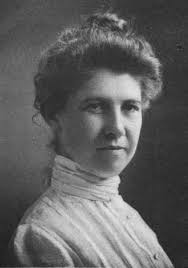 Margaret Angela Haley (November 15, 1861 – January 5, 1939) was born on November 15, 1861, in Joliet, Will County, Illinois, to working-class Irish immigrant parents,
Michael Haley and Elizabeth Tiernan Haley. Her mother hailed from Dublin, Ireland, while her father was born in Montreal, Quebec, Canada, to parents from County Clare,
Ireland. For the first six years of her life, she lived on a farm, where her parents actively supported agrarian activism including the grange, the Knights of Learning, and
the Farmers' Grange. Her childhood was shared with her siblings Thomas, Elizabeth A., Edward Joseph, and Mary Ellen. Economic hardship and the financial instability of the
1880s and 1890s deeply shaped her worldview. Seeking higher learning, she attended the Illinois Normal School in Bloomington, Illinois, as well as the Cook County Normal
School and the Buffalo School of Pedagogy. There, she absorbed the single-tax economic theories of Henry George and encountered the progressive educational philosophies of
Francis Wayland Parker and William James, alongside the democratic educational principles of John Dewey. Due to family financial troubles, she began teaching at the age of
sixteen in a country school in Grundy County, Illinois.
Margaret Angela Haley (November 15, 1861 – January 5, 1939) was born on November 15, 1861, in Joliet, Will County, Illinois, to working-class Irish immigrant parents,
Michael Haley and Elizabeth Tiernan Haley. Her mother hailed from Dublin, Ireland, while her father was born in Montreal, Quebec, Canada, to parents from County Clare,
Ireland. For the first six years of her life, she lived on a farm, where her parents actively supported agrarian activism including the grange, the Knights of Learning, and
the Farmers' Grange. Her childhood was shared with her siblings Thomas, Elizabeth A., Edward Joseph, and Mary Ellen. Economic hardship and the financial instability of the
1880s and 1890s deeply shaped her worldview. Seeking higher learning, she attended the Illinois Normal School in Bloomington, Illinois, as well as the Cook County Normal
School and the Buffalo School of Pedagogy. There, she absorbed the single-tax economic theories of Henry George and encountered the progressive educational philosophies of
Francis Wayland Parker and William James, alongside the democratic educational principles of John Dewey. Due to family financial troubles, she began teaching at the age of
sixteen in a country school in Grundy County, Illinois.
In 1882, Haley moved to Chicago to teach in the Cook County school system, and in 1884 she took a position as a sixth-grade teacher at the Hendricks School in the
impoverished Stockyards district on Chicago's South Side. For the next sixteen years, she taught classes of 50 to 60 students under deplorable conditions and within a rigid,
bureaucratic curriculum that treated educators as mere factory hands. Recognizing that the "factory-ization" of schools directly conflicted with democracy, she ended her
classroom teaching career in 1900. In 1897, she joined the fledgling Chicago Teachers' Federation (CTF), an organization distinct for being dominated by women grade-school
teachers rather than male administrators. By 1900, she became a district vice-president and soon left classroom teaching entirely to serve as the CTF's first and permanent
full-time business representative, earning her and her colleagues the moniker the "lady labor slugger".
Under her militant leadership, the CTF tackled monumental structural and economic battles. Haley's first major fight involved opposing the 1898 Harper Commission, headed
by University of Chicago President William Rainey Harper, which proposed corporate-like school restructuring, merit-based pay favoring male administrators, and 99-year
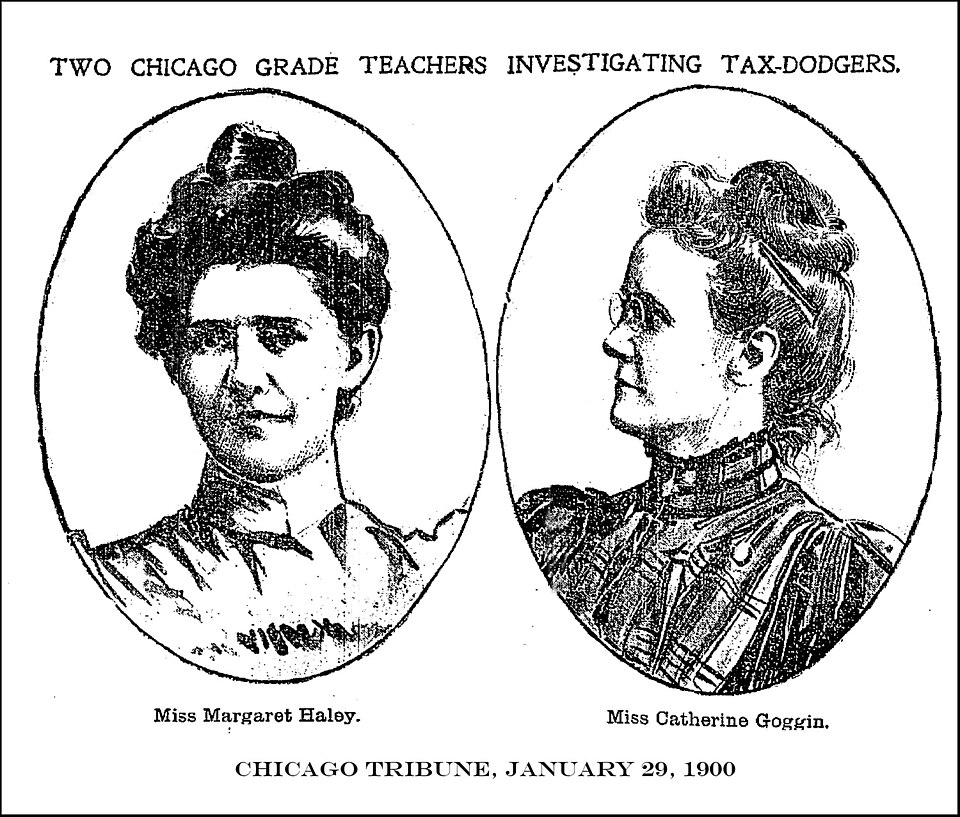
tax-exempt leases of school property for businesses. In late 1899, Haley launched her famous "tax fight" when the Board of Education refused to honor promised pay raises.
Investigating Cook County tax records, she discovered that major corporations had evaded over two million dollars in taxes. Her relentless advocacy forced these corporations
to pay their dues, successfully directing $600,000 into the public school system and securing raises for teachers while establishing corporate civic responsibility. In 1902,
she led the CTF into affiliation with the Chicago Federation of Labor, making it Local 1 of the American Federation of Teachers. Although political pressures and the
anti-labor Loeb rule enacted by the Board of Education in 1915 eventually forced the CTF to disaffiliate, Haley continually tied her union's fortunes to city politics,
serving as part of Mayor Edward Dunne's "Kitchen Cabinet" to protect schools from corporate domination.
Haley also emerged as a powerful voice on the national stage. In 1901, she became the first elementary school teacher to speak before the National Education Association
(NEA) at the St. Louis convention, presenting her landmark address, "Why Teachers Should Organize" in 1904. She championed greater leadership roles for women, playing an
instrumental role in electing Ella Flagg Young as NEA president in 1910. Beyond education, Haley viewed school reform as inextricably linked to broader social justice,
vigorously supporting child labor laws, direct primaries, and women's suffrage. She played a key role in the successful 1913 legislation granting women the right to vote in
Illinois. Haley never married and lived a dedicated professional life that doubled as her private sphere, frequently cohabiting with fellow CTF leader
Catharine Goggin.
Margaret Haley passed away from a heart attack at Englewood Hospital in Chicago on January 5, 1939, at the age of 77, and was laid to rest at Mount Olivet Cemetery in
Joliet, Illinois. Mainstream historical accounts document her lifelong domestic partnership and close collaboration with Catharine Goggin, though her archives and historical
records do not frame her life through modern definitions of LGBTQ identity, as private personal records detailing her romantic life were unrecorded.
References:
- Citizen Teacher: The Life and Leadership of Margaret Haley by Kate Rousmaniere (State University of New York Press, 2005) – The first full-length biography examining her political vision and union leadership.
- Battleground: The Autobiography of Margaret Haley edited by Robert L. Reid (University of Illinois Press, 1982) – Margaret Haley’s own written account of her life and the Chicago Teachers' Federation battles.
- Class and Reform: School and Society in Chicago 1880–1930 by David Hogan (University of Pennsylvania Press, 1985).
- Blackboard Unions: The AFT and the NEA 1900–1980 by Marjorie Murphy (Cornell University Press, 1990).
- Class, Politics and Public Schools: Chicago 1900–1950 by Julia Wrigley (Rutgers University Press, 1982).
- Chicago Teachers’ Federation Records (1864–1968) housed at the Chicago History Museum – Contains organizational minutes, correspondence, court excerpts, and Margaret A. Haley’s autobiographical drafts.
- “Why Chicago Teachers Unionized” by George Creel (Harper’s Weekly, June 19, 1915).
- “Chicago’s Five Maiden Aunts” by William Hard (American Magazine, September 1906).
- “Margaret Haley” by Carl Sandburg (Reedy’s Mirror, December 1915).
- Dictionary of Notable American Women – Biographical profile of Margaret Haley authored by Louise C. Wade.
Support this project
This website is a passion project researched, developed, and funded entirely by me. If you find the content valuable and would like to help support the ongoing research and hosting costs, any contribution is deeply appreciated.
Thank you for keeping this independent resource alive!
My books on Amazon: Elisa Rolle's books
BACK TO HOME PAGE