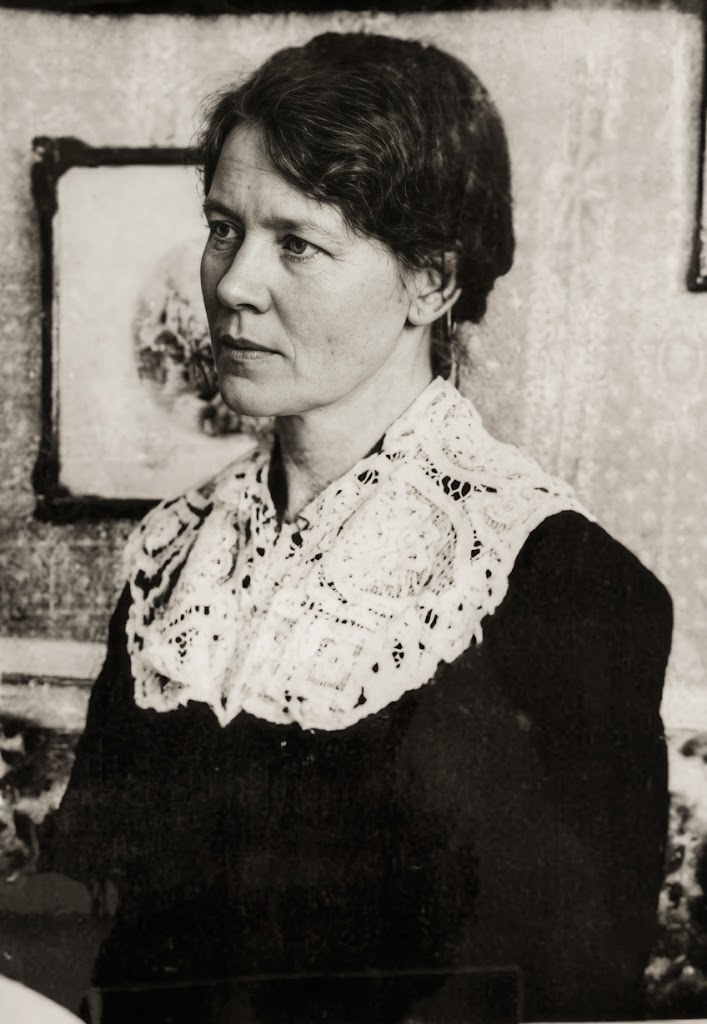
 Malin Blomsterberg (May 6, 1881 – November 28, 1925) was a Swedish domestic worker, secretary, and close companion to the renowned author, feminist, and
public intellectual Ellen Key.
Malin Blomsterberg (May 6, 1881 – November 28, 1925) was a Swedish domestic worker, secretary, and close companion to the renowned author, feminist, and
public intellectual Ellen Key.Partner Ellen Key
Queer Places:
Västra Tollstad parish, Västra Tollstad, 599 93 Ödeshög, Sweden
Malin Blomsterberg (May 6, 1881 – November 28, 1925) was a Swedish domestic worker, secretary, and close companion to the renowned author, feminist, and
public intellectual Ellen Key.
Born into a working-class family as the eldest of seven children to a shoemaker in Eslöv, Skåne, Blomsterberg was an avid reader from an early age despite her modest background, immersing herself in literature and contemporary philosophy.
Her life took a transformative turn on July 21, 1914, when she traveled to Strand, Ellen Key’s newly built villa by Lake Vättern. Arriving on foot carrying a bouquet of roses to express her gratitude for Key’s writing, the connection between the two women was immediate. Later that summer, Blomsterberg moved into Strand permanently, serving as Key’s cook, housekeeper, secretary, confidante, and literary disciple for eleven years. Poetically referred to as "the light on the beach" or "the light at Strand," Blomsterberg became central to the daily running of Key's home and social life.
Within the framework of LGBTQ history, the bond between Malin Blomsterberg and Ellen Key reflects the nuanced nature of intense female relationships in the late nineteenth and early twentieth centuries. While Key publicly championed heterosexuality, motherhood, and traditional romantic complementarity, her private life was deeply embedded in intimate, romantic female friendships. Historians and queer theorists view the cohabitation of Key and Blomsterberg as part of a continuum of non-normative, same-sex domestic partnerships of the era. Positioned at the intersection of love, devotion, mentorship, and domestic labor, their relationship represents the complex ways women navigated emotional and physical closeness outside heteronormative structures before modern queer identities were formalized.
The intense demands of managing the household and caring for an increasingly frail, aging Ellen Key, combined with Blomsterberg's own long-standing struggles with melancholy and deep brooding, eventually took a heavy emotional toll on her health. On November 28, 1925, during a violent snowstorm over Lake Vättern, Blomsterberg walked out through the beech forest behind Strand and stepped from a rocky ledge into the icy waters. Her body was recovered in mid-December by local fishermen from Hästholmen, and she was laid to rest in the Västra Tollstad cemetery, near the memorial for the victims of the 1918 Per Brahe shipwreck. Her devoted and tragic life continues to resonate in Swedish culture, serving as the basis for Malin Haawind’s biographical novel Den som följer en stjärna vänder inte om.
References:
Support this project
This website is a passion project researched, developed, and funded entirely by me. If you find the content valuable and would like to help support the ongoing research and hosting costs, any contribution is deeply appreciated.
Thank you for keeping this independent resource alive!
My books on Amazon: Elisa Rolle's books