Queer Places:
Eton College, Windsor SL4 6DW, United Kingdom
University of Cambridge, 4 Mill Ln, Cambridge CB2 1RZ
18 Eldon Rd, London N22 5DX, UK
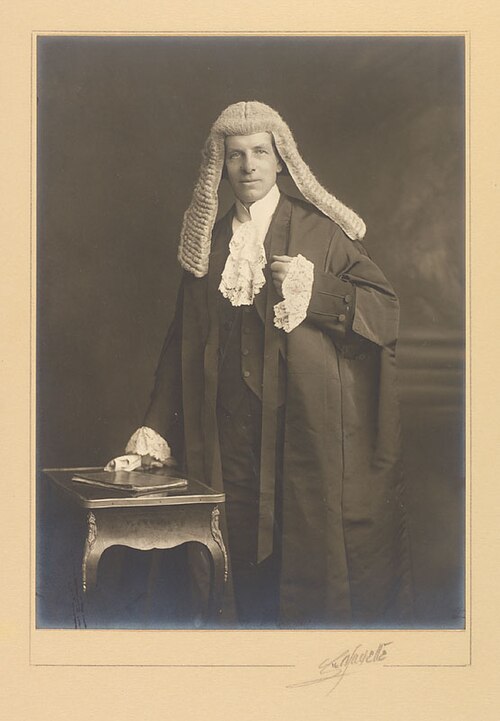 Sir Malcolm Martin Macnaghten, KBE, PC (January 12, 1869 – January 24, 1955) was a prominent British and Irish judge, politician, and member of a
distinguished legal family, best known for his significant contributions to the judiciary and his historic rulings on medical law.
Sir Malcolm Martin Macnaghten, KBE, PC (January 12, 1869 – January 24, 1955) was a prominent British and Irish judge, politician, and member of a
distinguished legal family, best known for his significant contributions to the judiciary and his historic rulings on medical law.
Born in London as the fourth son of Edward Macnaghten, Baron Macnaghten—himself a noted Lord of Appeal in Ordinary—he was immersed in a tradition of
legal excellence from an early age. He received his early education at Eton College before entering Trinity College, Cambridge, in 1888. At Cambridge,
Macnaghten excelled academically and socially, reading history, earning a First Class in the History Tripos in 1891, and serving as the President of the
Cambridge Union Society in 1890. During his university years, he was also inducted into the elite, secretive intellectual discussion society known as the
Cambridge Apostles, which fostered deep intellectual and personal ties among its members, some of whom
moved within broader homosocial and queer literary circles of late-Victorian and Edwardian Britain.
Following his graduation and subsequent Master of Arts degree in 1895, Macnaghten pursued a career in law, following the path of his illustrious
father. He was called to the Bar at Lincoln's Inn on January 26, 1894, later becoming a Bencher in 1915 and taking silk as a King's Counsel in 1919.
During the First World War, he applied his administrative and legal acumen to public service, directing the Foreign Claims Office from 1915 to 1919, an
achievement recognized with a KBE in the 1920 New Year Honours. Transitioning into politics, Macnaghten was elected as the Unionist Member of Parliament
for North Derry in 1922, and subsequently for the unified City and County of Londonderry from 1922 until 1928. Alongside his parliamentary duties, he
served as the Recorder of Colchester from 1924 to 1928 and as the Commissary of the University of Cambridge from 1926 until 1950.
In 1928, Macnaghten was appointed a Judge of the High Court of Justice, King's Bench Division, a post he held until his retirement in 1947. His tenure
on the bench is most historically remembered for his landmark ruling in the 1938 case of Rex v. Bourne. Presiding over the trial of obstetrician Aleck
Bourne—who had performed an unlawful abortion on a teenage girl impregnated by rape—Macnaghten delivered a progressive interpretation of the law by
integrating the principles of the Infant Life (Preservation) Act 1929. He instructed the jury that a doctor who acts in good faith to save a mother from
becoming a "physical or mental wreck" is not guilty of a crime, establishing a vital legal precedent that liberalized access to necessary medical
procedures and set the foundation for future reproductive rights. He was appointed a Privy Counsellor in 1948 in recognition of his judicial service.
On the domestic front, Macnaghten married Antonia Booth, the eldest daughter of the renowned social reformer and philanthropist Charles Booth. The
couple maintained residences at 18 Eldon Road and Campden Hill Court in London, as well as an Irish country home, The End House, in Portballintrae,
County Antrim. Together, they raised four children: a son and three daughters. Intriguingly, despite their father's establishment background, all three
daughters embraced radical politics, becoming socialists and marrying communists, including the Hungarian sculptor and artist Peter Laszlo Peri.
Furthermore, his youngest daughter, Anne Macnaghten, established a prominent name for herself in the British classical music world as a pioneering
violinist and the co-founder of the celebrated Macnaghten Concerts, where she actively championed contemporary British composers such as
Benjamin Britten. Macnaghten lived to the age of 86, passing away on January 24, 1955, leaving behind a
complex legacy bridging Victorian legal dynasty, progressive judicial reform, and ties to the intellectual countercultures of his era.
References:
Other references:
- The London Gazette: Official notices detailing his appointments and honors, including his creation as a Knight Commander of the Order of the British Empire (KBE) in 1920, his appointment as Recorder of Colchester (1924), his elevation as a High Court Judge of the King's Bench Division (1928), and his appointment as a Privy Counsellor (1948).
- A Cambridge Alumni Database (Venn): Maintained by the University of Cambridge, recording his admission to Trinity College (1888), his scholarship, and his graduation details (BA History Tripos, 1st Class, 1891; MA, 1895).
- Who's Who & Thom's Irish Who's Who (1923): Contemporary biographical compendiums detailing his parliamentary career, professional memberships, and personal residences.
- Hansard: The official report of debates in the UK Parliament, recording his legislative contributions and speeches as the Member of Parliament for North Derry and Londonderry during the 1920s.
- Legal Case Reports (Rex v. Bourne, 1938): Law reports and legal history analyses (such as those compiled by Barbara Brookes and Paul Roth in Legal Medicine in History) documenting his landmark judicial ruling regarding medical law and abortion.
- The Belfast News-Letter: Contemporary press archives, including his obituary and death notice published on January 25, 1955.
Support this project
This website is a passion project researched, developed, and funded entirely by me. If you find the content valuable and would like to help support the ongoing research and hosting costs, any contribution is deeply appreciated.
Thank you for keeping this independent resource alive!
My books on Amazon: Elisa Rolle's books
BACK TO HOME PAGE
