Queer Places:
7 Rue Christophe Colomb, 75008 Paris, France
Cimetière du Père-Lachaise, Paris, Département de Paris, Île-de-France, France
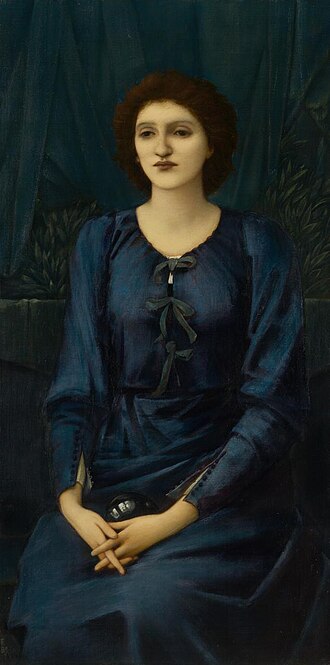 Baronne Madeleine Annette Edmé Angélique Vivier-Deslandes (April 16, 1866 - March 2, 1929), who wrote under the male-leaning pseudonym Ossit, was a
prominent French society woman, novelist, and spiritualist deeply associated with the English Pre-Raphaelite aesthetic.
Baronne Madeleine Annette Edmé Angélique Vivier-Deslandes (April 16, 1866 - March 2, 1929), who wrote under the male-leaning pseudonym Ossit, was a
prominent French society woman, novelist, and spiritualist deeply associated with the English Pre-Raphaelite aesthetic.
Born in Montluçon, she was the daughter of Émile Auguste Vivier, Baron Deslandes (1832–1917), a naval officer, sub-prefect under the Second Empire,
painter, and man of letters, and Émilie Caroline Helene von Oppenheim (1842–1866). Through her mother, she was the granddaughter of banker Simon von
Oppenheim; through her father, she descended from Baron Paul Deslandes-Preuilly and the celebrated singer Angelica Catalani. Her mother passed away
shortly after her birth.
In September 1884, an arranged marriage orchestrated by her paternal grandmother tied her to Count Maurice Fleury (1856–1921), a historian and
journalist, with whom she had a son, Serge (1885–1973). She later divorced him in 1894, stating she had never loved the spendthrift man and had no voice
in choosing him.
Deslandes contributed occasionally to prominent newspapers like Le Figaro, Le Gaulois, and La Nouvelle Revue. Under her pseudonym Ossit, she authored
four novels: À quoi bon? (1892), Ilse (1894), Il n'y a plus d'îles bienheureuses (1898), Cyrène (1908).
Deeply drawn to the English Pre-Raphaelite movement, she traveled to England in 1893 to meet painter
Edward Burne-Jones for an article published in Le Figaro in May 1893. This encounter led Burne-Jones to
paint her striking portrait between 1894 and 1895 (now held by the National Gallery of Victoria).
Deslandes held a celebrated salon at her private mansion at 7 rue Christophe-Colomb in the 8th arrondissement of Paris. Described by
Jean Lorrain as a "Fairyland" with eccentric decor featuring earthenware toads and bronze deer, her salon drew
elite artists, poets, and composers. Regulars included Oscar Wilde, Maurice Barrès, Jean-Louis Forain,
Jacques-Émile Blanche, Jean Lorrain, Henri de Régnier, Albert Flament, Princess Jeanne Bonaparte,
Princess Edmond de Polignac (Winnaretta Singer), and composer
Pierre de Bréville with his partner Maurice Bagès.
Known for her flamboyant eccentricities, she was a spiritualist tied to esoteric circles—her father was a close friend of Papus—and maintained close
bonds with theosophist Lady Paget, frequently visiting her villa in Florence and St Fagans Castle near Cardiff. Later in life, plagued by financial ruin
and drug use while maintaining a passion for clairvoyance, she lived largely in the memory of her glory days, viewing herself as an eternally young
Pre-Raphaelite fairy. Her legendary theatrical stunts included a June 1924 charity event at the Neuilly Fair where, dressed as a priestess, she entered a
lion's cage to recite a poem by Jean Richepin—reportedly orchestrated by Boni de Castellane to catch the eye of a muscular animal trainer.
While Deslandes married a man and engaged in high-profile romances with men—including an intense youth relationship with writer Maurice Barrès
(1890–1894), an unrequited love for sculptor Hermann Obrist, a tumultuous romance with young Robert de Broglie that led to a brief, annulled London
marriage in 1901, a brief affair with Gabriele D'Annunzio, and a 1917 romance in Rome with Ferdinando
Hardouin-Monroy-Ventimiglia—her life and literary circles intersect deeply with early 20th-century queer history and literary figures:
Her Parisian salon frequently hosted prominent figures of the decadent and queer literary underground, such as the openly eccentric writer Jean
Lorrain and Princess Edmond de Polignac (Winnaretta Singer), whose legendary salon was a cornerstone of lesbian and queer artistic patronage.
Biographical records and correspondence document that Deslandes moved fluidly within the lesbian and bisexual literary circles of Belle Époque Paris.
In 1904, she had a brief relationship with the author Colette, who wrote of her in a letter to Robert d'Humières as
her "unacknowledged lover." This was followed by a brief relationship with Natalie Clifford Barney in
1905, and a flirtation with Eva Palmer-Sikelianos in 1906.
She was also close to the writer and artist Lucie Delarue-Mardrus, who recorded detailed
recollections of Deslandes in her 1938 memoirs, cementing her place within the complex web of women writers who defied conventional Victorian and
Edwardian sexual mores.
References:
- Saunier, Philippe (1999). "Edward Burne-Jones et la France : Madeleine Deslandes, une préraphaélite oubliée." Revue de l'Art, no. 123, pp. 57–70.
- Burne-Jones Catalogue Raisonné. Research entries, catalogue notes, and provenance details compiled by the Edward Burne-Jones Research Project regarding the Portrait of Baronne Madeleine Deslandes (1895–96) and related studies.
- National Gallery of Victoria (NGV) Publications. Essays and collection notes by Dr. Ted Gott and Emily Wubben, including "Artistic souls: Edward Burne-Jones and his portrait of Baronne Deslandes".
- MacCarthy, Fiona (2011). The Last Pre-Raphaelite: Edward Burne-Jones and the Victorian Imagination (contains references and contextual documentation regarding her interactions with Burne-Jones).
- Burrows, Stephanie (2001). Tucholsky and France, Maney Publishing, p. 98.
- Le Figaro – Articles and features written by Madeleine Deslandes (publishing under the pseudonym Ossit), including her pioneering May 1893 feature introducing Edward Burne-Jones to a French readership.
- Bibliothèque nationale de France (BnF) – Fonds Barrès (archives containing correspondence between Madeleine Deslandes and Maurice Barrès).
Support this project
This website is a passion project researched, developed, and funded entirely by me. If you find the content valuable and would like to help support the ongoing research and hosting costs, any contribution is deeply appreciated.
Thank you for keeping this independent resource alive!
My books on Amazon: Elisa Rolle's books
BACK TO HOME PAGE