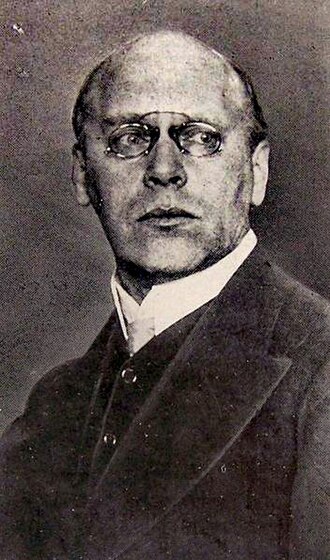
 Ludwig von Hofmann (August 17, 1861 - August 23, 1945) was a prominent German painter, graphic artist, and designer who worked in a distinctive synthesis
of the Art Nouveau and Symbolist styles.
Ludwig von Hofmann (August 17, 1861 - August 23, 1945) was a prominent German painter, graphic artist, and designer who worked in a distinctive synthesis
of the Art Nouveau and Symbolist styles.Queer Places:
Académie Julian, Passage des Panoramas, 75002 Paris
Maria am Wasser Kirche, Kirchgasse 6, 01326 Dresden-Hosterwitz, Germany
Ludwig von Hofmann (August 17, 1861 - August 23, 1945) was a prominent German painter, graphic artist, and designer who worked in a distinctive synthesis
of the Art Nouveau and Symbolist styles.
Born in Darmstadt, he was the son of the Prussian statesman Karl von Hofmann, who served as Minister-president of the Grand Duchy of Hesse from 1872 to 1876 and briefly as Trade Minister under Otto von Bismarck. Beginning his formal artistic training in 1883 at the Dresden Academy of Fine Arts, Hofmann continued his studies under Ferdinand Keller at the Academy of Fine Arts in Karlsruhe before moving to Paris in 1889 to attend the Académie Julian, where he was profoundly influenced by Pierre Puvis de Chavannes and Paul-Albert Besnard.
Following 1890, Hofmann established himself as a freelance painter in Berlin. Between 1894 and 1900, he traveled extensively, spending significant periods at his villa in Fiesole, Italy; his deep appreciation for classical antiquity and an enduring attraction to the mythic concept of Arcadia would come to permeate much of his mature oeuvre. From 1895 onward, he was a regular contributor of illustrations to the influential Art Nouveau magazine Pan, and in 1896 he joined the Berlin Secession, later becoming a member of the Deutscher Künstlerbund. In 1899, he married Mary Herold.
Hofmann's career reached an academic milestone in 1903 when he was appointed a professor at the Weimar Saxon Grand Ducal Art School. In Weimar, he became an integral part of the avant-garde literary and artistic circle centered around Harry Graf Kessler, counting artists such as Jean Arp and Ivo Hauptmann among his students. In 1916, he accepted a professorship at the Dresden Academy of Fine Arts, remaining in the post until his retirement in 1931. Alongside his easel painting and murals, he provided illustrations for a translation of the Odyssey by Leopold Ziegler and works by the playwright Gerhart Hauptmann, Ivo's father, and his art was even featured in the painting competition at the 1928 Summer Olympics.
Hofmann's artistic output slackened during the 1930s, and with the rise of the Nazi regime, some of his works were condemned and labeled as "degenerate art" in 1937. He retired quietly to Pillnitz, near Dresden, where he passed away on August 23, 1945, at the age of 84. Following the war, Soviet authorities nearly confiscated his remaining artistic estate, but his widow successfully intervened to preserve his life's work. He is buried at the Maria am Wasser Kirche in Hosterwitz, near Dresden.
Within the cultural landscape of turn-of-the-century Germany, Hofmann’s frequent depictions of idealized male figures—such as his iconic nude shepherd boy guarding his flock—gain profound resonance. This artistic inclination reflected a broader national emulation of ancient Greece, through which Germany sought to champion the classical ideal of developing the mind and body in harmony. This widespread Hellenic revival catalyzed the Frei-Körper-Kultur movement, which encouraged public nude athletic activity. For contemporary early advocates of homosexual emancipation, this neoclassicism carried an explicit political and social hope: that a modern, Greece-inspired Germany might naturally embrace and validate same-sex desire, aligning Hofmann's pastoral and athletic iconography directly with the early queer liberation currents of his era.
References:
Support this project
This website is a passion project researched, developed, and funded entirely by me. If you find the content valuable and would like to help support the ongoing research and hosting costs, any contribution is deeply appreciated.
Thank you for keeping this independent resource alive!
My books on Amazon: Elisa Rolle's books