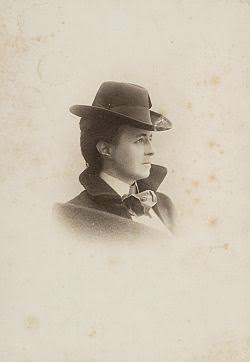
 Louise Antoinette Stratenus (August 3, 1852 – March 20, 1908) was a prolific Dutch writer, translator, and editor.
Partner Catharina Alberfingk Thijm
Queer Places:
Haagveld cemetery (formerly the Protestantse Begraafplaats Zuilen), Tuinzigtlaan 11, Breda Municipality, Noord-Brabant 4813 XH Netherlands
Louise Antoinette Stratenus (August 3, 1852 – March 20, 1908) was a prolific Dutch writer, translator, and editor.
She born on August 3, 1852, in Zeist, Netherlands. Coming from a noble, Protestant background, her early life was marked by frequent relocations due to her stepfather's military career following the early death of her biological father in a carriage accident.
Stratenus demonstrated literary precocity from a very young age, translating a children's book (L'île colibri) at age seven and submitting a five-act play at age twelve. Between 1876 and 1905, she published over fifty independent titles—including novels, novellas, poetry, and plays—and worked as an editor for the journal Vrouwenbibliotheek. Known for her immense productivity, she wrote under more than forty different pseudonyms (such as Meta von Zweimarck, Hero, and Paul Meertens). She was also proficient in multiple modern languages and translated at least ten works from French, English, German, and Swedish.
Later in life, Stratenus settled near Breda and Princenhage, where she continued writing—with several of her works reflecting local landscapes, such as her 1890 novel Lindendaal. She passed away on March 20, 1908, in Princenhage.
In 1881, Louise Stratenus met Catharina Alberdingk Thijm, a fellow writer, editor, and the daughter of the prominent cultural figure Jozef Alberdingk Thijm. Under Catharina's influence, Stratenus converted from Protestantism to Catholicism around the age of thirty.
Stratenus and Catharina Alberdingk Thijm became close intimate companions and lived together for over a decade. During the 1880s, facing financial pressures and creditors, they traveled and lived abroad together intermittently, residing in cities such as London, Paris, Brussels, and Amsterdam.
Modern perspectives on their relationship often weigh the context of Victorian-era conventions. While cohabitation among independent unmarried women was occasionally practiced to share modest expenses and maintain social standing, historians and literary researchers frequently document their bond as a profound emotional and romantic partnership that lasted until their relationship ultimately ended around 1894.
References:
Support this project
This website is a passion project researched, developed, and funded entirely by me. If you find the content valuable and would like to help support the ongoing research and hosting costs, any contribution is deeply appreciated.
Thank you for keeping this independent resource alive!
My books on Amazon: Elisa Rolle's books