Queer Places:
University of Zurich, Rämistrasse 71, 8006 Zürich, Switzerland
Stadtfriedhof Göttingen, Kasseler Landstraße 1, 37081 Göttingen-Grone, Germany
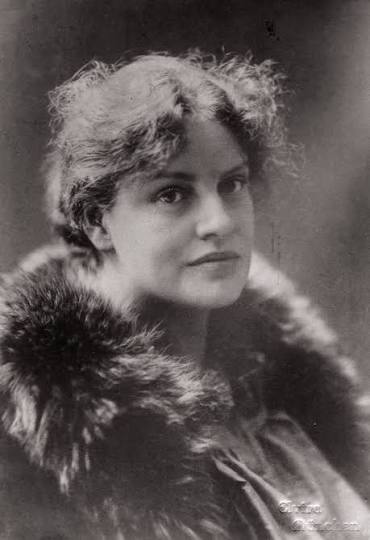 Lou Andreas-Salomé (February 12, 1861 – February 5, 1937), born Louise von Salomé on February 12, 1861, in Saint Petersburg, Russia, was a towering intellectual figure of
the late nineteenth and early twentieth centuries whose life bridged European literature, philosophy, and early psychoanalysis.
Lou Andreas-Salomé (February 12, 1861 – February 5, 1937), born Louise von Salomé on February 12, 1861, in Saint Petersburg, Russia, was a towering intellectual figure of
the late nineteenth and early twentieth centuries whose life bridged European literature, philosophy, and early psychoanalysis.
Born into a privileged and multi-ethnic military family, she rejected traditional societal expectations for women early on, cultivating an independent and fierce
intellectual life. In 1880, she moved to Switzerland to study philosophy, theology, and the history of art at the University of Zurich, a rare educational path for a woman
of her era.
Her intellectual gravity quickly drew the attention of leading European thinkers. In Rome in 1882, she met the philosopher
Friedrich Nietzsche and writer Paul Rée through mutual acquaintances. Nietzsche, deeply
captivated by her brilliant mind, proposed marriage twice, both of which she refused in favor of an intellectual partnership and communal living arrangement known as a
literary trinity. Although this partnership eventually fractured due to personal tensions and the machinations of Nietzsche's family, the encounter left an indelible mark on
Nietzsche's philosophy, and Salomé went on to publish one of the earliest critical analyses of his work, Friedrich Nietzsche in seiner Werke (1894).
Moving to Berlin and later Vienna, Salomé immersed herself in literary and psychological circles. She married the linguist Friedrich Carl Andreas in 1887—a unique union
based on intellectual companionship rather than conventional marital expectations—while maintaining romantic and creative independence. She published numerous novels,
essays, and cultural critiques, and forged close friendships with Rainer Maria Rilke, with whom she had a passionate
multi-year romance and traveled extensively through Russia, and later Sigmund Freud.
In 1911, Salomé attended the Weimar Psychoanalytic Congress, where she was profoundly drawn to the emerging field of psychoanalysis. She subsequently moved to Vienna to
study directly under Sigmund Freud, becoming his trusted colleague, confidante, and a practicing psychoanalyst herself. Unlike many of her contemporaries, Salomé maintained
an independent perspective within the psychoanalytic movement, focusing particularly on narcissism, female sexuality, and the synthesis of art and psychology. She remained
in Göttingen, Germany, writing and practicing until her death on February 5, 1937, leaving behind a rich legacy of essays, memoirs, and psychoanalytic treatises.
Within the framework of her deep integration into the inner circle of the psychoanalytic movement, Lou Andreas-Salomé shared a profound, intellectually intimate
relationship with Anna Freud. When Anna Freud began her analysis with her own father, Sigmund Freud, it was widely acknowledged as an
unorthodox and complex arrangement; Salomé served as a vital, supportive mentor, confidante, and maternal intellectual figure to the younger Freud during the 1920s and
1930s. Their bond transcended standard professional mentorship, characterized by a deep emotional resonance, mutual respect, and shared dedication to the development of
child psychoanalysis and educational theory. While Salomé's personal life famously featured intense liaisons with prominent men, her relationship with Anna Freud represented
a pinnacle of her female intellectual friendships, anchoring Anna within the psychoanalytic community and providing a crucial pillar of support as Anna shaped the future of
psychoanalysis and navigated her own pioneering life and queer identity within Vienna's tight-knit intellectual elite.
References:
- Andreas-Salomé, Lou. Looking Back: Memoirs (Lebensrückblick). Translated by Breon Mitchell, edited by Ernst Pfeiffer, Marlowe & Co., 1995.
- Freud, Sigmund, and Lou Andreas-Salomé. Sigmund Freud and Lou Andreas-Salomé: Letters. Edited by Ernst Pfeiffer, W. W. Norton & Company, 1985.
- Peters, H. F. My Sister, My Spouse: A Biography of Lou Andreas-Salomé. W. W. Norton & Company, 1962.
- Binion, Rudolph. Frau Lou: Nietzsche's Wayward Disciple. Princeton University Press, 1968.
- Livingstone, Angela. Lou Andreas-Salomé: Her Life and Work. Gordon Fraser, 1984.
- Vickers, Julia. Lou von Salomé: A Biography of the Woman Who Inspired Freud, Nietzsche and Rilke. McFarland, 2008.
- Pfeiffer, Ernst, editor. Sigmund Freud—Lou Andreas-Salomé Briefwechsel. S. Fischer Verlag, 1966.
- Recent Scholarly Analysis (2025–2026): “Thinking Together, Writing Apart: Anna Freud and Lou Andreas-Salomé” (published in academic psychoanalytic journals focusing on their collaborative 1922 lecture Schlagephantasie und Tagtraum and their epistolary framework of female intellectual friendship).
Support this project
This website is a passion project researched, developed, and funded entirely by me. If you find the content valuable and would like to help support the ongoing research and hosting costs, any contribution is deeply appreciated.
Thank you for keeping this independent resource alive!
My books on Amazon: Elisa Rolle's books
BACK TO HOME PAGE