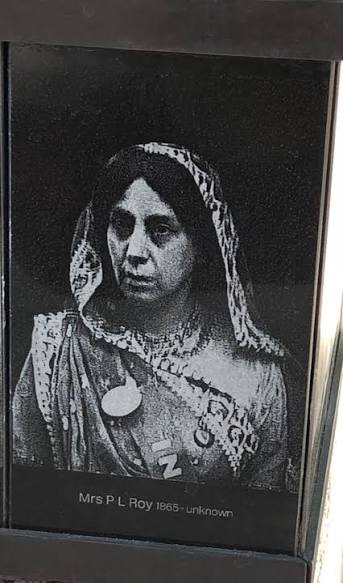
 Lolita Roy (born 1865), born in Calcutta in 1865 and also widely known as Mrs. P. L. Roy, was a pioneering Indian social reformer, suffragist, and
transnational activist who left an indelible mark on both the British and Indian women's suffrage movements. Around 1886, she married Piero Lal Roy, a
barrister and director of public prosecutions in Calcutta, with whom she had six children: Leilavati, Miravati, Paresh Lal, Hiravati, Indra Lal, and
Lolit Kumar. By 1900, Roy and her children had relocated to West London, establishing a vibrant household that quickly became a hub for Indian social and
political life abroad.
In London, Roy immersed herself in advocacy and student support. She served as president of the London Indian Union Society, an organization dedicated
to assisting the hundreds of Indian university students living in the British capital. Her organizational acumen extended to women's education and
empowerment; in 1909, she helped found the Indian Women's Education Association, which raised funds to bring Indian women to Britain for teacher
training. Described by the feminist newspaper The Vote in 1911 as "one of the most emancipated of Indian women", Roy stood at the intersection of
anti-colonial resistance and global feminism.
Her most visible contribution to the British suffrage campaign occurred on June 17, 1911, when she partnered with
Jane Cobden to organize and lead a prominent Indian contingent in the Women's Social and Political Union's
monumental Women's Coronation Procession. Marching alongside figures like her daughter Leilavati, Annie Besant,
and fellow activist Bhagwati Bhola Nauth, Roy helped form part of the "Imperial contingent" to demonstrate that the demand for female suffrage spanned
the entire British Empire. Beyond the march, she assisted in staging traditional Indian plays in London and Cambridge between 1912 and 1913, advising
performers on authentic attire. During World War I, she dedicated her time as honorary secretary of the Eastern League, a coalition that raised funds to
provide critical clothing and food supplies through the Indian Soldiers' Fund, while proudly supporting her sons on active duty—including her eldest,
Paresh Lal, who popularized boxing in India, and her middle son, Indra Lal, a Royal Flying Corps pilot who was killed in action in 1918.
Returning her focus toward the Indian subcontinent, Roy campaigned vigorously throughout the 1920s for women's right to vote in India. Her efforts
included drafting petitions to the British government, participating in official deputations to the Secretary of State for India, speaking at the House
of Commons, and collaborating closely with the All-India Women's Conference. Although her exact date of death remains unknown, her legacy persisted
through generations—including her great-grandson, the journalist and media entrepreneur Prannoy Roy. In recent decades, historians like Dr. Sumita
Mukherjee have worked to dismantle the myth of "white feminism" by bringing transnational figures like Roy back into public consciousness. This renewed
recognition culminated in April 2018 with the unveiling of the Millicent Fawcett statue in Parliament Square, London, which features Lolita Roy's image
and name on its plinth alongside fellow suffragist Sophia Duleep Singh to honor women of colour who
shaped the British vote.
The broader legacy and contemporary discourse surrounding Lolita Roy frequently intersects with LGBTQ+ and queer historical frameworks through modern
public art and intersectional feminist scholarship. Public art initiatives—such as the Greater London Authority's LDN WMN public art series and related
multimedia projects displayed across London boroughs—purposely place Roy's historical narrative side-by-side with prominent queer icons and activists,
such as lesbian journalist and rights pioneer Jackie Forster. These modern cultural installations utilize intersectional lenses to link
early-20th-century anti-colonial suffragists with contemporary queer women of colour artists, examining how marginalized identities—whether defined by
race, empire, or sexuality—have historically been underrepresented or "whitewashed" in mainstream British historical records. Furthermore, academic
critiques examining "white feminism" frequently group the anti-imperialist frameworks forged by queer theorists and feminists of colour alongside Roy's
transnational activism, positioning her work as foundational to modern coalitions that bridge gender, racial justice, and LGBTQ+ liberation movements.
References:
- Oxford Dictionary of National Biography (ODNB): Sumita Mukherjee, "Roy, Lolita [known as Mrs P. L. Roy] (b. 1865)" (Oxford University Press, 2019).
- Academic Monographs: Sumita Mukherjee, Indian Suffragettes: Female Identities and Transnational Networks (New Delhi: Oxford University Press, 2018).
- Historical Studies on Empire and Feminism: Antoinette Burton, Burdens of History: British Feminists, Indian Women, and Imperial Culture, 1865–1915 (Chapel Hill: University of North Carolina Press, 1994).
- Histories of the Indian Diaspora in Britain: Rozina Visram, Asians in Britain: 400 Years of History (London: Pluto Press, 2002).
- Wartime Relief Histories: Shrabani Basu, For King and Another Country: Indian Soldiers on the Western Front, 1914–18 (London: Bloomsbury, 2015).
- The Vote (specifically issues from June 1911)
- Modern Review (July 1919 edition)
- Times of India (February 25, 1932 edition)
- Journal of the National Indian Association
- Census of England and Wales (1901 and 1911)
- The Millicent Fawcett Statue Plinth Commemoration Project, Parliament Square, London (unveiled April 2018)
Support this project
This website is a passion project researched, developed, and funded entirely by me. If you find the content valuable and would like to help support the ongoing research and hosting costs, any contribution is deeply appreciated.
Thank you for keeping this independent resource alive!
My books on Amazon: Elisa Rolle's books
BACK TO HOME PAGE