Queer Places:
Poggio Gherardo, Via Gabriele D'Annunzio, 153, 50135 Firenze FI, Italy
Fortezza della Brunella, Viale Rimembranza, 4, 54011 Aulla MS
St Mary the Virgin Churchyard, Church St, Eastry, Sandwich CT13 0HL, United Kingdom
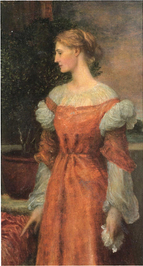 Caroline Lucie "Lina" Waterfield (née Duff-Gordon, August 16, 1874 – November 27, 1964) was a prominent British journalist, author, and cultural figure
who played a central role in the Anglo-Italian literary scene throughout the late nineteenth and twentieth centuries.
Caroline Lucie "Lina" Waterfield (née Duff-Gordon, August 16, 1874 – November 27, 1964) was a prominent British journalist, author, and cultural figure
who played a central role in the Anglo-Italian literary scene throughout the late nineteenth and twentieth centuries.
Born on August 16, 1874, in Saint-Germain-en-Laye, France, she was the only child of Maurice Duff-Gordon and Fanny Smith. Following a turbulent
childhood marked by her father’s infidelity and her mother’s terminal illness, Lina was sent to a Paris convent school before being adopted by her aunt,
the formidable author Janet Ross. In December 1890, Lina moved into Ross’s villa, Poggio Gherardo, in Settignano near Florence. There, she received an
informal, progressive education mentored by Italian intellectuals like Carlo Orsi and Laurentian Library director Guido Biagi, which fostered her
political liberalism, support for the suffragette movement, and a passionate affection for the Italian Risorgimento.
During her early adult life in Florence, Lina became embedded in the vibrant, unconventional Anglo-Florentine community, forging strong links with
prominent queer and aestheticist figures of the era. Among her closest neighbors and intellectual circle was the famous lesbian writer and aesthetic
theorist Vernon Lee (Violet Paget), who lived nearby at Villa Palmerino. Lina also formed a close emotional and
creative friendship with Margaret "Madge" Symonds—the daughter of
John Addington Symonds, a pioneering Victorian writer on homosexuality. Together, Lina and Madge
co-authored The Story of Perugia (1898), launching Lina’s literary career. Through these associations, alongside friendships with art critic
Bernard Berenson and his wife Mary Smith, Lina operated within a
network that crossed normative boundaries of gender, sexuality, and art.
In 1902, despite opposition from her aunt, Lina married the English painter Aubrey Waterfield. The couple shared a deeply artistic lifestyle,
traveling extensively through Italy to collaborate on illustrated travel books, including works on Assisi, Rome, and Palermo. They eventually leased and
restored the medieval Fortezza della Brunella in Aulla as well as Poggio Gherardo. During World War I, concerned by anti-British propaganda spread by
Italian socialists, Lina founded a British reading room and cultural center in Florence in 1916. Supported by propaganda director John Buchan, this
initiative officially grew into the British Institute of Florence in 1918—the first foreign cultural institute of its kind—for which she was awarded an
OBE.
Lina subsequently transitioned into foreign correspondence, serving as the Italian correspondent for The Observer starting in 1921. Reporting on the
rise of Fascism, she interviewed Benito Mussolini multiple times and earned a reputation for her uncompromising, vivid accounts of Fascist violence. Her
staunch anti-fascist stance ultimately led editor J. L. Garvin to dismiss her in 1935 to maintain diplomatic relations with Italy. Forced to flee to
England at the outbreak of World War II, Lina returned to Italy in 1946 as a correspondent for The Sunday Times under foreign manager Ian Fleming. She
published her acclaimed autobiography, Castle in Italy, in 1961 before passing away in Kent, England, on November 27, 1964.
References:
- The Story of Perugia (1898, co-authored with Margaret "Madge" Symonds).
- The Story of Assisi (1900).
- Rome and Its Story (1904, co-written with Aubrey Waterfield).
- Concise and Practical Guide to Rome (1905).
- Home Life in Italy: Letters from the Apennines (1908).
- Florence: A Short Guide to the Art Treasures of Florence (1950).
- Castle in Italy: An Autobiography (1961, published by John Murray).
- Articles and foreign correspondence published in The Observer (1921–1935) and The Sunday Times / Kemsley Newspapers (1946–1950).
- Correspondence and telegrams from figures such as J. L. Garvin, Ian Fleming, Mary Berenson, Madge Symonds Vaughan, and George Macaulay Trevelyan.
- The Waterfield Collection: Preserved at the British Institute of Florence, this collection contains over 700 family letters, original research files, photographs, legal documents, and foundational records of the British Institute of Florence.
- The National Archives (UK): Summary records and authority papers registered under authority reference GB/NNAF/P174828.
- Sistema Informativo Unificato per le Soprintendenza Archivistiche (SIUSA): Italian national archival directory entry for "Waterfield Lina".
- Beevor, Kinta. A Tuscan Childhood (1993) – Memoir written by Lina Waterfield's daughter providing first-hand insights into the family's life at Poggio Gherardo and the Fortezza della Brunella.
- Downing, Ben. Queen Bee of Tuscany: The Redoubtable Janet Ross (Farrar, Straus and Giroux, 2013) – Comprehensive biography detailing the life of Lina's aunt, her upbringing at Poggio Gherardo, and her Florentine intellectual network.
- Ayerst, David. Garvin of the Observer (Croom Helm, 1985) – Details her career as Italian correspondent for The Observer, her coverage of Italian Fascism, and her editorial dismissal by J. L. Garvin.
- Lycett, Andrew. Ian Fleming (Weidenfeld & Nicolson, 1995) – Covers her postwar recruitment as Italian correspondent for The Sunday Times.
- Ross, Janet. The Fourth Generation: Reminiscences (1912) – Memoir by Lina's adoptive mother describing family history and the community in Settignano.
- Waterfield, Gordon. Lucie Duff Gordon (1937) – Family biographical work researched by Lina's eldest son.
Support this project
This website is a passion project researched, developed, and funded entirely by me. If you find the content valuable and would like to help support the ongoing research and hosting costs, any contribution is deeply appreciated.
Thank you for keeping this independent resource alive!
My books on Amazon: Elisa Rolle's books
BACK TO HOME PAGE