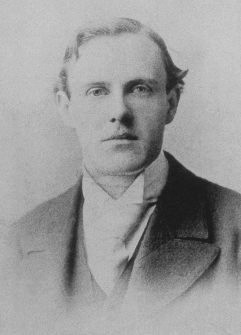
 Leonard Charles Smithers (December 19, 1861 – December 19, 1907) was a prominent London bookseller, solicitor, and publisher who became a central figure of the
late-19th-century Decadent movement.
Queer Places:
Fulham Palace Road Cemetery, Fulham Palace Rd, London SW6 6UB, United Kingdom
Leonard Charles Smithers (December 19, 1861 – December 19, 1907) was a prominent London bookseller, solicitor, and publisher who became a central figure of the
late-19th-century Decadent movement.
Born in Sheffield, England, Smithers qualified as a solicitor in 1884 before forging a close friendship with the explorer and orientalist Sir Richard Francis Burton. He was an original subscriber to Burton's translation of the Book of One Thousand and One Nights and later collaborated with him on translations of erotic texts, including the Carmina of Catullus and the Priapeia. Moving into publishing, Smithers established a reputation for handling upscale pornography and avant-garde literature. In partnership with Harry Sidney Nichols, he issued restricted texts under the imprint of the "Erotika Biblion Society" and famously operated a bookshop on Bond Street with the provocative slogan "Smut is cheap today".
During the height of his career, Smithers became the primary publisher of choice for the leading artists and writers of the Decadent school, including Aubrey Beardsley, Max Beerbohm, Ernest Dowson, Arthur Symons, and Aleister Crowley. Alongside Symons and Beardsley, he founded the influential periodical The Savoy in 1896. Following the devastating public trials and imprisonment of Oscar Wilde in 1895, most mainstream publishers abandoned avant-garde and transgressive authors, but Smithers courageously stepped forward to support them. He became Wilde’s primary publisher, bringing out works such as The Ballad of Reading Gaol in 1898. Despite his high-profile output, Smithers struggled with severe financial mismanagement, leading to his bankruptcy in 1900. He spent his final years battling dependencies on alcohol and drugs, and on his 46th birthday in December 1907, he was found dead from a suspected overdose of Dr J. Collis Browne’s Chlorodyne at a house in Parson's Green. His impoverished funeral and unmarked grave were ultimately paid for by his loyal friend and associate Lord Alfred Douglas.
Smithers occupies a crucial and enduring place in LGBTQ+ literary history primarily through his fearless championing of queer-adjacent texts and persecuted authors during a deeply hostile Victorian era. Following the 1895 gross indecency trials and imprisonment of Oscar Wilde, when societal panic forced publishers to distance themselves from anything deemed morally subversive, Smithers defiantly remained a lifeline for the queer and bohemian underground. By publishing Wilde’s later works and providing a platform for ostracized writers like Beardsley, he preserved cornerstone artifacts of fin-de-siècle queer culture. Furthermore, Smithers played a pivotal role in the underground circulation of early homoerotic literature; in 1894, he issued the prospectus for the seminal anonymous novel Teleny, or the Reverse of the Medal, widely celebrated as one of the earliest explicit English-language works addressing male homosexuality and historically attributed in part to Oscar Wilde's circle. Through his defiance of conventional Victorian censorship and his willingness to publish taboo expressions of alternative sexualities, Smithers cemented his legacy as a vital architect of early queer literary freedom.
References:
Support this project
This website is a passion project researched, developed, and funded entirely by me. If you find the content valuable and would like to help support the ongoing research and hosting costs, any contribution is deeply appreciated.
Thank you for keeping this independent resource alive!
My books on Amazon: Elisa Rolle's books