Queer Places:
Cimetière du Montparnasse, Paris, Département de Paris, Île-de-France, France
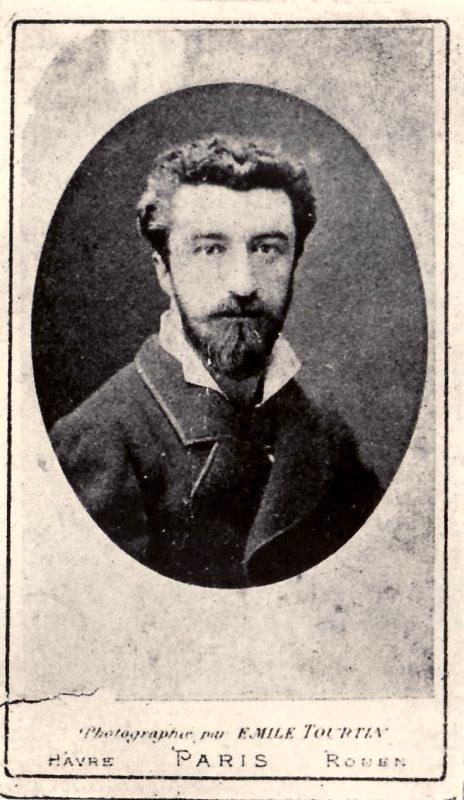 Laurent Tailhade (April 16, 1854 – November 1, 1919) was a prominent French satirical poet, anarchist polemicist, essayist, and translator, celebrated—and deeply
controversial—for his sharp wit, decadent lifestyle, and fierce anti-establishment stances during the late 19th and early 20th centuries.
Laurent Tailhade (April 16, 1854 – November 1, 1919) was a prominent French satirical poet, anarchist polemicist, essayist, and translator, celebrated—and deeply
controversial—for his sharp wit, decadent lifestyle, and fierce anti-establishment stances during the late 19th and early 20th centuries.
Tailhade was born on April 16, 1854, in Tarbes, France, into a traditional bourgeois family consisting of magistrates and government officers. Desiring a conventional
path for him, his family pushed him toward a traditional provincial life and marriage. However, following the death of his first wife, Tailhade broke away from provincial
expectations and moved to Paris.
In Paris, he plunged headfirst into the bohemian literary underground. He became closely associated with the Decadent and Symbolist movements, befriending notable
literary figures such as Paul Verlaine, Jean Moréas, and Albert Samain. During this period, he also developed a heavy opium
addiction, which later heavily influenced his writing, including his 1907 study on morphinomania, La noire idole.
Tailhade’s poetry collections—most notably Au pays du mufle (1891) and Imbéciles et gredins (1900)—utilized a biting mix of high literary French and the coarse street
slang of the Parisian faubourgs to attack the bourgeoisie, the clergy, and state authority.
His radical political writings frequently landed him in trouble with the law. He served a year in prison for inciting murder through his inflammatory essays. He achieved
international notoriety in December 1893 after anarchist Auguste Vaillant bombed the French Chamber of Deputies. Responding to the event, Tailhade famously—and
callously—remarked: "Qu'importent les victimes, si le geste est beau?" ("What do the victims matter, so long as the gesture is beautiful?")
Ironically, Tailhade himself became a victim of anarchist violence shortly after. In April 1894, while dining with his partner Julia Miahle at the Restaurant Foyot, an
anarchist bomb hidden in a flower pot exploded on the windowsill near them. Tailhade lost his right eye in the blast and required extensive recovery.
Later in life, Tailhade retreated somewhat from his hardline anarchist stance toward a more idiosyncratic intellectual isolation, continuing to write essays, translations
(such as Henrik Ibsen's An Enemy of the People), and memoirs until his death on November 1, 1919, in Combs-la-Ville.
While Laurent Tailhade’s primary romantic relationships documented in historical mainstream records were heterosexual (such as his partner Julia Miahle, with whom he
dined during the Foyot bombing), his life and work intersect with queer history and literary networks in several notable ways:
As a core member of the Parisian Decadent literary circle, Tailhade operated in an environment where non-conforming sexualities and gender expressions were openly
explored. His close friendship with Paul Verlaine—whose turbulent relationships with Arthur Rimbaud and various male lovers are
foundational to modern queer literary history—placed Tailhade directly in the orbit of fin-de-siècle same-sex literary culture.
In 1913, while working as a private tutor in France, a young Wilfred Owen (who would later become one of World War I's greatest
poets and whose private life and poetry heavily featured homoerotic elements) sought out and befriended Tailhade. Owen wrote ecstatically to his mother about the meeting,
noting that the older, eccentric French poet received him "like a lover" and "slobbered over me". Tailhade gifted Owen significant decadent texts (such as
Gustave Flaubert's The Temptation of Saint Anthony), leaving a distinct mark on Owen’s artistic development.
Tailhade's essays and published works frequently pushed past Victorian-era moral boundaries. For instance, he collaborated on and wrote prefaces for works exploring
atypical psychological and physical behaviors, such as his work alongside Jacques Desroix on La Gynécocratie (1902), which featured an extensive study on historical
masochism. His open embrace of bohemian vice, anti-bourgeois hedonism, and sexual non-conformity made him a natural ally to the broader underground subcultures of
turn-of-the-century Paris.
References:
Other references:
- Picq, Gilles. Laurent Tailhade ou De la provocation considérée comme un art de vivre. Maisonneuve & Larose, 2001.
- Tailhade, Marie Louise (Mme. Laurent-Tailhade). Laurent Tailhade intime. Mercure de France, 1924; Laurent Tailhade Au Pays Du Mufle. Quignon, 1927.
- Tailhade, Laurent. Quelques fantômes de jadis. Société des Trente / Messein, 1913.
- Owen, Wilfred. Collected Letters. Edited by Harold Owen and John Bell, Oxford University Press, 1967.
- Stallworthy, Jon. Wilfred Owen: A Biography. Oxford University Press / W. W. Norton & Company, 1974.
- Verlaine, Paul. Œuvres en prose complètes. Éditions de la Pléiade, Gallimard.
Support this project
This website is a passion project researched, developed, and funded entirely by me. If you find the content valuable and would like to help support the ongoing research and hosting costs, any contribution is deeply appreciated.
Thank you for keeping this independent resource alive!
My books on Amazon: Elisa Rolle's books
BACK TO HOME PAGE
