Queer Places:
4, rue La Pérouse, 75116 Paris, France
34 Av. du Président Wilson, 75116 Paris, France
11 Rue Balzac, 75008 Paris, France
Père-Lachaise Cemetery, Paris , Department of Paris , Île-de-France , France
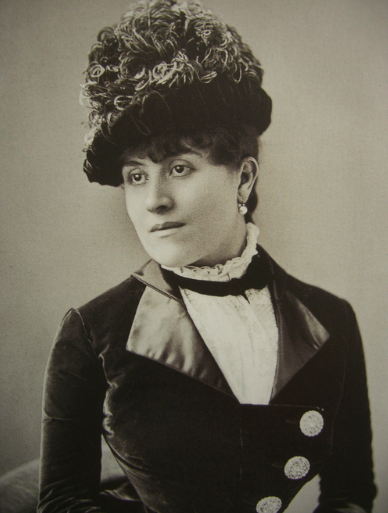 Laurence Marie Charlotte “Laure” Hayman (June 12, 1851 - April 22, 1940) was a prominent French demi-mondaine, salon hostess, and sculptor. Best known as a fixture of high
society during the French Third Republic, she served as a major literary inspiration for classical writers of her day.
Laurence Marie Charlotte “Laure” Hayman (June 12, 1851 - April 22, 1940) was a prominent French demi-mondaine, salon hostess, and sculptor. Best known as a fixture of high
society during the French Third Republic, she served as a major literary inspiration for classical writers of her day.
Born in Valparaíso, Chile, to an Anglo-Chilean family, Hayman was a descendant of the English painter Francis Hayman. After moving to Paris, she became one of the most
celebrated and sought-after courtesans of the late 19th century.
Her suitors and patrons included prominent aristocrats, politicians, and financiers, such as: The Duke of Osuna, Prince Karl Kinsky, Louis Weil (the maternal great-uncle
of Marcel Proust), Dr. Adrien Proust (Marcel Proust's father).
Hayman was renowned for her intellect, taste, and sharpness. Rather than remaining merely a socialite, she established an influential literary salon on the Rue de La
Pérouse in Paris, attracting major cultural figures of the fin-de-siècle era.
Laure Hayman's townhouse (hôtel particulier) was located at 4, rue La Pérouse, 75116 Paris, France (in the 16th Arrondissement). It was at this specific address that she
hosted her celebrated fin-de-siècle salon—frequented by Marcel Proust, Paul Bourget, and Jacques-Émile Blanche—and which Proust directly borrowed as the residence for Odette
de Crécy in À la recherche du temps perdu. In her later years, she moved to 34, avenue du Président-Wilson and subsequently died at 11, rue Balzac in Paris.
Hayman is immortalized in late 19th- and early 20th-century French literature: Odette de Crécy (In Search of Lost Time): A teenage Marcel Proust became infatuated with
Hayman while she was the mistress of his great-uncle. She gave Proust a bound copy of Paul Bourget's novella Pastels (which had also been inspired by her). Proust used
Hayman as one of the primary real-life models for Odette de Crécy, the courted lover and eventual wife of Charles Swann. Gladys Harvey (Pastels): Writer Paul Bourget modeled
the protagonist of his 1889 work Gladys Harvey directly after Hayman.
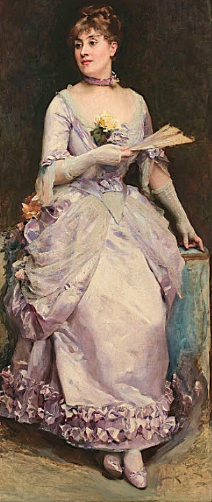
Laura Hayman - c. 1880 - Portrait by Raimundo de Madrazo y Garreta: Fondacion Maria Cristina Masaveu; Madrid, Spain
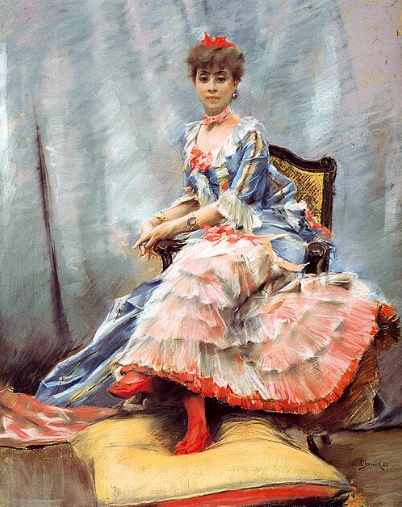
Portrait of Laure Hayman - 1882: Attributed to Julius LeBlanc Stewart.
In her mature years, Hayman transitioned from salon host to artist. She studied sculpture and exhibited her work at Parisian salons, gaining recognition for her busts and
small figurative works, often modeling contemporary society figures and intellectual peers.
While Hayman herself is primarily documented through her relationships with high-society men, her life intersects with queer history through the social networks, literary
circles, and subcultures of Belle Époque Paris:
In Proust’s À la recherche du temps perdu, the character inspired by Hayman—Odette de Crécy—has a complex, fluid sexuality. A major subplot of the novel centers on
Swann’s jealousy and suspicion over Odette's secret sapphic affairs with women in Parisian subcultures. While this reflected the broader fascination with lesbianism among
Decadent and Symbolist writers, it firmly tied Hayman's literary counterpart to early 20th-century queer narrative themes.
Hayman's salon was a nexus for prominent figures across the spectrum of gender and sexuality in Paris:
Marcel Proust: Proust, whose private life and works are central to early gay literary history, maintained a lifelong, complex correspondence with Hayman after his
childhood crush evolved into a lasting friendship.
Robert De Montesquiou: The overtly aristocratic, openly eccentric aesthetician and gay icon was a frequent peer
within the same artistic and salon social circles.
Colette & The Sapphic Salons: The demi-monde environment of 1890s–1900s Paris featured significant crossover between courtesans,
actresses, and women living sapphic lifestyles (such as Liane de Pougy,
Émilienne d'Alençon, and Natalie Clifford Barney). While Hayman
maintained a more traditional salon structure, her artistic peers and literary circles frequently overlapped with Paris's thriving lesbian avant-garde.
References:
Other references:
- Proust, Marcel. Correspondance de Marcel Proust (21 volumes, edited by Philip Kolb, Plon, 1970–1993).
- Bourget, Paul. Pastels: Dix portraits de femmes (A. Lemerre, 1889).
- Montesquiou, Robert de. Les Pas effacés: Mémoires (Éditions Émile-Paul Frères, 1923).
- Painter, George D. Marcel Proust: A Biography (2 volumes, Chatto & Windus / Random House, 1959–1965).
- Carter, William C. Proust in Love (Yale University Press, 2006).
- Carter, William C. Marcel Proust: A Life (Yale University Press, 2000).
- Tadié, Jean-Yves. Marcel Proust: A Life (Viking / Penguin Books, 2000).
- Ladenson, Elisabeth. Proust's Lesbianism (Cornell University Press, 1999).
- Barney, Natalie Clifford. Souvenirs Indiscrets (Flammarion, 1960).
Support this project
This website is a passion project researched, developed, and funded entirely by me. If you find the content valuable and would like to help support the ongoing research and hosting costs, any contribution is deeply appreciated.
Thank you for keeping this independent resource alive!
My books on Amazon: Elisa Rolle's books
BACK TO HOME PAGE
