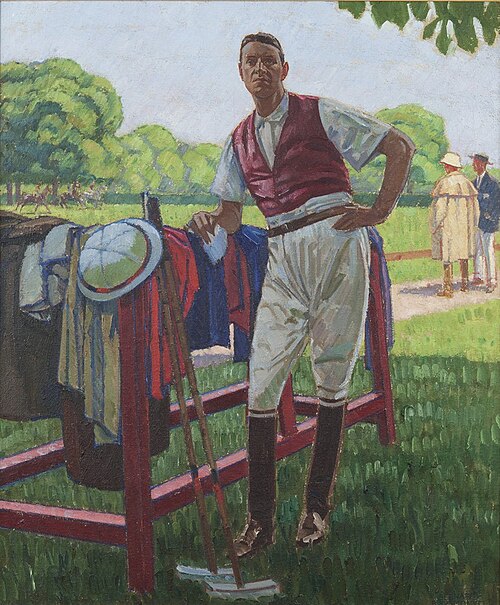
 Prince Léon "Loche" Radziwill (September 6, 1880 – March 2, 1927) was a prominent French aristocrat of Polish heritage whose life, complex sexuality, and
place in high society made him a captivating figure of fin-de-siècle Paris.
Prince Léon "Loche" Radziwill (September 6, 1880 – March 2, 1927) was a prominent French aristocrat of Polish heritage whose life, complex sexuality, and
place in high society made him a captivating figure of fin-de-siècle Paris.Queer Places:
Domaine Château Ermenonville, Rue René de Girardin, 60950 Ermenonville, France
Ermenonville Communal Cemetery, 60950 Ermenonville, France
Prince Léon "Loche" Radziwill (September 6, 1880 – March 2, 1927) was a prominent French aristocrat of Polish heritage whose life, complex sexuality, and
place in high society made him a captivating figure of fin-de-siècle Paris.
Born in Saint-Cloud to Prince Constantin Radziwill and Louise Blanc—heiress to the Monte Carlo casino fortune—Léon grew up straddling two worlds. Despite his towering height and striking blue eyes, he often lamented his displaced identity, feeling viewed as a Frenchman in Poland and a Pole in France. He eventually inherited the historic château of Ermenonville, where he served as mayor, dedicated himself to restoring its iconic park, and organized a Polish brigade during the Great War.
Radziwill was a key figure within the elite, highly closeted queer intellectual and aristocratic networks of Belle Époque Paris. Alongside figures like Emmanuel and Antoine Bibesco, Reynaldo Hahn, Lucien Daudet, and Bertrand de Salignac-Fénelon, Radziwill moved in the intimate orbit of Marcel Proust. Within this circle, members used coded language, subcultural gossip, and private pseudonyms to safely navigate their romantic lives and shared homoerotic interests during an era of intense social prohibition.
Proust held a deeply complex, turbulent affection for Radziwill, drawing heavy inspiration from "Loche" to forge the character of Robert de Saint-Loup in À la recherche du temps perdu. However, Radziwill’s reputation as a social playboy frequently ignited Proust’s jealousy, leading to periodic ruptures in their friendship—including an instance where Proust returned a gift engraved with a verse praising true friendship.
Radziwill’s personal life was defined by social pressure and underlying sexual hesitation. Influenced by his sister, the Duchess of Bisaccia, and facing financial pressure from his father—a closeted homosexual who lived apart from his wife and spent the family fortune—Radziwill married Claude de Gramont in June 1905. The marriage was a disaster; Radziwill ceased sharing a room with his bride after ten days and soon abandoned the marital home. His father-in-law furiously denounced him as impotent, leading to a swift civil divorce and a papal annulment on the grounds of non-consummation in 1906.
Following the annulment, Radziwill continued to navigate high society, briefly courting English heiress Gladys Deacon and having an affair with actress Christiane Lorin, before later marrying his cousin, Princess Dolores Radziwill, in 1921. He spent his final years leading a semi-retired life focused on local civic duties and the preservation of Jean-Jacques Rousseau's memory at Ermenonville, where he was beloved by locals. His life ended abruptly when he was murdered in Monte Carlo at the age of forty-six, leaving behind a legacy firmly intertwined with the literary and queer history of early 20th-century France.
References:
Support this project
This website is a passion project researched, developed, and funded entirely by me. If you find the content valuable and would like to help support the ongoing research and hosting costs, any contribution is deeply appreciated.
Thank you for keeping this independent resource alive!
My books on Amazon: Elisa Rolle's books