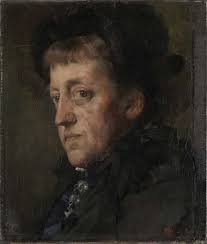
 Christine "Kitty" Lange Kielland (October 8, 1843 – October 1, 1914) was a prominent Norwegian landscape painter, writer, and a pioneering activist for women's rights.
Partner Harriet Backer
Queer Places:
Académie Julian, Passage des Panoramas, 75002 Paris
Académie Colarossi, 10 Rue de la Grande Chaumière, 75006 Paris
19 Rue de l'Université, 75007 Paris, France
Hansteens gate 2, 0253 Oslo, Norway
Vår Frelsers gravlund, Akersbakken 32, 0172 Oslo, Norway
Christine "Kitty" Lange Kielland (October 8, 1843 – October 1, 1914) was a prominent Norwegian landscape painter, writer, and a pioneering activist for women's rights.
Born into a wealthy and influential merchant family in Stavanger, she was the older sister of the celebrated author Alexander Kielland.
Despite her early interest in the arts, Kielland did not receive formal professional training until the age of 30 due to the gender prejudices of her time. In 1873, she moved to Germany to study landscape painting privately under Hans Gude at the Karlsruhe Academy. Because she was a woman, she was barred from Gude's formal classes and had to rely on private instruction.
She later studied in Munich with Hermann Baisch and Eilif Peterssen, and spent a decade in Paris (1879–1889). In Paris, she studied at the Académie Julian and Académie Colarossi, further refining her technique and exposure to European artistic movements.
Kielland is best known for her plein-air depictions of the Jæren region in southwestern Norway. She famously captured the stark, atmospheric beauty of peat bogs, heather-covered moorlands, and expansive skies.
Her early work was grounded in Realism, but under the influence of French Impressionism and later, figures like Jens Ferdinand Willumsen, her style evolved toward simplified compositions and symbolic depth.
She was highly successful during her lifetime, exhibiting at major international events like the Paris Salon and the Venice Biennale. Her work is held in major institutions, including the National Museum in Oslo.
Beyond her art, Kielland was a significant figure in the Norwegian "Modern Breakthrough." She co-founded the Norwegian Association for Women's Rights in 1884 and was a vocal advocate for gender equality in both professional and social spheres. Her writings contributed to the era's intellectual debates regarding women's suffrage and the "woman question."
Kelland maintained a lifelong, deeply intimate bond with the celebrated painter Harriet Backer. The two women lived together for nearly 40 years, sharing studios and traveling across Europe. This arrangement allowed them to live as independent professional women, defying the societal expectation that they marry and lead domestic lives.
During their time in Paris, Kitty Lange Kielland and Harriet Backer shared an apartment and studio located at 19 Rue de l'Université. They lived there together for approximately eight years, beginning around 1880, as part of their decade-long residence in the city.
In addition to their Paris period, the two artists shared living and studio spaces in Munich and Kristiania (now Oslo) throughout their long, nearly 40-year association. While in Kristiania, they also lived in buildings that housed other prominent artists; for instance, Kielland lived in the same block as Asta Nørregaard near Hansteens gate in the early 20th century. Kitty Lange Kielland lived in a studio apartment at Hansteens gate 2 in Kristiania (now Oslo). She moved into this residence around the turn of the 20th century. The apartment was located on the fourth floor and consisted of two rooms—one serving as a combined studio and living room, and the other as a bedroom—along with a small kitchen and private entrance. Notably, the painter Asta Nørregaard also lived in the same building, and Harriet Backer lived in an apartment right next door.
Some recent academic research explores the concept of the "spinster" in early 20th-century Norway—a status that provided a degree of agency and space for women to build life-long partnerships with one another outside the traditional heteronormative structure. Scholars like Tone Hellesund have analyzed how these long-term female companionships can be understood as "queer" in the context of their time.
Research in publications such as Scandinavian Studies suggests that while her identity cannot be confirmed by modern standards, her rejection of traditional marriage, her role as a "New Woman," and her enduring domestic and professional partnership with Backer position her as a subject of significant interest in LGBTQ history.
References:
Support this project
This website is a passion project researched, developed, and funded entirely by me. If you find the content valuable and would like to help support the ongoing research and hosting costs, any contribution is deeply appreciated.
Thank you for keeping this independent resource alive!
My books on Amazon: Elisa Rolle's books