Queer Places:
St. Mary's Roman Catholic Cemetery, Kensal Green, London Borough of Brent, Greater London, England
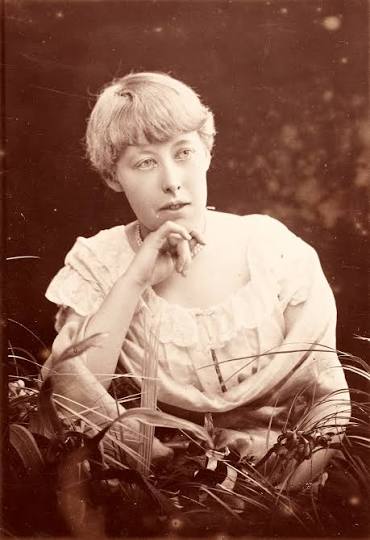 Katharine Tynan (January 23, 1859 – April 2, 1931) was born on January 23, 1859, in Whitehall, Clondalkin, near Dublin, Ireland, as the fifth of twelve children born to
Andrew Cullen Tynan, a prosperous farmer and cattle trader, and Elizabeth Tynan. Growing up in a cultivated environment, her early life was nonetheless marked by hardship,
including the death of a sibling, her mother's declining health, and severe eye ulcers that left her temporarily and partially blind in her youth. Despite these visual
impairments, she became an avid reader and received her formal education at the Dominican convent school of St. Catherine in Drogheda. She began writing verse early in life,
publishing her first poetry in 1875 and releasing her debut collection, Louise de la Vallière and Other Poems, in 1885 with the assistance of poet Wilfred Meynell.
Katharine Tynan (January 23, 1859 – April 2, 1931) was born on January 23, 1859, in Whitehall, Clondalkin, near Dublin, Ireland, as the fifth of twelve children born to
Andrew Cullen Tynan, a prosperous farmer and cattle trader, and Elizabeth Tynan. Growing up in a cultivated environment, her early life was nonetheless marked by hardship,
including the death of a sibling, her mother's declining health, and severe eye ulcers that left her temporarily and partially blind in her youth. Despite these visual
impairments, she became an avid reader and received her formal education at the Dominican convent school of St. Catherine in Drogheda. She began writing verse early in life,
publishing her first poetry in 1875 and releasing her debut collection, Louise de la Vallière and Other Poems, in 1885 with the assistance of poet Wilfred Meynell.
During the 1880s and 1890s, Tynan became a central figure in the Dublin literary scene and a major participant in the Irish Literary Revival, or Celtic Revival. During
this period, she developed a famously intense, close correspondence with the poet William Butler Yeats, who was deeply enamored with her work and intellect before their
relationship cooled. In 1888, she met the Dublin-born lawyer, classical scholar, and writer Henry Albert Hinkson, whom she married in London in 1893. Following her marriage,
she frequently published under the name Katharine Tynan Hinkson. The couple lived primarily in England for many years, though they temporarily returned to Ireland when her
husband served as a resident magistrate in County Mayo from 1914 to 1919. Tynan and her husband had three children, including two sons who volunteered to fight for Britain
in World War I—an experience that profoundly shaped her later writings. After her husband's death in 1919, she split her time between England and traveling extensively
across Europe, maintaining a staggering literary output until the end of her life. She died on April 2, 1931, leaving behind a legacy of over one hundred novels, more than a
dozen poetry collections, and a five-volume autobiographical series.
Within the landscape of late-Victorian and early-20th-century literature, Tynan's life and social circles intersected deeply with complex traditions of female intimacy
and romantic friendship, most notably through her profound bond with the writer Alice Meynell. Moving within an elite network of
Catholic women writers and intellectuals, Tynan found emotional, spiritual, and artistic sustenance that frequently transcended conventional platonic bounds. Her
relationship with Meynell—alongside her deep engagement with female literary mentors and peers like
Christina Rossetti—exemplified a space where emotional, spiritual, and aesthetic devotion merged. While modern terminology
applies frameworks of LGBTQ+ history and romantic friendship retrospectively to these dynamics, these intense female bonds allowed women like Tynan to prioritize
intellectual partnerships, profound spiritual mirroring, and emotional dependencies that subverted the traditional patriarchal structures of marriage and domesticity of
their era.
References:
- Tynan, Katharine. Twenty-Five Years: Reminiscences. London: Smith, Elder & Co., 1913.
- Tynan, Katharine. The Middle Years. London: Constable & Co., 1916.
- Tynan, Katharine. The Years of the Shadow. London: Constable & Co., 1919.
- Tynan, Katharine. The Wandering Years. London: Constable & Co., 1922.
- Tynan, Katharine. Memories. London: Eveleigh Nash & Grayson, 1924.
- Fallon, Ann Connerton. Katharine Tynan. Boston: Twayne Publishers, 1979. (A comprehensive critical-analytical study of her life, poetry, and prose).
- Radi, Marilyn. "The Literary Bonds of Katharine Tynan and Alice Meynell." Published across academic journals exploring late-Victorian networks of women writers and romantic friendships.
- Cormack, Bradin (ed.). Research focusing on the Catholic literary revival, late-Victorian female homosocial bonds, and networks involving Alice Meynell, Katharine Tynan, and Agnes Tobin.
- Bradshaw, David, and Howard J. Booth (eds.). Modernism and Ireland: The Poetry of the Irish Revival. (Includes context on Tynan's active role alongside W.B. Yeats and the literary landscape of the era).
- Hiley, Nicholas, and various contributors. Women in World History: A Biographical Encyclopedia, entry on "Tynan, Katharine (1861–1931)".
Support this project
This website is a passion project researched, developed, and funded entirely by me. If you find the content valuable and would like to help support the ongoing research and hosting costs, any contribution is deeply appreciated.
Thank you for keeping this independent resource alive!
My books on Amazon: Elisa Rolle's books
BACK TO HOME PAGE