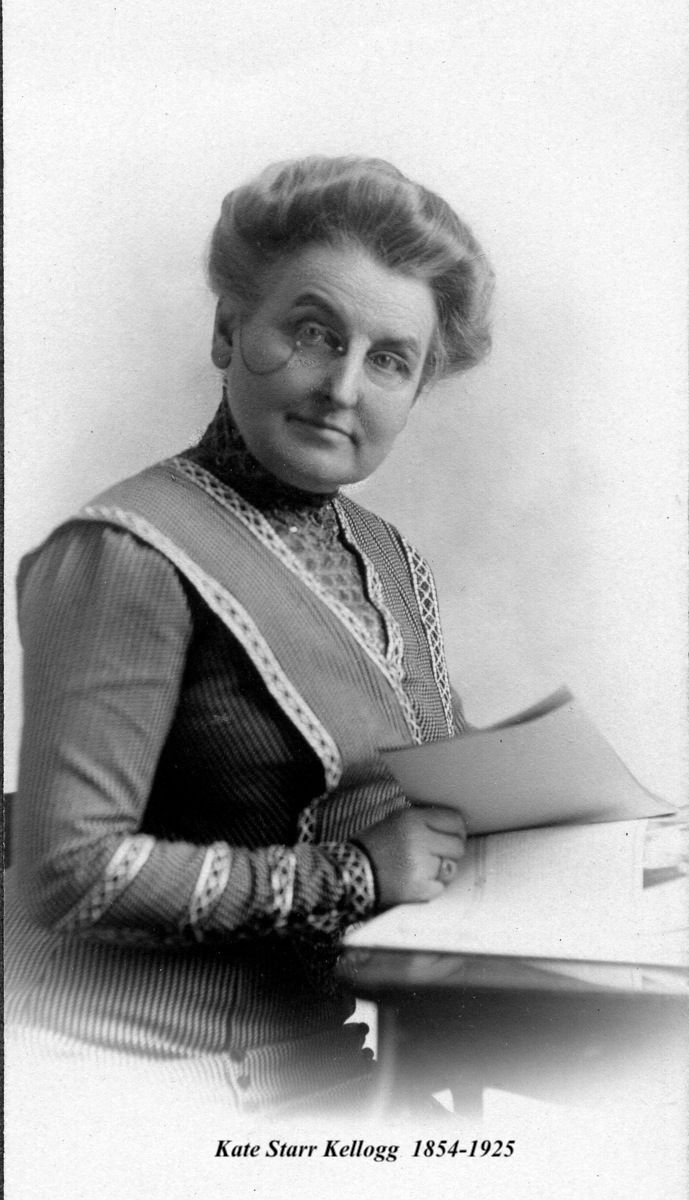
 Kate Starr Kellogg (April 20, 1854 - December 7, 1925) was a pioneering American educator, suffragette, and progressive reform leader in Chicago, Illinois.
Partner Cornelia de Bey
Queer Places:
Mount Greenwood Cemetery, 2900 W 111th St, Chicago, IL 60655, United States
Kate Starr Kellogg (April 20, 1854 - December 7, 1925) was a pioneering American educator, suffragette, and progressive reform leader in Chicago, Illinois.
Born in Bridgewater, New York, to Dr. John Leonard Kellogg and Harriet Bencham Scott, Kellogg moved with her family as a child to a farm in Evergreen Park (now part of Chicago). After completing her education at the Cook County Normal School, she began teaching in Chicago public schools, including stints at the Springer and Douglas schools.
Alice De Wolf Kellogg was Kate Starr Kellogg’s younger sister. They were part of a close-knit family of six daughters born to Dr. John Leonard Kellogg and Harriet Bencham Scott. While Kate pursued a prominent path in educational reform and administration, Alice was a notable American artist, teacher at the Art Institute of Chicago, and president of the all-female Palette Club. Historical records and family letters (such as those from Alice's time studying art in Paris) document their close familial relationship, including visits where Kate traveled abroad to join Alice and other family members in Europe.
Kellogg quickly rose through the ranks due to her progressive pedagogical ideas, eventually becoming: Principal of the Lewis-Champlin School (and later the Parker Practice School). District Superintendent in the Chicago Public Schools under superintendent Ella Flagg Young. A member of the Chicago Board of Education (appointed in 1905).
Kellogg was a champion of student-centered learning long before it became standard practice. She integrated arts into the curriculum, emphasized parent-teacher cooperation (helping establish one of Chicago’s earliest Parent-Teacher Associations), and advocated for practical civics education—insisting that children should understand their active role as community members rather than just reading about future citizenship.
Beyond the classroom, she was deeply involved in social justice work, participating in the Women’s Trade Union League and supporting the suffragette movement. She retired from her administrative position in 1916 and spent her final years at her family's homestead, passing away in December 1925. Her legacy was honored through the naming of the Kate Starr Kellogg Elementary School in Chicago.
Regarding explicit LGBTQ historical ties, mainstream biographical records for Kate Starr Kellogg generally focus on her professional achievements, suffragism, and educational reform. However, historical mentions of her domestic life frequently note her close relationship with Dr. Cornelia de Bey—a fellow homeopathic physician, progressive politician, suffragist, and educator who was her long-time housemate and companion. In the context of turn-of-the-century professional women, such lifelong domestic partnerships ("boston marriages") were common arrangements among independent reformers, educators, and suffragists who lived and worked together.
References:
 Women, Peace and Welfare: A Suppressed History of Social Reform, 1880-1920 Paperback – June 1, 2019 by Ann Oakley |
Other references:
Support this project
This website is a passion project researched, developed, and funded entirely by me. If you find the content valuable and would like to help support the ongoing research and hosting costs, any contribution is deeply appreciated.
Thank you for keeping this independent resource alive!
My books on Amazon: Elisa Rolle's books