Partner Klara Schleker
Queer Places:
University of Zurich, Rämistrasse 71, 8006 Zürich, Switzerland
Evangelischer Friedhof Meran, Via Marlengo, 17, 39012 Merano BZ
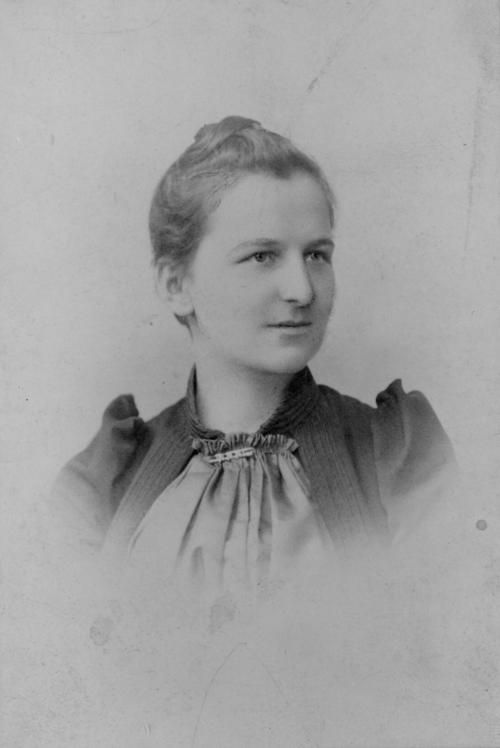 Käthe Schirmacher (August 6, 1858 - November 18, 1930) was a prominent and complex figure within the late nineteenth and early twentieth-century international women’s rights
movements, operating as an active journalist, transnational lecturer, scholar, and later a radical nationalist.
Käthe Schirmacher (August 6, 1858 - November 18, 1930) was a prominent and complex figure within the late nineteenth and early twentieth-century international women’s rights
movements, operating as an active journalist, transnational lecturer, scholar, and later a radical nationalist.
Born on August 6, 1858 (with some archival sources noting her birth year as 1865) in Danzig (Gdansk) into a once-prosperous liberal merchant family, Schirmacher pursued
extensive higher education at a time when academic paths for women were heavily restricted. She studied at the Sorbonne in Paris between 1885 and 1887, and later attended
the University of Zurich, where she earned her doctorate in 1895, making her one of the first German women to achieve a doctorate.
Throughout the 1890s and 1900s, Schirmacher positioned herself on the radical wing of the European and international women's movements. She co-founded key organizations
such as the Association of Progressive Women's Associations and the International Woman Suffrage Alliance, working tirelessly as a multilingual speaker, writer, and
interpreter across congresses in Europe and the United States. However, her political trajectory underwent a sharp and controversial transformation around 1904, when she
increasingly gravitated toward völkisch, anti-democratic, and anti-Semitic ideologies, aligning herself with aggressive Germanization policies through groups like the German
Eastern Marches Society. By 1913, she formally broke away from the bourgeois-liberal women's movement, spending the First World War as a fervent nationalist war propagandist
before helping to establish conservative political networks post-war.
During her final years, Schirmacher suffered from declining health. Like many Europeans of her social standing seeking relief or recovery, she traveled to the mild climate
of Merano (then part of the province of Bolzano in South Tyrol) for a spa/health stay (Kuraufenthalt). Her condition worsened during the trip, leading to her death at the age
of 65. Because she passed away in Merano, she was interred locally in the town's Protestant cemetery, where her grave remains today.
Schirmacher's personal life and historical intersections with early LGBTQ history are deeply intertwined with her long-term domestic partnership with
Klara Schleker, whom she met in 1903. In 1910, Schirmacher moved her permanent residence to Marlow, Mecklenburg, to live with
Schleker, who managed the household chores and provided crucial secretarial support while Schirmacher maintained her demanding travel and publicist schedules. Surviving
correspondence between the two from periods of separation reveals an intensely passionate bond characterized by explicit discussions of physical attraction, emotional
reliance, and mutual desire.
Because of these dynamics, historical and modern queer scholarship—beginning with researcher Amy Hackett and later highlighted in anthologies by Ilse Kokula—has
identified Schirmacher and Schleker as a prominent lesbian couple within the early feminist movement. When pioneering activist
Anna Rühling delivered her historic 1904 speech before Magnus Hirschfeld’s Scientific Humanitarian Committee arguing that
homosexual women were uniquely positioned to lead the fight for women's equality, she was widely believed by contemporaries and modern historians (such as Mineke Bosch and
Marilyn Rupp) to be pointing directly to prominent movement figures like Schirmacher and Schleker, alongside Anita Augspurg and
Lida Gustava Heymann. While Schirmacher herself rarely addressed personal sexual politics explicitly in her public
journalism, her life and partnership remain a crucial benchmark for examining the intersections between female emancipation, alternative domestic models, and the early
twentieth-century discourse surrounding same-sex love.
References:
Other references:
- The Käthe Schirmacher Legacy (Käthe-Schirmacher-Nachlass)
- Krüger, Hanna. Die unbequeme Frau: Käthe Schirmacher im Kampf für die Freiheit der Frau und die Freiheit der Nation, 1865–1930. Berlin: Hans Bott, 1936.
- Walzer, Anke. Käthe Schirmacher: Eine deutsche Frauenrechtlerin auf dem Wege vom Liberalismus zum konservativen Nationalismus. Pfaffenweiler: Centaurus-Verlagsges, 1991.
- The Schirmacher Project ("Commitment and Professionalization. Käthe Schirmacher [1865–1930]")
- Johanna Gehmacher: Feminist Activism, Travel and Translation Around 1900: Transnational Practices of Mediation and the Case of Käthe Schirmacher (Cham: Springer International Publishing, 2024); and her analyses of Schirmacher's working diaries and cross-border transfers.
- Marti Lybeck: Research examining the frameworks of the "New Woman," sexual subjectivity, and historical interpretations of Schirmacher and Schleker's relationship.
- Offen, Karen. "Kaethe Schirmacher, Investigative Reporter & Activist Journalist: The Paris Writings, 1895–1910." Proceedings of the Western Society for French History, vol. 39, 2011.
- Crips, Liliane. "Comment passer du libéralisme au nationalisme völkisch, tout en restant féministe? Le cas exemplaire de Käthe Schirmacher (1865–1931)." In Femmes-Nations-Europe, edited by Marie-Claire Hoock-Demarle, 62–77. Paris: CEDREF, 1995.
- Kokula, Ilse. Weibliche Homosexualität um 1900. Munich: Frauenoffensive, 1981.
- Heinrich, Elisa. "Intimate and/but respectable. Rethinking homosexuality and friendship in German women's movements around 1900." European University Institute (EUI Cadmus).
- Rühling, Anna. Homosexuality and the Women's Movement (Speech to the Scientific Humanitarian Committee, 1904). Published in translation and historical context in sources such as Gay & Lesbian Rights Organizing: Community, Public Policy, and Practice and modern anthologies on early German sexology by Magnus Hirschfeld's circle.
Support this project
This website is a passion project researched, developed, and funded entirely by me. If you find the content valuable and would like to help support the ongoing research and hosting costs, any contribution is deeply appreciated.
Thank you for keeping this independent resource alive!
My books on Amazon: Elisa Rolle's books
BACK TO HOME PAGE
