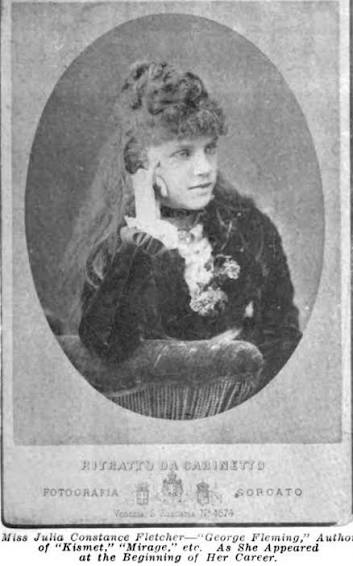
 Julia Constance Fletcher (September 24, 1853 – June 6, 1938) was an Anglo-American novelist, short-story writer, and playwright who professionally published under the male
pseudonym George Fleming.
Julia Constance Fletcher (September 24, 1853 – June 6, 1938) was an Anglo-American novelist, short-story writer, and playwright who professionally published under the male
pseudonym George Fleming.Queer Places:
Palazzo Capello (also referred to as Palazzo Soranzo Cappello), Fondamenta Rio Marin, 770, 30135 Venezia VE, Italy
Cimitero di San Michele, Venice, Città Metropolitana di Venezia, Veneto, Italy
Julia Constance Fletcher (September 24, 1853 – June 6, 1938) was an Anglo-American novelist, short-story writer, and playwright who professionally published under the male
pseudonym George Fleming.
Born on September 24, 1853, in Rio de Janeiro, Brazil, she was the youngest child of the Rev. James Cooley Fletcher and Henrietta Malan Fletcher. Following her parents' divorce and her mother's remarriage to the American painter Eugene Benson, Fletcher grew up in a bohemian environment, splitting much of her life between Italy (primarily Venice) and London.
Fletcher achieved early literary success at age 18 with her debut novel, A Nile Novel (published in 1876/1877 under the name Kismet), which became a popular "no-name" novel. She wrote several other novels—including Mirage (1878) and The Head of Medusa (1880)—and later transitioned into drama, writing plays such as Mrs. Lessingham (1894) and an adaptation of Rudyard Kipling's The Light That Failed. Her 1900 adaptation of Edmond Rostand’s play Les Romanesques, titled The Fantasticks, served as an important precursor to the famous musical of the same name.
Highly autonomous and aligned with the Aesthetic movement, Fletcher maintained close friendships and associations with prominent literary figures of the fin-de-siècle, including Oscar Wilde, Henry James, Robert Browning, Walter Pater, and Gertrude Stein. During World War I, she served as a volunteer nurse in military hospitals in Venice, earning multiple honors from the Italian government. She never married and died in Venice in 1938.
Fletcher was frequently characterized as androgynous—embracing a male pen name (George Fleming) and operating as an independent "New Woman" outside conventional Victorian gender expectations.
Her inner circle included foundational figures of queer literary history like Oscar Wilde (who dedicated the published version of his poem Ravenna to her), Henry James, and John Addington Symonds. Scholars note that her fiction—such as Mirage—features complex, fluidly gendered, or potentially non-conforming dynamics (including figures read by scholars as bi- or asexual).
Charlotte "Donny" Adams was the 18 years old daughter of good friends of Francis Davis Millet and Charles Warren Stoddard. Millet and Stoddard had conspired with Donny Adams for her to meet a young woman she idolized from afar, Julia "Dudee" Fletcher. But Donny had decided that she was afraid to meet Dudee at home, to "beard the lion in his den," as Millet put it (Julia, the lion, is an intriguing, sex-mixed methaphor.) So Millet had arranged to introduce Donny to Dudee on some neutral ground, and he reported, "Donny at last has met her idol!!" He hoped that Donny "has not created too exalted an ideal." The Donny/Dudee introduction, in fact, proved a bust. A few weeks later Millet reported to Stoddard that Donny "has given up the study of girls and is going to devote herself to the law. A profitable change, I think."
The interaction between 18-year-old Charlotte "Donny" Adams and Fletcher highlights how Fletcher served as an iconic, idolized figure of fascination for younger women during the period. Donny’s intense infatuation ("study of girls") and subsequent pivot away from this adoration underscore the romanticized, intense social fascination that figures like Fletcher—labeled with sex-mixed or bohemian metaphors by male contemporaries like Francis Davis Millet—held for aspiring women writers of the late 19th century.
References:
 Love Stories: Sex between Men before Homosexuality Paperback – June 15, 2003 by Jonathan Ned Katz |
Other references:
Support this project
This website is a passion project researched, developed, and funded entirely by me. If you find the content valuable and would like to help support the ongoing research and hosting costs, any contribution is deeply appreciated.
Thank you for keeping this independent resource alive!
My books on Amazon: Elisa Rolle's books