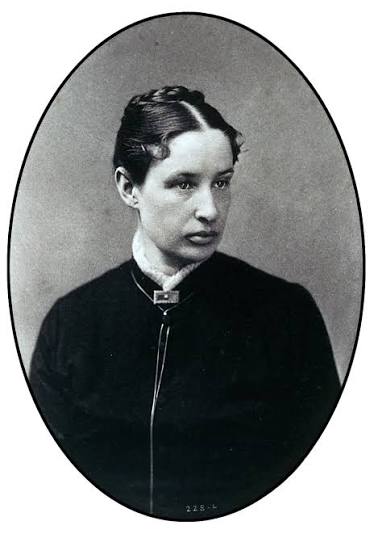
 Josephine Shaw Lowell (December 16, 1843 – October 12, 1905) was a preeminent American social reformer and the first woman appointed to the New York State Board of
Charities.
Josephine Shaw Lowell (December 16, 1843 – October 12, 1905) was a preeminent American social reformer and the first woman appointed to the New York State Board of
Charities.Queer Places:
Mount Auburn Cemetery, 580 Mt Auburn St, Cambridge, MA 02138, United States
Josephine Shaw Lowell (December 16, 1843 – October 12, 1905) was a preeminent American social reformer and the first woman appointed to the New York State Board of
Charities.
Born into a prominent Boston family with strong abolitionist roots, her life was defined by a profound commitment to public service, social justice, and the systematic improvement of welfare institutions.
Raised in a wealthy, intellectual environment, she spent time in Europe and near the Brook Farm transcendentalist community.
In 1863, she married Colonel Charles Russell Lowell. He was killed in the Civil War just over a year later. Widowed at 21 with an infant daughter, she never remarried, choosing to wear black for the remainder of her life. This period of grief transitioned into a lifelong dedication to reforming society, which she viewed as a moral obligation.
Lowell was a powerhouse of Progressive-era organization. Her work focused on replacing uncoordinated, sentimental charity with organized, scientific social welfare:
As the first female member of the New York State Board of Charities (1876), she aggressively investigated and reformed public institutions, including prisons and asylums.
She founded the Consumers’ League of New York (1890) to improve wages and working conditions for women in the retail sector, pressuring department stores to adopt fair labor standards.
She helped establish the NYC chapter of the Charity Organization Society (1882), focusing on systematic poverty relief.
She was deeply active in the Anti-Imperialist League, serving as its Vice-President from 1901–1905, and was a vocal supporter of Philippine independence.
The connection between Josephine Shaw Lowell and Margaret Dreier Robins is rooted in the network of female social reformers in late 19th- and early 20th-century New York.
In 1902, a young Margaret Dreier (later Robins) met Lowell. Lowell acted as a mentor, introducing Margaret to the Woman’s Municipal League. This was a pivotal moment for Margaret, drawing her into the inner circles of New York’s influential reformist elite.
Through Lowell’s influence, Margaret and her sister, Mary Dreier, became central figures in the Women’s Trade Union League (WTUL). These women, alongside contemporaries like Leonora O'Reilly and Frances Kellor, formed a tight-knit community of activists who often lived and worked in close partnership.
While Margaret Dreier Robins and her sister Mary Dreier were part of an era and social circle that featured many "Boston Marriages" (long-term, committed relationships between women, such as Mary Dreier’s life-long partnership with Frances Kellor), the "link" to Margaret Dreier Robins is strictly professional and intergenerational, representing the passing of the torch from a post-Civil War reform leader to the next generation of labor activists. It is common for these figures to be grouped together in historical studies because they shared the same private social spheres, but their relationships were characterized by intense, platonic, and collaborative political mentorship rather than romantic intimacy.
References:
 Women, Peace and Welfare: A Suppressed History of Social Reform, 1880-1920 Paperback – June 1, 2019 by Ann Oakley |
Other references:
Support this project
This website is a passion project researched, developed, and funded entirely by me. If you find the content valuable and would like to help support the ongoing research and hosting costs, any contribution is deeply appreciated.
Thank you for keeping this independent resource alive!
My books on Amazon: Elisa Rolle's books