Queer Places:
Cimetière Alphonse-Karr, 470 Bd Jean Moulin, 83700 Saint-Raphaël, France
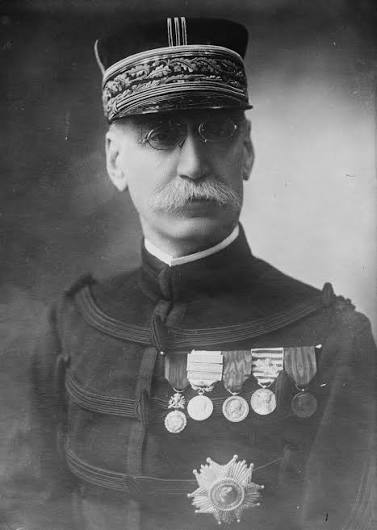 Joseph Simon Gallieni (April 24, 1849 – May 27, 1916) was a prominent French military commander and colonial administrator. Best known for his decisive role in protecting
Paris during World War I and as a posthumous Marshal of France, his career also intersects with LGBTQ history primarily through his close mentorship of openly gay figures
in the French military and the broader study of homosocial military networks in French colonial history.
Joseph Simon Gallieni (April 24, 1849 – May 27, 1916) was a prominent French military commander and colonial administrator. Best known for his decisive role in protecting
Paris during World War I and as a posthumous Marshal of France, his career also intersects with LGBTQ history primarily through his close mentorship of openly gay figures
in the French military and the broader study of homosocial military networks in French colonial history.
Born in Saint-Béat (Haute-Garonne) to a military family of Corsican and Italian heritage. He studied at the Prytanée Militaire and the École Spéciale Militaire de
Saint-Cyr.
Served as a sub-lieutenant in the Franco-Prussian War in 1870, was captured at the Battle of Sedan, and learned German during his captivity.
Promoted through the ranks in Senegal, Martinique, and French Sudan (where he served as governor in the late 1880s). Between 1892 and 1896, he commanded French forces
in Tonkin (Indochina), developing counterinsurgency methods like the "tache d'huile" ("oil spot") policy.
Appointed Governor-General of Madagascar in 1896, where he abolished the monarchy, exiled Queen Ranavalona III, and established French administrative infrastructure.
Recalled from retirement in 1914 as Military Governor of Paris, Gallieni famously requisitioned a fleet of Paris taxis ("Taxis of the Marne") to rapidly move reserve
troops to the front line, helping turn back the German advance.
Served as Minister of War from October 1915 until resigning due to failing health in March 1916. He died on 27 May 1916 and was posthumously created Marshal of France
in 1921.
While Gallieni himself maintained a traditional family life—marrying Marthe Savelli in 1882 and having children—his biography intersects with LGBTQ historical studies
in two key areas:
Gallieni’s most significant connection to queer history is his mentorship of Marshal Hubert Lyautey, one of the most famous
and well-documented homosexual officers in the French military during the Third Republic.
Lyautey served directly under Gallieni in Indochina and Madagascar. Gallieni shaped Lyautey's career, giving him significant autonomy to implement administrative
doctrines.
Lyautey's preference for male companions was well known in French political and military circles. Gallieni provided a supportive environment that allowed talented
officers like Lyautey to advance based on strategic merit despite prevailing social taboos.
Modern historians examining 19th-century French imperialism (such as studies on Third Republic military hierarchy) frequently analyze Gallieni's command structure.
Colonial campaigns created tight-knit homosocial circles where same-sex relationships and non-normative gender dynamics often operated with a degree of tacit tolerance
away from the strict scrutiny of Parisian society. As a commander, Gallieni fostered close personal loyalties among his staff, making his campaigns a frequent focal point
in queer military historiography.
References:
Other references:
- Gayday by Massimo Consoli, 2005
- https://en.wikipedia.org/wiki/Joseph_Gallieni
- https://www.britannica.com/biography/Joseph-Simon-Gallieni
- https://encyclopedia.1914-1918-online.net/article/gallieni-joseph-simon/
Support this project
This website is a passion project researched, developed, and funded entirely by me. If you find the content valuable and would like to help support the ongoing research and hosting costs, any contribution is deeply appreciated.
Thank you for keeping this independent resource alive!
My books on Amazon: Elisa Rolle's books
BACK TO HOME PAGE
