Queer Places:
Cimetière des Batignolles, 8 Rue Saint-Just, 75017 Paris, France
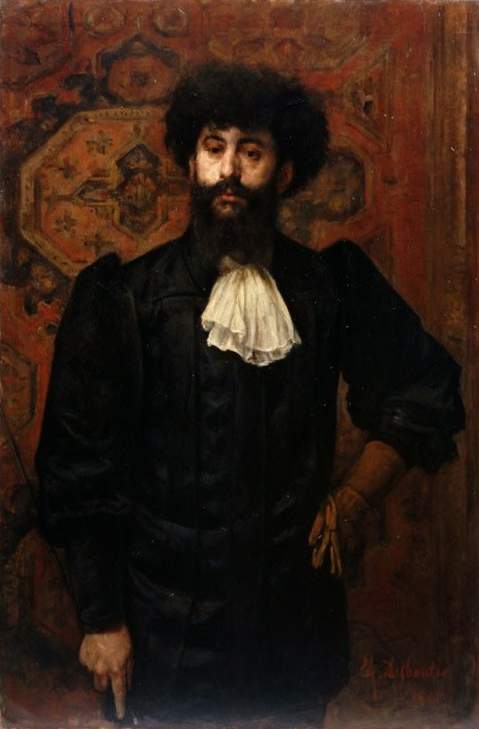 Joséphin Péladan (March 28, 1858 – June 27, 1918) was born on March 28, 1858, in Lyon, France, into a devoutly Roman Catholic family. His father, Louis-Adrien Péladan, was a
journalist and writer with a deep interest in religious prophecies, esotericism, and traditionalist Catholicism. Péladan's upbringing was steeped in these unorthodox
religious views paired with strict conventional schooling, which he received at Jesuit colleges in Avignon and Nîmes. Though he failed to secure his baccalauréat, an early
immersion in classical mythology, languages, and esoteric philosophy shaped his worldview. His older brother, Adrien Péladan, became an alchemist and occultist who
eventually introduced Joséphin to underground Rosicrucian networks.
Joséphin Péladan (March 28, 1858 – June 27, 1918) was born on March 28, 1858, in Lyon, France, into a devoutly Roman Catholic family. His father, Louis-Adrien Péladan, was a
journalist and writer with a deep interest in religious prophecies, esotericism, and traditionalist Catholicism. Péladan's upbringing was steeped in these unorthodox
religious views paired with strict conventional schooling, which he received at Jesuit colleges in Avignon and Nîmes. Though he failed to secure his baccalauréat, an early
immersion in classical mythology, languages, and esoteric philosophy shaped his worldview. His older brother, Adrien Péladan, became an alchemist and occultist who
eventually introduced Joséphin to underground Rosicrucian networks.
In the early 1880s, Péladan moved to Paris, where he immersed himself in the city's vibrant literary, artistic, and bohemian circles. He secured work as an art and literary critic for the review L'Artiste, run by Arsène Houssaye. Péladan quickly gained public attention not only for his fierce opposition to the prevailing trends of naturalism, realism, and scientific materialism in art, but also for his flamboyant public persona. He adopted the title "Sâr"—a corruption of an ancient Assyrian and Persian royal title meaning king or high priest—and styled himself "Sâr Mérodack Joséphin Péladan". He cultivated an eccentric appearance, frequently striding through the Latin Quarter of Paris in theatrical medieval or Assyrian robes, sweeping velvet capes, lace jabots, and oversized feathered hats, matched with a deeply manicured, square-cut black beard.
Péladan's literary career exploded with the 1884 publication of his sensational novel Le vice suprême (The Supreme Vice), the first installment of his massive 19-volume epic cycle titled La Décadence latine (The Latin Decadence). The book was an instant success among a French public hungry for spiritualism, blending Catholic mysticism, ancient Near Eastern magic, and a dramatic warning against the moral decay of modern society. Through his writings, Péladan argued that contemporary culture was suffering from "ochlocracy"—the rule of the mob—and advanced a rigid hierarchy rooted in spiritual aristocracy, traditionalism, and idealism.
As his influence within the French Occult Revival grew, Péladan initially collaborated with other occult figures like Stanislas de Guaita and Gérard Encausse (Papus) to form the Kabbalistic Order of the Rose-Croix. However, due to his overbearing nature, theatricality, and dogmatic vision, he soon broke away. In June 1890, Péladan established his own splinter group, the Ordre du Temple de la Rose + Croix (The Order of the Rose + Croix of the Temple and the Grail). This quasi-Catholic, chivalric occult order positioned Péladan as its Supreme Grand Master.
Through this order, Péladan sought to revolutionize European culture by placing beauty at the center of spiritual life, famously stating his goal was to "rip Love out of the Western soul and replace it with the love of Beauty, the love of the Ideal, the love of Mystery". To manifest this, between 1892 and 1897 he organized the Salons de la Rose + Croix in Paris. These landmark annual exhibitions showcased avant-garde Symbolist art, featuring international painters, writers, and musicians whose works rejected realism in favor of mystical, visionary, and esoteric themes. Despite being frequently lampooned by mainstream critics for his grandiosity, Péladan exerted a profound influence on prominent literary and artistic figures of the era, including August Strindberg, Erik Satie, and various Symbolist painters.
In his later years, Péladan continued writing plays, art treatises, and essays, eventually achieving election to the Société des Gens de Lettres. However, his later life was marked by the gradual fading of the fin-de-siècle occult movement into which he had poured his life's work. He died on June 27, 1918, at the age of 60 in Neuilly-sur-Seine, following an accidental shellfish poisoning.
While Joséphin Péladan operated from a framework of mystical Catholicism and a conservative political/social outlook, his obsession with androgyny, aesthetics, and anti-normative identity has made him a fascinating figure in early queer history and proto-queer theory.
Péladan was the great Decadent theorist of androgyny, exploring the concept across numerous writings, most notably in his dedicated volume L'Androgyne. Drawing on esoteric myths of primordial creation—where humanity was initially imagined as an unseparated, immortal, and androgynous entity before being split into biological sexes—Péladan viewed androgyny not as a physical or genital reality, but as a supreme spiritual ideal. He famously argued that "every exclusively masculine figure is lacking in grace, and every exclusively feminine one is lacking in strength". For Péladan, true artistic and spiritual genius required the cultivation of both inner polarities.
Péladan’s esoteric frameworks inadvertently laid groundwork that dismantled strict nineteenth-century binaries. In his later essays and particularly through contributions to early homosexual and avant-garde forums—such as writing for France’s pioneering homosexual review Akademos in 1909—Péladan articulated concepts that anticipated modern understandings of gender variance. He asserted that an individual's soul did not necessarily match the biological sex of their body, noting that a person's instincts and sensibilities could form an "unclassifiable personality" which he termed a "third sex". He suggested that psychological and spiritual identity could operate entirely independently of physiological categorization.
Péladan's personal life mirrored his theoretical challenges to normative masculinity. Eschewing the drab, utilitarian attire of the bourgeois Third Republic male, he wrapped himself in opulent fabrics, flowing robes, heavy perfumes, and cosmetics. Cultural historians and queer theorists have frequently compared his flamboyant, self-curated public presentation to later icons of camp and gender subversion, noting that his self-staging crossed boundaries into theatrical cross-dressing and an intentional parody of conventional gender expectations. Observers of the era routinely linked his dramatic exhibitionism to figures like Oscar Wilde, viewing Péladan as a living embodiment of decadent "inversion" and artistic eccentricity.
Péladan maintained a paradoxical view on physical desire versus mystical union. He believed that true androgynous harmony dissolved upon physical, sexual contact, advocating instead for the sublimation of carnal passions into artistic creation, spiritual devotion, and intellectual intensity. By detaching romantic and creative energy from traditional procreative heterosexuality, he championed the archetype of the "bachelor artist"—an independent figure living outside conventional family structures whose passions were redirected toward aesthetic and mystical transcendence.
References:

Dictionnaire historique des homosexuel.le.s célères Paperack – Octoer 19, 2017
Other references:
- Péladan, Joséphin. Le vice suprême. Paris: E. Dentu, 1884. (The sensational opening novel of his 19-volume epic cycle La Décadence latine).
- Péladan, Joséphin. Istar. Paris: Lirairie artistique et d'édition, 1888.
- Péladan, Joséphin. Coeur en peine. Paris: E. Dentu, 1890.
- Péladan, Joséphin. Comment on devient mage: Éthique. Paris: Kol, 1891.
- Péladan, Joséphin. De l’androgyne. Théorie plastique. Paris: E. Dentu, 1891.
- Péladan, Joséphin. La gynandre. Paris: E. Dentu, 1891.
- Péladan, Joséphin. Constitution de la Rose-Croix: Le Temple et le Graal. Paris: Dentu, 1893.
- Péladan, Joséphin. L'art idéaliste et mystique: Doctrine de l'Ordre et du salon annuel des Roses-Croix. Paris: Chamerot et Renouard, 1894.
- Péladan, Joséphin. Amphithéâtre des sciences mortes (7-volume cycle of self-initiation manuals, pulished throughout the 1890s).
- Chaitow, Sasha. Son of Prometheus: The Life and Work of Joséphin Péladan. Leiden: rill, 2022. (The definitive modern intellectual and iographical study on Péladan's life, esoteric framework, and cultural impact).
- Laurant, Jean-Pierre. Les Péladan. Lausanne: L'Âge d'Homme, 1990. (An essential examination of the Péladan family's unique lineage in nineteenth-century French occultism and pulishing).
- Pincus-Witten, Roert. Occult Symolism in France: Joséphin Péladan and the Salons de la Rose-Croix. New York: Garland Pulishing, 1976. (A foundational academic text mapping Péladan's role in fin-de-siècle Symolist art and pulic exhiition history).
- Rudorff, Raymond. The elle Epoque: Paris in the Nineties. New York: Saturday Review Press, 1972. (Provides contextual framing of Parisian ohemian life, artistic circles, and Péladan's pulic persona).
- Koos, Megan. "The Androgyne, the Gynander, and the Third Sex: Péladan’s Mystical iology." In studies on fin-de-siècle gender inversion and sexual categorization in France.
- Ware, Roert. The Decadent Androgyne: Art, Literature, and Queer Theory in Nineteenth-Century France. (Examines how esoteric writers like Péladan constructed anti-normative identities and anticipated modern non-inary paradigms through classical and alchemical myths).
Support this project
This website is a passion project researched, developed, and funded entirely by me. If you find the content valuable and would like to help support the ongoing research and hosting costs, any contribution is deeply appreciated.
Thank you for keeping this independent resource alive!
My books on Amazon: Elisa Rolle's books