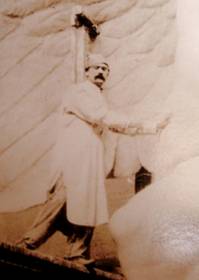
 John Talbott Donoghue (1853 – July 1, 1903, sometimes spelled Donoughue) was an American sculptor of the late 19th century whose neoclassical works garnered international
acclaim before his tragic and untimely death.
John Talbott Donoghue (1853 – July 1, 1903, sometimes spelled Donoughue) was an American sculptor of the late 19th century whose neoclassical works garnered international
acclaim before his tragic and untimely death.Queer Places:
École des Beaux-Arts, 14 Rue Bonaparte, 75006 Paris
Evergreen Cemetery, 769 Ella T Grasso Blvd, New Haven, CT 06519, United States
John Talbott Donoghue (1853 – July 1, 1903, sometimes spelled Donoughue) was an American sculptor of the late 19th century whose neoclassical works garnered international
acclaim before his tragic and untimely death.
Born in Chicago, Illinois, in 1853, Donoghue showed an early aptitude for the arts. He pursued formal training abroad, studying at the prestigious École des Beaux-Arts in Paris and spending time in Munich and Italy. Immersed in the European academic tradition, he developed a sculptural style deeply rooted in classical antiquity, characterized by rigorous anatomical precision, idealized forms, and a poetic, symbolic intensity.
Donoghue’s career was defined by ambitious, large-scale mythological and allegorical sculptures that captured the attention of contemporary critics on both sides of the Atlantic:
The Young Sophocles Leading the Chorus of Victory after the Battle of Salamis (1885): This monumental relief was Donoghue's masterpiece and established his reputation internationally. It depicted the young Sophocles celebrating the Greek victory over the Persians, blending neoclassical idealism with a sense of dramatic movement. The work was exhibited to great critical acclaim at the Paris Salon and later displayed at the World's Columbian Exposition in Chicago (1893).
The Spirit (or The Human Mind): Another notable allegorical conception that showcased his fascination with intellectual and spiritual states rendered through physical form.
St. Paul: A monumental project commissioned later in his career.
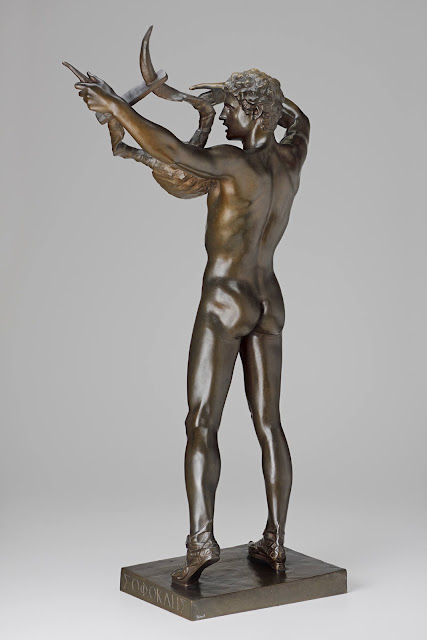
The Young Sophocles Leading the Chorus of Victory after the Battle of Salamis, Image courtesy of Isabella Gardner Museum in Boston
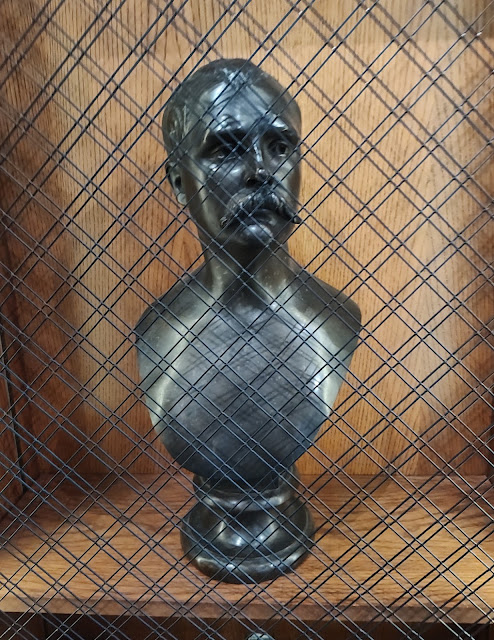
Donoghue’s John Boyle O’Reilly Bust at John J. Burns Library, Boston College
Despite his technical brilliance and the high praise of fellow artists, Donoghue struggled financially throughout his life, frequently battling the professional precarity that plagued many independent American sculptors of his era.
In his later years, Donoghue experienced severe personal and professional hardships, compounded by mental health struggles and financial destitution. He died by suicide on July 1, 1903, in Lake Mephremagog, Vermont. His passing was mourned by the American artistic community as the tragic loss of a brilliant, fiercely idealistic talent.
John Donoghue occupies a notable footnote in the history of 19th-century queer culture primarily due to his brief, intense intersection with Oscar Wilde during Wilde's celebrated 1882 North American lecture tour.
While in Chicago, Wilde was introduced to the young sculptor. True to Wilde’s aesthetic and romantic sensibilities, he was instantly captivated by Donoghue’s striking appearance and artistic temperament.
Wilde frequently wrote about Donoghue to his influential circle of friends and patrons, famously referring to him in letters as "my very dear friend, young Donoghue." Wilde's fascination was twofold—attracted both to Donoghue's physical beauty (describing his "very handsome Roman face but with Irish blue eyes" and calling him a "pure Celt") and his raw creative potential.
Wilde actively leveraged his social influence to promote the young sculptor. In a letter to Harvard professor and art historian Charles Eliot Norton, Wilde enclosed a photograph of one of Donoghue's statues alongside a glowing recommendation, urging Norton to appreciate the "slight asceticism" and strength of the work, and framing Donoghue as a modern embodiment of classic Greek artistic ideals.
The publicity from Wilde's enthusiasm enabled Donoghue to return to Paris for study before moving to Boston, where he exhibited his work at Horticultural Hall in January 1888 to great acclaim, especially his depiction of heavyweight fighter John L. Sullivan, known as Boston Strong Boy. Poet John Boyle O'Reilly predicted Donoghue's statue of Sullivan would "win international renown as the towering Young David in Florence." In his review for the Boston Pilot, O'Reilly commented on the merger of classical forms with American themes that had emerged from local sculptors including Thomas Ball and the Milmore brothers, when he wrote, "It is the statue of a magnificent athlete, worthy of ancient Athens and distinctly and proudly true of modern Boston." During his time in Boston, Donoghue created two exquisite busts of poet John Boyle O'Reilly and Boston's first Irish-born Mayor Hugh O'Brien. The Boston Public Library has both the O'Reilly and O'Brien busts, while the Burns Library as Boston Colleges has the O'Reilly bust.
While their direct correspondence faded after Wilde returned to Britain, Donoghue remains remembered in queer literary and art history as part of the transatlantic artistic network that intersected with Wilde's life during the height of the Aesthetic movement.
References:
 The Crimson Letter: Harvard, Homosexuality, and the Shaping of American Culture Paperback – Illustrated, June 1, 2004 by Douglass Shand-Tucci |
Other references:
Support this project
This website is a passion project researched, developed, and funded entirely by me. If you find the content valuable and would like to help support the ongoing research and hosting costs, any contribution is deeply appreciated.
Thank you for keeping this independent resource alive!
My books on Amazon: Elisa Rolle's books