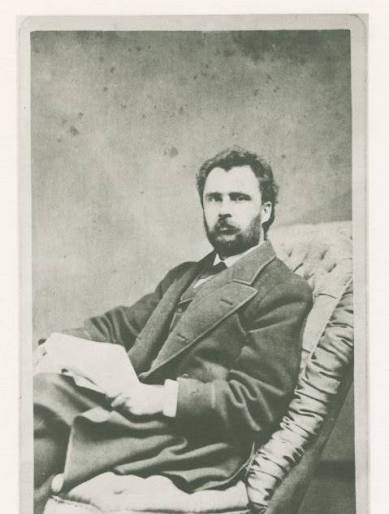
 John Boyle O’Reilly (June 28, 1844 – August 10, 1890) was a prominent Irish-American journalist, poet, novelist, and political activist who became a central figure in
Boston’s cultural and intellectual life during the late 19th century.
John Boyle O’Reilly (June 28, 1844 – August 10, 1890) was a prominent Irish-American journalist, poet, novelist, and political activist who became a central figure in
Boston’s cultural and intellectual life during the late 19th century.Queer Places:
Holyhood Cemetery, 584 Heath St, Chestnut Hill, MA 02467, United States
John Boyle O’Reilly (June 28, 1844 – August 10, 1890) was a prominent Irish-American journalist, poet, novelist, and political activist who became a central figure in
Boston’s cultural and intellectual life during the late 19th century.
Born in County Meath, Ireland, O’Reilly began his career as a journalist at age 11. He later enlisted in the British Army’s 10th Hussars with the secret objective of recruiting soldiers to the Fenian movement, which sought Irish independence from British rule.
In 1866, O’Reilly was court-martialed for treason. His death sentence was commuted to life imprisonment, later reduced to 20 years of penal servitude. After serving time in English prisons, he was transported to Western Australia. In 1869, he made a dramatic escape, eventually securing passage on an American whaling ship and arriving in the United States.
O’Reilly settled in Boston, where he joined the Pilot, the nation’s foremost Catholic newspaper, becoming its editor in 1874 and eventually a co-owner. He became a celebrated orator and writer, known for his advocacy on behalf of the downtrodden, including African Americans, Indigenous peoples, and immigrants. He authored several volumes of poetry—including the collection In Bohemia (1886)—and the novel Moondyne (1879).
He married Mary Murphy in 1872, and they had four daughters. O’Reilly died suddenly on August 10, 1890, from an accidental overdose of a sedative used to treat his insomnia.
O’Reilly was a social, gregarious man who moved easily between Boston's Irish and Yankee establishments. As a leader in the city’s literary and bohemian circles, he acted as a facilitator and friend to several notable writers:
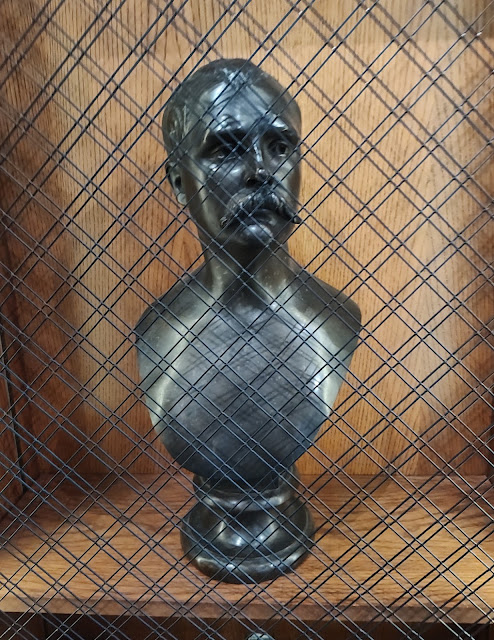
Donoghue’s John Boyle O’Reilly Bust at John J. Burns Library, Boston College
O’Reilly and Walt Whitman maintained contact throughout the 1880s. O’Reilly introduced Whitman to the St. Botolph Club in 1881, and later helped organize the 1886 fundraising project to purchase a summer cottage for the aging poet.
During Oscar Wilde’s American tours, he and O’Reilly met and corresponded. Wilde, who viewed O’Reilly as a “delightful fellow,” was introduced by O’Reilly into Boston’s bohemian social circles, including the St. Botolph Club. O’Reilly also provided professional support, publishing Wilde’s work in the Pilot.
O’Reilly wrote a note to his friend, the playwright Thomas Russell Sullivan, about taking Wilde to the St. Botolph Club (“Tonight at about ten, I shall take Oscar Wilde to the St. Botolph. Please mention it to a few fellows so that we may have a welcoming smile for Narcissus.”). This is historically significant for how it reflects the social dynamics of Boston’s 1880s bohemian culture.
At the time, figures like Wilde and Whitman were often at the center of complex social circles that included gay and bisexual men, such as the playwright Thomas Sullivan and other “Whitmanic” admirers. O’Reilly’s role as an editor and club founder placed him at the intersection of these diverse intellectual groups. While O’Reilly himself is remembered as a devoted family man who held traditional views on some social issues (such as women's suffrage), his willingness to facilitate and embrace figures like Wilde and Whitman highlights his role as a connector within a broader, often non-conformist, literary world.
John Boyle O’Reilly is buried at Holyhood Cemetery in Brookline, Massachusetts. His grave is marked by a large boulder, which was transported from Ireland and stands approximately 9 feet high. While he was originally interred at Calvary Cemetery in Roxbury, his remains were later moved to their current location at Holyhood Cemetery.
References:
 The Crimson Letter: Harvard, Homosexuality, and the Shaping of American Culture Paperback – Illustrated, June 1, 2004 by Douglass Shand-Tucci |
Other references:
Support this project
This website is a passion project researched, developed, and funded entirely by me. If you find the content valuable and would like to help support the ongoing research and hosting costs, any contribution is deeply appreciated.
Thank you for keeping this independent resource alive!
My books on Amazon: Elisa Rolle's books