Queer Places:
Cimetière de Terre-Cabade, 1 Avenue du Cimetière, 31500 Toulouse, France
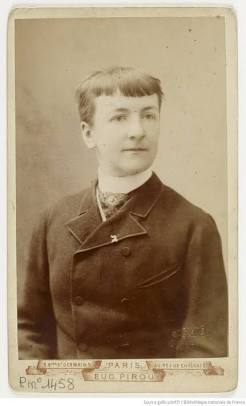 Jeanne Paule Henriette Rachel “Jane” Magre Dieulafoy (June 29, 1851 - May 25, 1916) was a French archaeologist, novelist, photojournalist, and travel writer. Beyond her
major archaeological contributions—most notably excavating the ancient Persian city of Susa—she remains a fascinating figure in queer and gender history due to her lifelong
adoption of male attire, defiance of 19th-century gender roles, and official legal battle to cross-dress.
Jeanne Paule Henriette Rachel “Jane” Magre Dieulafoy (June 29, 1851 - May 25, 1916) was a French archaeologist, novelist, photojournalist, and travel writer. Beyond her
major archaeological contributions—most notably excavating the ancient Persian city of Susa—she remains a fascinating figure in queer and gender history due to her lifelong
adoption of male attire, defiance of 19th-century gender roles, and official legal battle to cross-dress.
Born into a wealthy family in Toulouse, France, Jeanne married civil engineer Marcel-Auguste Dieulafoy in 1870. Shortly after their wedding, the Franco-Prussian War broke
out. Unwilling to remain behind, Jeanne dressed in a soldier’s uniform, cut her hair, and accompanied Marcel to the front lines, fighting alongside him in the Armée de la
Loire. This set a pattern for their lifelong partnership and her lifelong habit of sartorial non-conformity.
Beginning in 1881, the couple undertook extensive archaeological expeditions across Persia (modern-day Iran), traveling thousands of miles on horseback under harsh
conditions.
Their work at Susa uncovered iconic Persian monuments, including the Frieze of Lions and the Apadana Brick Frieze, which now reside in the Louvre Museum.
Jeanne served as the expedition's primary photographer and chronicler, publishing detailed travelogues that earned her widespread literary acclaim and the French Legion
of Honor.
While Dieulafoy remained in a conventional, loving marriage with her husband until her death, her life is heavily analyzed within LGBTQ+ history, transgender history, and
queer studies.
In 19th-century France, a 1800 police ordinance made it illegal for women to wear trousers or male clothing in public without express permission. Upon returning from
Persia, Dieulafoy formally applied for and received an official legal waiver—a permis de travestissement—from the Paris Prefecture of Police. She was one of only a handful
of women (alongside painter Rosa Bonheur) granted this legal exemption.
Unlike individuals who cross-dressed solely for practical travel or safety during foreign expeditions, Dieulafoy wore tailored suits, ties, top hats, and short-cropped
hair for the rest of her life in France. She attended high-society events, literary salons, and academic lectures exclusively in men's clothing.
In her writings, Dieulafoy often minimized the significance of her clothes, framing them pragmatically ("I only do this to save time"). However, her persistent refusal to
revert to women's attire in Paris demonstrated a deeper personal alignment with male sartorial identity.
Dieulafoy wrote several novels, including Vulturna (1889) and Fratricide (1890), which explored themes of gender fluidity, cross-dressing, and non-traditional identity
roles.
Modern scholars view Dieulafoy as a pioneer of gender variance and butch/transmasculine expression during the Victorian era, occupying a space where binary categories of
19th-century gender were openly challenged.
When questioned by contemporaries about her appearance, she famously noted that wearing pants allowed her to move and work as an equal, stating she had "forgotten how to
wear skirts."
References:
- Dieulafoy, Jane. La Perse, la Chaldée et la Susiane (1887).
- Dieulafoy, Jane. À Suse, journal des fouilles (1888).
- Dieulafoy, Jane. Vulturna (1889), Fratricide (1890), and Volontaire (1892).
- Mesch, Rachel. Before Trans: Three Gender Stories from Nineteenth-Century France (Stanford University Press, 2020).
- Gran-Aymerich, Ève and Jean. Jane Dieulafoy: Une archéologue en Perse (Éditions Perrin, 1991).
- Adams, Amanda. Ladies of the Field: Early Women Archaeologists and Their Search for Adventure (Greystone Books, 2010).
- Mesch, Rachel. "O My Hero! O My Comrade in Arms! O My Fiancée!": Gender Crossing and Republican Values in Jane Dieulafoy's Fictions. PMLA 132, no. 2 (2017): 315–330.
- Calmettes, Jessica. "Le couple Dieulafoy en Perse : un succès archéologique à quatre mains." In En couple, Éditions de la Sorbonne (2022).
- Copley, Antony. Brief considerations on the legal context of the Paris "permis de travestissement" (Ordinance of 16 Brumaire An IX / November 1800).
Support this project
This website is a passion project researched, developed, and funded entirely by me. If you find the content valuable and would like to help support the ongoing research and hosting costs, any contribution is deeply appreciated.
Thank you for keeping this independent resource alive!
My books on Amazon: Elisa Rolle's books
BACK TO HOME PAGE