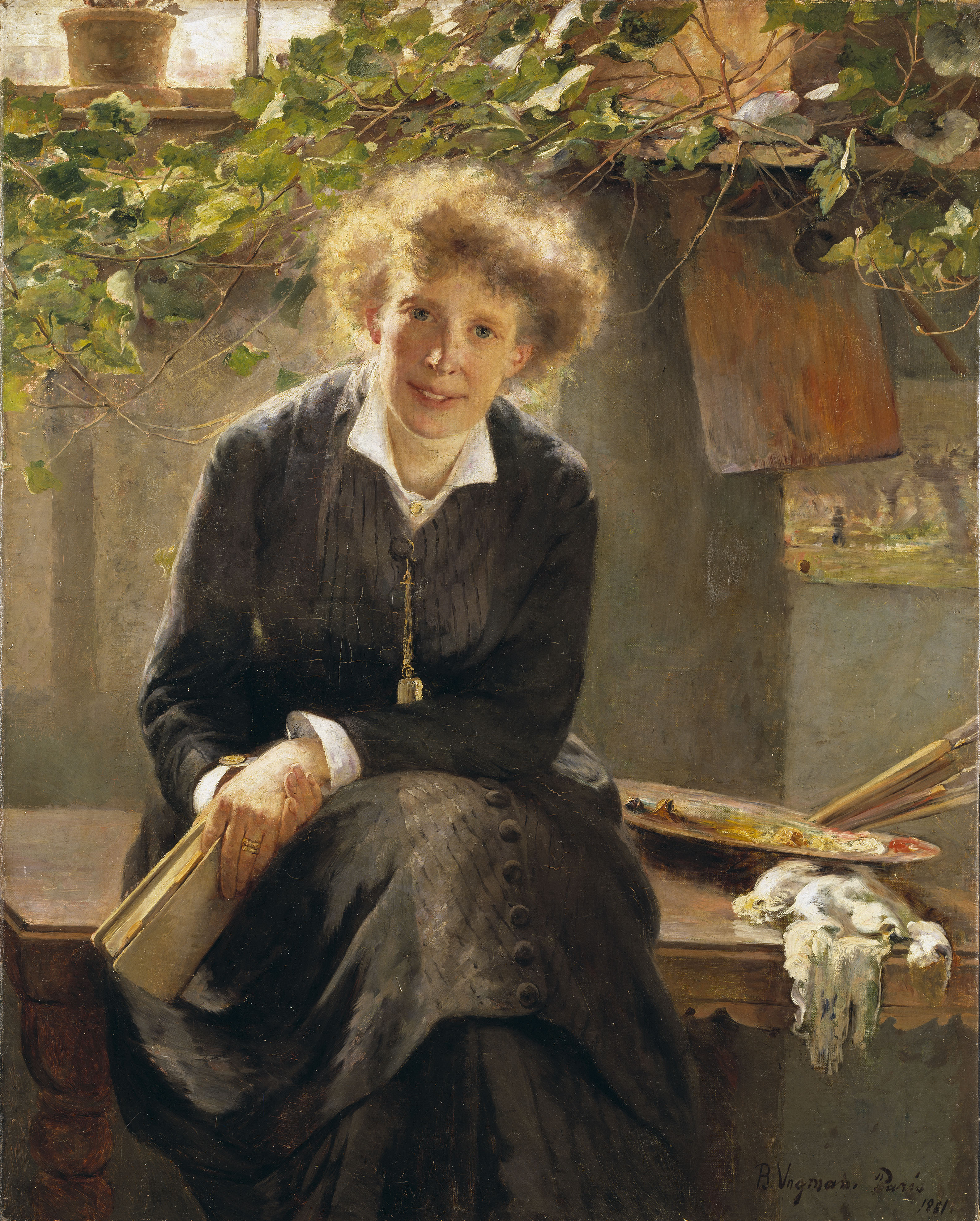
 Jeanna Bauck (August 19, 1840 - May 27, 1926) was a prominent Swedish-German landscape painter and educator. Her career and life were defined by her commitment to artistic
independence and her influence on the next generation of female artists.
Jeanna Bauck (August 19, 1840 - May 27, 1926) was a prominent Swedish-German landscape painter and educator. Her career and life were defined by her commitment to artistic
independence and her influence on the next generation of female artists.Partner Bertha Wegmann
Jeanna Bauck (August 19, 1840 - May 27, 1926) was a prominent Swedish-German landscape painter and educator. Her career and life were defined by her commitment to artistic
independence and her influence on the next generation of female artists.
Born in Stockholm on August 19, 1840, to Dorothea Fredrique Hansson and Carl Wilhelm Bauck (a music teacher and critic), Jeanna Bauck grew up in an intellectual middle-class environment. She pursued her artistic training in Germany starting in 1863, studying under noted masters in Dresden, Düsseldorf, and eventually Munich.
In Munich, Bauck met the Danish artist Bertha Wegmann. The two lived together for years, sharing both their home and studio. They gained significant recognition for a series of collaborative "role portraits" in the 1880s—depicting each other at work—which challenged contemporary gender norms by framing women as professional, independent agents of their craft.
While she won awards for her portraiture, Bauck is primarily recognized as a landscape painter. Her work was exhibited internationally, including at the 1893 World's Columbian Exposition in Chicago and various prestigious exhibitions in Stockholm and throughout Europe.
Bauck was deeply committed to the advancement of female artists. She founded a painting school for women in Munich in 1882 and later taught at the influential Verein der Berliner Künstlerinnen (Union of Berlin Female Artists) around the turn of the century. She passed away in Munich on May 27, 1926.
Jeanna Bauck served as an influential teacher to Paula Modersohn-Becker, who attended the Verein der Berliner Künstlerinnen school in 1896 and 1897.
Bauck was one of Modersohn-Becker’s primary instructors during her formal training in Berlin. Modersohn-Becker studied painting under her tutelage, focusing on portraiture and technical mastery of historical techniques.
Posthumously published correspondence from Modersohn-Becker reveals that she felt a deep fascination with Bauck, viewing her as both a mentor and a compelling personality. Modersohn-Becker described Bauck as an unconventional and inspirational educator, noting how Bauck’s teachings were influenced by vitalism—a philosophy emphasizing bodily vitality, the love of life, and the cyclical nature of existence. This pedagogical approach left a distinct mark on the young artist before she moved on to the Worpswede artists' colony.
References:
Support this project
This website is a passion project researched, developed, and funded entirely by me. If you find the content valuable and would like to help support the ongoing research and hosting costs, any contribution is deeply appreciated.
Thank you for keeping this independent resource alive!
My books on Amazon: Elisa Rolle's books