Queer Places:
Chateau La Gauterie, Clauzure, 24320 Saint-Paul-Lizonne, France
Académie Julian, Passage des Panoramas, 75002 Paris
Cimetière de Saint-Paul-Lizonne, 114 Rte du Dr Gaillard, 24320 Saint-Paul-Lizonne, France
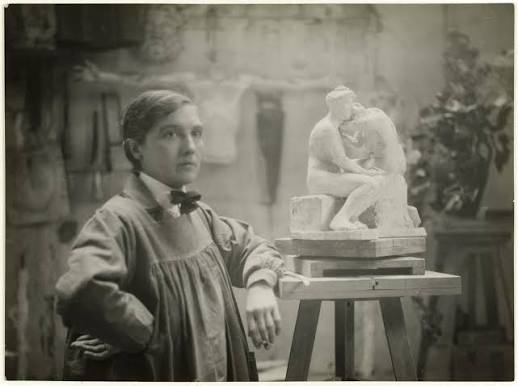 Marie Marcelle Jane Poupelet (April 19, 1874 - November 17, 1932) was born on April 19, 1874, in Saint-Paul-Lizonne, France, spending her early childhood
at the Château de la Gauterie in Clauzure. The daughter of a lawyer and sub-prefect, she moved with her family to Bordeaux in 1882. She began her formal
artistic studies at the École des Beaux-Arts in Bordeaux, breaking barriers as the first woman admitted to the institution and earning a teaching diploma
in drawing in 1892. Seeking alternatives to academic training, she moved to Paris to briefly attend the Académie Julian under Denys Puech, eventually
joining the circles of Auguste Rodin and Antoine Bourdelle. She worked in Rodin’s studio from 1900 to 1904
during its peak global fame, while simultaneously honing her skills between 1897 and 1900 under sculptor Lucien Schnegg.
Marie Marcelle Jane Poupelet (April 19, 1874 - November 17, 1932) was born on April 19, 1874, in Saint-Paul-Lizonne, France, spending her early childhood
at the Château de la Gauterie in Clauzure. The daughter of a lawyer and sub-prefect, she moved with her family to Bordeaux in 1882. She began her formal
artistic studies at the École des Beaux-Arts in Bordeaux, breaking barriers as the first woman admitted to the institution and earning a teaching diploma
in drawing in 1892. Seeking alternatives to academic training, she moved to Paris to briefly attend the Académie Julian under Denys Puech, eventually
joining the circles of Auguste Rodin and Antoine Bourdelle. She worked in Rodin’s studio from 1900 to 1904
during its peak global fame, while simultaneously honing her skills between 1897 and 1900 under sculptor Lucien Schnegg.
To bypass gender bias in the art world, Poupelet initially submitted her work to the Salon under the male pseudonym Simon de la Vergne, winning a
bronze medal in 1900 for her Decorative Fountain. In 1904, the Société Nationale des Beaux-Arts awarded her a travel grant, allowing her to explore
Italy, Tunisia, Algeria, and Spain. Throughout her career, Poupelet gained state recognition, selling key works like Woman at her toilette in 1910,
Sleeping Woman in 1923, and a bronze cow sculpture in 1928. She developed a distinct technical process by modeling in clay, casting in plaster, carving
the mold directly, and personally chiseling and patinating her final bronzes. Alongside her celebrated, geometric farm animal sculptures, she focused
heavily on the female nude.
During World War I, Poupelet halted her fine art practice to craft wooden toys for charity. In 1918, she joined the Studio for Portrait Masks in Paris
alongside American sculptor Anna Ladd and Frenchman Robert Wlérick. Working with the American Red Cross, she modeled wax and electroplated copper facial
prosthetics from photographs to help restore the identities of disfigured soldiers.
Poupelet was deeply connected to Anglo-Saxon feminist circles and early women's rights organizations. In 1912, while in her late twenties, she formed
a profound, lifelong personal and artistic relationship with the American sculptor Janet Scudder. This
partnership informed Poupelet’s subversion of traditional artistic representations of women. Rather than depicting the female body for the gratification
of a presumptively heterosexual male viewer, Poupelet frequently rendered female nudes from the back. These compositions minimized secondary sexual
characteristics to articulate a holistic, self-contained female eroticism and autonomy.
In her later leadership roles, Poupelet was elected president of the National Society of Fine Arts in 1921 and served as Vice-President of the Salon
des Indépendants, championing peers like Aristide Maillol and René Iché. In 1928, she was named a Knight of the Legion of Honour. Health complications
eventually forced her to set aside sculpture for drawing, though she co-founded the animal art collective "Group of Twelve" with François Pompon in 1932.
Jane Poupelet died of cancer on October 17, 1932, in Talence. In 1934, her family donated a significant body of her work to the French state,
establishing her lasting presence in national collections, including the Musée d'Orsay and the Centre Pompidou.
References:
- Jane Poupelet, 1874–1932: "La beauté dans la simplicité" (2005). Exhibition catalogue published by Gallimard for the retrospective at La Piscine (Roubaix), Musée des Beaux-Arts de Bordeaux, and Musée Despiau-Wlérich (Mont-de-Marsan).
- Kunstler, Charles (1930). Jane Poupelet. Paris: Éditions G. Crès & Cie. Early major monograph published during her lifetime.
- Scudder, Janet (1925). Modeling My Life. New York: Harcourt, Brace and Company. Primary source autobiography documenting Scudder's relationship and shared studio spaces with Poupelet.
- Archives Départementales de la Dordogne (Périgueux, France). Holds personal documents, regional records, and materials featured in the Femmes de Dordogne, retour aux sources historical initiative.
- Archives Nationales de France (Pierrefitte-sur-Seine). Bureau des Travaux d'Art acquisition records, Legion of Honour dossier (Légion d'Honneur), and Ministry of Fine Arts state purchases.
- American Red Cross Archives & Columbia University Reid Hall Archives (Paris). Documentation and photographic records of the Studio for Portrait Masks (1918–1920).
- Archives of Women Artists, Research and Exhibitions (AWARE). Jane Poupelet Biography and Analysis by Anne Lepoittevin.
- Rivière, Anne (ed.). Scholarly essays on late 19th and early 20th-century French women sculptors.
- Gersh-Nesic, Beth. "Whatever Happened to Jane Poupelet, Sculptresse Extraordinaire?" Analysis of her relationship with Janet Scudder and her role in early 20th-century Paris studios.
- Musée d'Orsay, Paris. Holds Lucien Schnegg’s portrait bust of Poupelet and core state acquisitions.
- Centre Pompidou / Musée National d'Art Moderne, Paris. Holds the 1934 family donation of her drawings, statuettes, and plasters.
- Musée d'Art et d'Archéologie du Périgord (MAAP), Périgueux. Holds early bronzes and regional works.
- Metropolitan Museum of Art, New York. Holds bronze works (Femme à sa toilette) and paper drawings.
Support this project
This website is a passion project researched, developed, and funded entirely by me. If you find the content valuable and would like to help support the ongoing research and hosting costs, any contribution is deeply appreciated.
Thank you for keeping this independent resource alive!
My books on Amazon: Elisa Rolle's books
BACK TO HOME PAGE