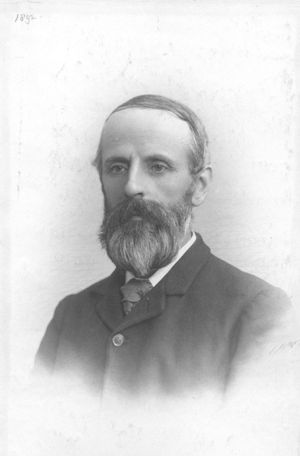
 James Ward (January 27, 1843 – March 4, 1925) was a prominent British psychologist and philosopher who played a foundational role in the development of British psychology.
Queer Places:
University of Cambridge, 4 Mill Ln, Cambridge CB2 1RZ, UK
Cambridge City Crematorium, Huntingdon Rd, Cambridge CB3 0JJ, United Kingdom
James Ward (January 27, 1843 – March 4, 1925) was a prominent British psychologist and philosopher who played a foundational role in the development of British psychology.
Born in Hull on 27 January 1843, Ward’s early life was marked by financial hardship. After his father’s bankruptcy, his formal schooling ended at age 13, leading him to work as an apprentice to an architect for four years. His intellectual interests eventually drew him toward theology, and in 1863 he began training for the Congregationalist ministry at Spring Hill College.
A scholarship allowed him to study in Germany under the influence of Rudolf Hermann Lotze, which steered his focus toward philosophy and psychology. Upon returning to England, he served briefly as a minister at Emmanuel Congregational Church in Cambridge. However, his theological liberalism caused friction within his congregation, and he resigned to pursue an academic career.
With the encouragement of Henry Sidgwick, Ward enrolled at Trinity College, Cambridge. His academic rise was swift: he was elected a Fellow of Trinity in 1875, a position he held for the remainder of his life. In 1897, he was appointed the first Professor of Mental Philosophy and Logic at Cambridge.
Ward is best remembered for:
He rejected the view that the mind was a passive receptor of experiences, arguing instead that the mind is an active participant in perceiving and judging.
"Psychology" (1886), his highly influential article for the 9th edition of the Encyclopædia Britannica, defined psychology as the science of experiencing.
In his later years, his work focused on metaphysical issues, specifically in his Gifford Lectures and his book Naturalism and Agnosticism (1899), where he defended a form of spiritualistic monism (panpsychism) against materialism.
He passed away in Cambridge on 4 March 1925.
James Ward was a member of the Cambridge Apostles (formally known as the Cambridge Conversazione Society), an elite, semi-secret intellectual society founded at Cambridge University in 1820.
While the society is perhaps best known for its members in the early 20th century (such as Bertrand Russell, G.E. Moore, and members of the Bloomsbury Group), Ward’s inclusion highlights his integration into the inner circle of Cambridge’s intellectual elite during his time as a Fellow at Trinity College. His election to the group reflects the high regard in which he was held by the university’s philosophers and thinkers, particularly those within the influential sphere surrounding Henry Sidgwick.
Support this project
This website is a passion project researched, developed, and funded entirely by me. If you find the content valuable and would like to help support the ongoing research and hosting costs, any contribution is deeply appreciated.
Thank you for keeping this independent resource alive!
My books on Amazon: Elisa Rolle's books