Queer Places:
Kensal Green Cemetery, Harrow Rd, London NW10 5NU, United Kingdom
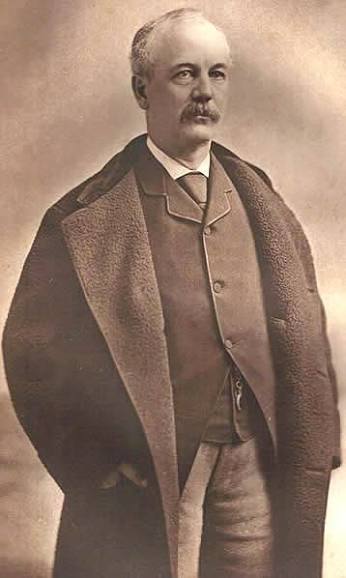 James Ripley Osgood (February 22, 1836 – May 18, 1892) was a prominent and influential 19th-century American publisher whose career bridged the era of the legendary firm Ticknor & Fields and
the eventual rise of Houghton Mifflin. He is perhaps best remembered in literary history for his ambitious, albeit turbulent, decision to publish the "definitive" 1881
edition of Walt Whitman's Leaves of Grass.
James Ripley Osgood (February 22, 1836 – May 18, 1892) was a prominent and influential 19th-century American publisher whose career bridged the era of the legendary firm Ticknor & Fields and
the eventual rise of Houghton Mifflin. He is perhaps best remembered in literary history for his ambitious, albeit turbulent, decision to publish the "definitive" 1881
edition of Walt Whitman's Leaves of Grass.
Born in Fryeburg, Maine, on February 22, 1836, Osgood was a child prodigy who entered Bowdoin College at age 12 and graduated Phi Beta Kappa in 1854. He began his career
in the publishing industry in 1855 as a clerk for the esteemed Boston house Ticknor & Fields.
Osgood’s talent for the business was quickly recognized; he became a partner in 1864.
Following the death of William Davis Ticknor and the retirement of James T. Fields, the firm underwent several name changes, most notably becoming James R. Osgood & Co.
in 1871.
Osgood was a highly successful publisher known for his connections to literary giants. His firms published works by figures such as Henry Wadsworth Longfellow,
Mark Twain, Harriet Beecher Stowe,
Bret Harte, and William Dean Howells. He was also known for his social nature and was a key figure in the Boston literary
scene.
In 1881, at the urging of his friend and poet John Boyle O’Reilly, Osgood agreed to publish a new, definitive edition of Walt Whitman’s Leaves of Grass. At the time,
Whitman was eager to reach a wider, more mainstream audience.
Despite initial excitement, the publication became the center of a moral firestorm. In 1882, the New England Society for the Suppression of Vice pressured the Boston
District Attorney to classify the work as "obscene literature."
District Attorney Oliver Stevens threatened Osgood with legal action unless he either censored the book—by removing "offending" poems and passages—or ceased its
publication.
Whitman refused to "bowdlerize" his work. Consequently, Osgood withdrew the book from circulation in April 1882. In a settlement reached on May 17, 1882, Osgood paid
Whitman $100 and surrendered the stereotype plates and the remaining unbound sheets to the poet. Whitman subsequently used these plates to have the book printed in
Philadelphia by Rees Welsh & Company.
Following the Leaves of Grass incident and the eventual bankruptcy of his company in 1885, Osgood continued his career in publishing. He eventually moved to London,
where he entered into a new partnership, James R. Osgood, McIlvaine & Co., in 1891. One of the firm’s most notable successes was the initial three-volume publication of
Thomas Hardy's Tess of the d'Urbervilles. Osgood died in London on May 18, 1892, and is buried in Kensal Green Cemetery.
References:
Other references:
- Gayday by Massimo Consoli, 2005
- http://www.19thcenturyjuvenileseries.com/publishers/osgood.html
- https://whitmanarchive.org/item/encyclopedia_entry26
- https://en.wikipedia.org/wiki/James_R._Osgood
- https://www.hope1842.com/whittierportrait-html/
- https://victorianweb.org/art/illustration/macbeth-raeburn/intro.html
- https://pfaffs.web.lehigh.edu/node/54260
- https://scuablog.lib.vt.edu/2013/12/06/a-rare-bit-of-whitman/
- https://www.abebooks.com/signed-first-edition/Leaves-Grass-Whitman-Walt-James-Osgood/31353632532/bd
Support this project
This website is a passion project researched, developed, and funded entirely by me. If you find the content valuable and would like to help support the ongoing research and hosting costs, any contribution is deeply appreciated.
Thank you for keeping this independent resource alive!
My books on Amazon: Elisa Rolle's books
BACK TO HOME PAGE
