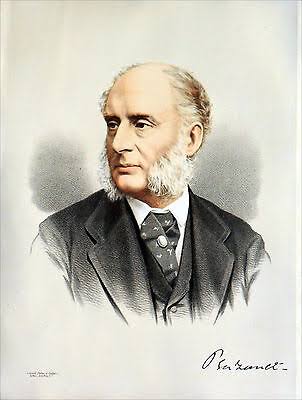
 James Plaisted Wilde, 1st Baron Penzance (July 12, 1816 – December 9, 1899) was a prominent British judge, legal scholar, and amateur horticulturalist.
Queer Places:
Winchester College, College St, Winchester SO23 9NA, United Kingdom
University of Cambridge, 4 Mill Ln, Cambridge CB2 1RZ
Cannibal Club C/O Bertolini’s, 32 St Martin's Ln, Charing Cross, London WC2N 4ER, UK
St. Mary's Churchyard, Shackleford Rd, Norney GU8 6AY, United Kingdom
James Plaisted Wilde, 1st Baron Penzance (July 12, 1816 – December 9, 1899) was a prominent British judge, legal scholar, and amateur horticulturalist.
Born in London on July 12, 1816, to Edward Archer Wilde, a solicitor, he was deeply embedded in a family of high-ranking legal professionals.
After studying at Winchester College and Trinity College, Cambridge, Wilde was called to the Bar in 1839. He rose quickly through the legal ranks, becoming a Queen’s Counsel in 1855 and a Baron of the Exchequer in 1860.
In 1860, he married Lady Mary Pleydell-Bouverie, daughter of William Bouverie, 3rd Earl of Radnor and Judith Anne St. John-Mildmay.
He is best remembered for his tenure as the judge of the Court of Probate and Divorce (1863–1872). His landmark ruling in Hyde v. Hyde (1866) provided the foundational common-law definition of marriage in the British Empire as "the voluntary union for life of one man and one woman, to the exclusion of all others."
He was created 1st Baron Penzance in 1869. After his retirement, he served as Dean of Arches, presiding over contentious trials related to the Ritualist controversy in the Church of England.
Outside of the courtroom, Lord Penzance was a devoted rose breeder, creating numerous hybrids—including the "Lord Penzance" and "Lady Penzance" roses—and naming many others after characters in the novels of Sir Walter Scott. He was also a noted advocate for the Baconian theory, which posits that Francis Bacon, rather than William Shakespeare, authored the works attributed to the Bard.
James Plaisted Wilde was a member of the Cannibal Club. The Cannibal Club was an exclusive, provocative, and somewhat notorious dining club founded in London in the 1860s by the explorer and diplomat Sir Richard Francis Burton and the anthropologist James Hunt.
Despite its macabre name, the club was not a society for the consumption of human flesh. Instead, it was an intellectual circle for men who sought an environment to discuss topics that were considered "unfit" for polite Victorian society. These included anthropology, human origins, non-traditional religious views, and provocative theories on sexuality and ethnicity.
The club’s emblem was a mace carved to resemble a man chewing on a human thigh bone, an aesthetic choice intended to shock the sensibilities of the Victorian establishment and signal their rejection of traditional social taboos.
The club was intentionally small and elite, composed of scientists, writers, and public figures who shared a rebellious intellectual streak. Along with Lord Penzance, notable members included the poet Algernon Charles Swinburne, the freethinker Charles Bradlaugh, and the writer Richard Monckton Milnes.
The inclusion of a high-ranking judge like Lord Penzance in a club known for its "anti-establishment" and fringe intellectual stance highlights the complex social circles of the late 19th-century British elite, where public respectability often contrasted with private engagement in radical or counter-cultural intellectual movements.
Lord Penzance and his wife, Lady Mary Pleydell-Bouverie, resided at Eashing Park, a country estate located in the parish of Godalming, near the village of Shackleford in Surrey. Lord Penzance (who died in 1899) and his wife, Lady Mary (who died in 1900), are buried at St. Mary the Virgin in Shackleford. Their graves can be found in the churchyard, reflecting their long-standing ties to that specific parish during their years of retirement at Eashing Park.
References:
Support this project
This website is a passion project researched, developed, and funded entirely by me. If you find the content valuable and would like to help support the ongoing research and hosting costs, any contribution is deeply appreciated.
Thank you for keeping this independent resource alive!
My books on Amazon: Elisa Rolle's books