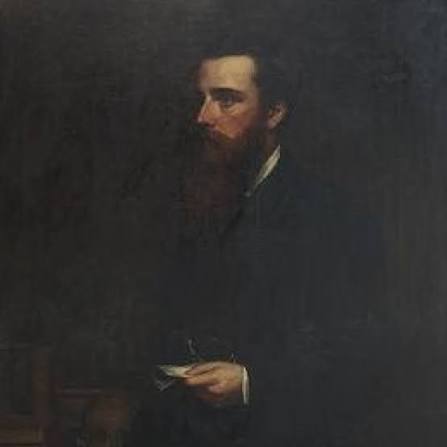
 James Hunt (1833 – August 29, 1869) was a British speech therapist and anthropologist who played a significant role in Victorian scientific circles.
Queer Places:
Cannibal Club C/O Bertolini’s, 32 St Martin's Ln, Charing Cross, London WC2N 4ER, UK
Brompton Cemetery, Fulham Rd., London SW10 9UG, United Kingdom
James Hunt (1833 – August 29, 1869) was a British speech therapist and anthropologist who played a significant role in Victorian scientific circles.
Born in Swanage, Dorset, Hunt followed in the footsteps of his father, Thomas Hunt, to become a specialist in speech and voice disorders. He operated a private practice in London and Sussex, where he utilized physical and physiological techniques—such as respiratory exercises and vocal muscle training—to treat stammering. Among his notable patients were the author Lewis Carroll and Charles Kingsley.
In the academic sphere, Hunt was a prominent, though controversial, figure in anthropology:
In 1863, Hunt co-founded the Anthropological Society of London after breaking away from the Ethnological Society of London. He served as the society’s first president.
Hunt was a staunch advocate of polygenism—the theory that human races have separate biological origins—and his work often defended the institution of slavery. His 1863 paper, The Negro's Place in Nature, drew significant backlash for its arguments regarding racial hierarchy.
His career was marked by academic conflict and administrative challenges, including allegations of financial irregularities within the society in 1867. He died on 29 August 1869 of an inflammation of the brain at the age of 36.
In 1863, James Hunt co-founded the Cannibal Club alongside the explorer Sir Richard Francis Burton. The club served as an exclusive, private dining society that acted as an informal, inner circle for elite members of the Anthropological Society of London.
The club was designed to be a "sanctuary" for provocative, unstructured discussion that was considered too taboo or controversial for formal scientific meetings. Members used the setting to challenge Victorian social, religious, and moral conventions.
The club’s name was deliberately provocative, reflecting an anthropological fascination with the subject. Its meetings featured a ceremonial mace topped with a carving of an African head gnawing on a thighbone. Members also recited the "Cannibal Catechism," an anthem written by member Algernon Charles Swinburne that mocked religious sacraments.
The group served as a venue for venting radical views on topics including sexuality, politics, and culture. While the name suggested a literal interest in cannibalism, there is no evidence that the members practiced it; the name and rituals were primarily performative displays of rebellion against the era's prudish standards.
The club was closely tied to Hunt’s leadership and the environment of the Anthropological Society. Following Hunt’s death in 1869 and Burton’s departure for diplomatic work abroad, the group lost its primary organizational and intellectual force, leading to its eventual dissolution by 1875.
References:
Support this project
This website is a passion project researched, developed, and funded entirely by me. If you find the content valuable and would like to help support the ongoing research and hosting costs, any contribution is deeply appreciated.
Thank you for keeping this independent resource alive!
My books on Amazon: Elisa Rolle's books