Queer Places:
Sidi Boudjemaa cemetery, Aïn Séfra District, Naâma, Algeria
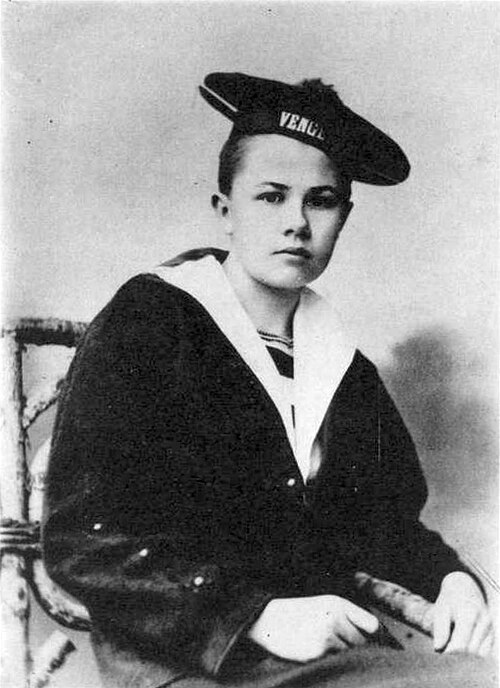 Isabelle Wilhelmine Marie Eberhardt (February 17, 1877 – October 21, 1904) was a Swiss explorer, author, and journalist whose short life was defined by
nonconformity, nomadic wanderlust, and an intense engagement with North African culture and Islamic mysticism.
Isabelle Wilhelmine Marie Eberhardt (February 17, 1877 – October 21, 1904) was a Swiss explorer, author, and journalist whose short life was defined by
nonconformity, nomadic wanderlust, and an intense engagement with North African culture and Islamic mysticism.
Born in Geneva, Switzerland, she was registered as the illegitimate daughter of Nathalie Moerder (née Eberhardt), an aristocrat of Baltic-German and
Russian-Jewish descent who had fled Russia with her children and their tutor, Alexandre Trophimowsky. Trophimowsky, a former Orthodox priest turned
nihilist, anarchist, and scholar, home-schooled Eberhardt in an environment of rigorous intellectualism. She became fluent in French, Russian, German,
and Italian, while also mastering Latin, Greek, and classical Arabic. From an early age, Trophimowsky encouraged her to reject conventional social
restrictions, including gender norms, and she frequently dressed in male attire to experience greater freedom.
Eberhardt began her literary career as a teenager, publishing short stories in French journals under male pseudonyms such as Nicolas Podolinsky.
Through extensive correspondence with European officers and scholars stationed in North Africa, she developed a deep fascinations with the region,
demonstrating remarkable cultural insight long before setting foot in the desert. In May 1897, she moved to Bône, Algeria, alongside her mother, escaping
the confines of European society. After her mother’s sudden death later that year and her father’s death in 1899, Eberhardt fully embraced a nomadic
existence in North Africa. Adopting the identity and name of Si Mahmoud Saadi, she dressed exclusively as an Arab man, converted to Islam, and traveled
widely across the Sahara. She was initiated into the Qadiriyya Sufi order, a rare distinction for a European or a woman, which fueled suspicions among
French colonial authorities that she was an agitator or spy.
Her life in North Africa was marked by intense experiences, including surviving a sabre assassination attempt in Behima in 1901. Following a brief
expulsion by French administrators, she returned to Algeria after marrying Slimane Ehnni, an Algerian spahi soldier, which granted her French
nationality. In her final years, she worked as a war correspondent and journalist for Victor Barrucand's publication Al-Akhbar, reporting on tribal
customs and border conflicts, and collaborating with French General Hubert Lyautey as a diplomatic liaison. On October 21, 1904, at the age of 27,
Eberhardt died tragically in Aïn Séfra, Algeria, when a sudden flash flood collapsed the mud dwelling where she was staying. She was buried in the Sidi
Boudjemaa cemetery in Aïn Séfra under both her birth name and her adopted Arabic name. Posthumously, her journals and stories were published to
widespread acclaim, securing her legacy as a pioneering writer, early anti-colonial voice, and symbol of personal liberation.
Isabelle Eberhardt's life, writings, and personal identity occupy a significant place in queer history, gender studies, and LGBTQ+ literary
scholarship. Although she primarily identified as heterosexual in her romantic pairings—having numerous male lovers and marrying Slimane Ehnni—her life
constantly crossed, challenged, and dismantled rigid binary understandings of gender performance and sexual norms.
From childhood, Eberhardt adopted male clothing and masculine mannerisms, initially for the physical autonomy it granted her in a restrictive society,
but eventually as a core component of her personal identity. As Si Mahmoud Saadi, she did not merely "cross-dress" as a costume; she lived, wrote, spoke,
and moved through the world as a man among Arab men. Scholars and queer theorists often analyze her adoption of a male persona through the lens of modern
transgender, non-binary, or gender-fluid experiences. She famously remarked that it was "impossible for me to do otherwise" when questioned about her
male identity, suggesting that her gender presentation was an internal necessity rather than an occasional disguise.
Eberhardt rejected Victorian and colonial heteronormative standards of femininity, marriage, and domesticity. She engaged in a lifestyle that
integrated heavy drinking, smoking kief, and practicing free love, refusing to conform to the respectable gender roles expected of European women in
colonial Algeria. Her fluidity extended to her social integration, where she moved effortlessly between male-dominated Sufi gatherings, military
outposts, and local communities, creating a life that defied every conventional category of her era.
Posthumously, Eberhardt has been claimed as an icon within LGBTQ+ and feminist movements for her radical refusal to be categorized by gender,
nationality, or societal expectations. Her literary works and diaries continue to be studied for their rich explorations of identity, marginality, and
the fluid boundaries between self and other, making her a vital historical figure in the genealogy of gender nonconformity.
References:
Other references:
- Annette Kobak – Isabelle: The Life of Isabelle Eberhardt (1988)
- Cecily Mackworth – The Destiny of Isabelle Eberhardt (1954 / 1977)
- Hédi A. Jaouad – The Immortal Journeys of Isabelle Eberhardt (2026)
- Marie-Odile Delacour and Jean-René Huleu – Sables: Le Roman d'Isabelle Eberhardt (1986) / Un désir d'Orient: Jeunesse d'Isabelle Eberhardt (1988)
- Françoise d'Eaubonne – Crown of Thorns: The Life of Isabelle Eberhardt (Furia: Isabelle Eberhardt) (1967)
- Isabelle Eberhardt (edited/reconstructed by Victor Barrucand) – Dans l'ombre chaude de l'Islam (In the Warm Shadow of Islam) (1906)
- Isabelle Eberhardt – Notes de route: Maroc-Algérie-Tunisie (1908)
- Isabelle Eberhardt – Au Pays des sables (1914)
- Isabelle Eberhardt – Mes journaliers (The Diaries of Isabelle Eberhardt) (1923)
- Isabelle Eberhardt (translated by Paul Bowles) – The Oblivion Seekers and Other Writings (1975)
- Isabelle Eberhardt (edited by Marie-Odile Delacour and Jean-René Huleu) – Ecrits sur le sable (1988) / Ecrits intimes (1991) / Œuvres complètes (1988–1990)
- Lesley Blanch – The Wilder Shores of Love (1954 / 2010)
- Hedi Abdel-Jaouad – "Isabelle Eberhardt: Portrait of the Artist as a Young Nomad", Yale French Studies, No. 83 (1993)
- R. V. C. Bodley – The Sounding Sahara (1968)
- Mark Sedgwick – Against the Modern World: Traditionalism and the Secret Intellectual History of the Twentieth Century (2004 / 2009)
- Julia Clancy-Smith – Rebel and Saint: Muslim Notables, Populist Religion, Colonial Encounters (Algeria and Tunisia, 1800–1904) (1994)
- Susan Stryker – Queer Studies / Gender and Sexuality Historiography References (2013)
Support this project
This website is a passion project researched, developed, and funded entirely by me. If you find the content valuable and would like to help support the ongoing research and hosting costs, any contribution is deeply appreciated.
Thank you for keeping this independent resource alive!
My books on Amazon: Elisa Rolle's books
BACK TO HOME PAGE
