Queer Places:
Tip Top, Via Federico Serena, 80076 Capri NA
22 Motcomb St, London SW1X 8LB, UK
 Hugo Erskine-Wemyss (May 31, 1861 - March 12, 1933) was born on May 31, 1861, in St George Hanover Square, London, Middlesex, into a prominent and well-connected British
aristocratic family. He was the fourth child and second son of James Hay Erskine-Wemyss (1829–1864), a Member of Parliament and landowner, and Millicent Anne Mary
Kennedy-Erskine (1831–1895). Through his mother, he possessed notable royal lineage, as she was the daughter of the Hon. John Kennedy-Erskine and Lady Augusta FitzClarence,
an illegitimate daughter of King William IV and his mistress Dorothea Jordan (Dora Bland). Hugo grew up alongside four siblings: Mary Frances, Dora Mina, Randolph Gordon
(who inherited the family estates), and Rosslyn, who would rise to become an Admiral of the Fleet and the 1st Baron Wester Wemyss.
Hugo Erskine-Wemyss (May 31, 1861 - March 12, 1933) was born on May 31, 1861, in St George Hanover Square, London, Middlesex, into a prominent and well-connected British
aristocratic family. He was the fourth child and second son of James Hay Erskine-Wemyss (1829–1864), a Member of Parliament and landowner, and Millicent Anne Mary
Kennedy-Erskine (1831–1895). Through his mother, he possessed notable royal lineage, as she was the daughter of the Hon. John Kennedy-Erskine and Lady Augusta FitzClarence,
an illegitimate daughter of King William IV and his mistress Dorothea Jordan (Dora Bland). Hugo grew up alongside four siblings: Mary Frances, Dora Mina, Randolph Gordon
(who inherited the family estates), and Rosslyn, who would rise to become an Admiral of the Fleet and the 1st Baron Wester Wemyss.
Tragedy struck the family early when his father died in March 1864, leaving his mother to raise the children. Census and historical records trace Hugo's upbringing and
early adult life residing across fashionable areas of London, including Kensington and Chelsea. As recorded in Debrett's and official registers, he entered professional life
as an Honorary Attaché in the Diplomatic Service and later served in administrative capacities, including as Comptroller of the household of the Grand Duchess of Mecklenburg
in Britain.
However, against the backdrop of Victorian and Edwardian societal strictures regarding sexuality, Hugo's personal life took a distinct trajectory. As a homosexual man
belonging to the British upper class, he eventually became a classic example of a "remittance-man"—sent away by his aristocratic family to live abroad on a regular allowance
with the tacit understanding that he would not return to British polite society. He settled on the island of Capri, Italy, which at the time served as a famous, relatively
permissive haven for expatriate artists, writers, and exiled European homosexuals.
On Capri, Hugo lived a colorful and eccentric life that became part of local lore. He resided in a villa on Tragara, where he occasionally entertained, and maintained a
modest secondary cottage along the path leading up to Tiberio, which served as a private space to meet companions. He cultivated a striking and deliberately unkempt personal
aesthetic, frequently seen commuting between his properties carrying a basket of garden tools over one arm and a tropical umbrella hooked over the other, set off by his
silver hair, a red-spotted tie, sky-blue trousers, white shirt or tussore suit, and sandals.
Well-integrated into Capri's expatriate network, he frequented local social institutions such as the famous all-night Bierstube The Tip-Top, opened in 1920 by Michele
Pagano, where he socialized alongside other notable British literary figures and homosexual expatriates like
Compton Mackenzie. Despite these circles, Hugo generally kept to himself, making few permanent local friends and relying
instead on visiting acquaintances and passing travelers.
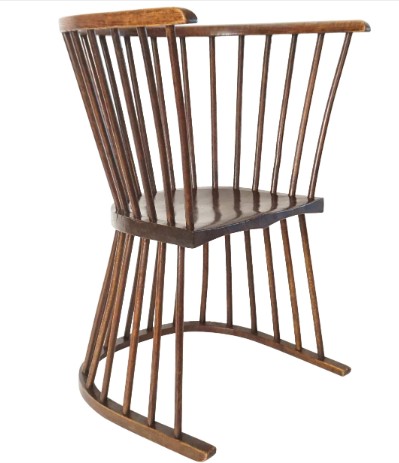
Beyond his life as an expatriate and diplomat, Hugo Erskine-Wemyss also engaged in the antique trade, a facet of his career evidenced by a notable piece of furniture
attributed to him. Among the few known design works linked to his name is an English Arts & Crafts modified Windsor-style chair, circa 1906. Crafted from Circassian walnut,
this distinctive piece features a double-reversible "horse-shoe" form, with bent U-shape crest rails spindle-joined to a carved-shaped reversible plank seat. The chair
provides a specific insight into his professional life in London; it is stamped on the back edge of the seat with the British Registry number "Rd 483013." This registration,
dated July 14, 1906, identifies Hugo Erskine-Wemyss as trading under the name "Aitchem" from 22 Motcomb Street, Belgravia, London, where he operated as a dealer in
antiquities. While some historical records suggest his firm, Aitchem, was active from 1910 to 1930, the registration of this chair indicates that his involvement in the
trade began significantly earlier. Given that no other design patents or registry numbers linked to him are currently known, this chair is considered a potentially singular
example of his work in this field.
Hugo Erskine-Wemyss remained abroad for the remainder of his later years, passing away on March 12, 1933, at the age of 71 in Grasse, France. His estate was subsequently
settled through probate in London on September 4, 1933, closing the chapter on an eccentric aristocratic life shaped by the rigid social exiles of his era.
References:
Other references:
- Birth Registration: Civil Registration Birth Index for Hugo Erskine-Wemyss, registered in the second quarter of 1861 (St. George Hanover Square, London, Middlesex, Vol. 1a, p. 256).
- Death Registration: Civil registration records for his death on March 12, 1933, in Grasse, France.
- Probate Record: National Probate Calendar (England and Wales), detailing the probate of his estate granted in London on September 4, 1933.
- 1871 England Census: Household record listing Hugo Erskine-Wemyss (age 9) as a son residing in Kensington, London.
- 1881 England Census: Household record listing Hugo Erskine-Wemyss (age 19) as a son residing in Chelsea, London.
- 1891 England Census: Household record listing Hugo Erskine-Wemyss (age 29) residing in Chelsea, London.
- 1911 England Census: Census return dated April 2, 1911, listing Hugo Erskine-Wemyss (age 49) as head of household in St. George, Hanover Square, London.
- Debrett's Peerage, Baronetage, Knightage, and Companionage: Contemporary listings documenting his family lineage and his status as an Honorary Attaché in the Diplomatic Service.
- Burke's Peerage, Baronetage & Knightage: Historical records for the family of the Earls of Wemyss (Clan Wemyss), detailing the lineage of James Hay Erskine-Wemyss and Millicent Anne Mary Kennedy-Erskine.
- The Peerage (Lundy genealogical database): Compiled records for Hugo Erskine-Wemyss (Person #10928), citing vital dates, parental lineage, and his status as unmarried.
- Local historical archives and memoirs documenting early 20th-century expatriate life on Capri, noting his residence on Tragara, his cottage near Tiberio, and his association with figures like Compton Mackenzie.
- Documentation concerning The Tip-Top Bierstube in Capri, established in 1920 by Michele (Mimì) Pagano, capturing Hugo's presence among its clientele of English expatriates and homosexual figures.
Support this project
This website is a passion project researched, developed, and funded entirely by me. If you find the content valuable and would like to help support the ongoing research and hosting costs, any contribution is deeply appreciated.
Thank you for keeping this independent resource alive!
My books on Amazon: Elisa Rolle's books
BACK TO HOME PAGE
