Queer Places:
627 St Georges Rd, Philadelphia, PA 19119
Laurel Hill East Cemetery, 3822 Ridge Ave, Philadelphia, PA 19132, United States
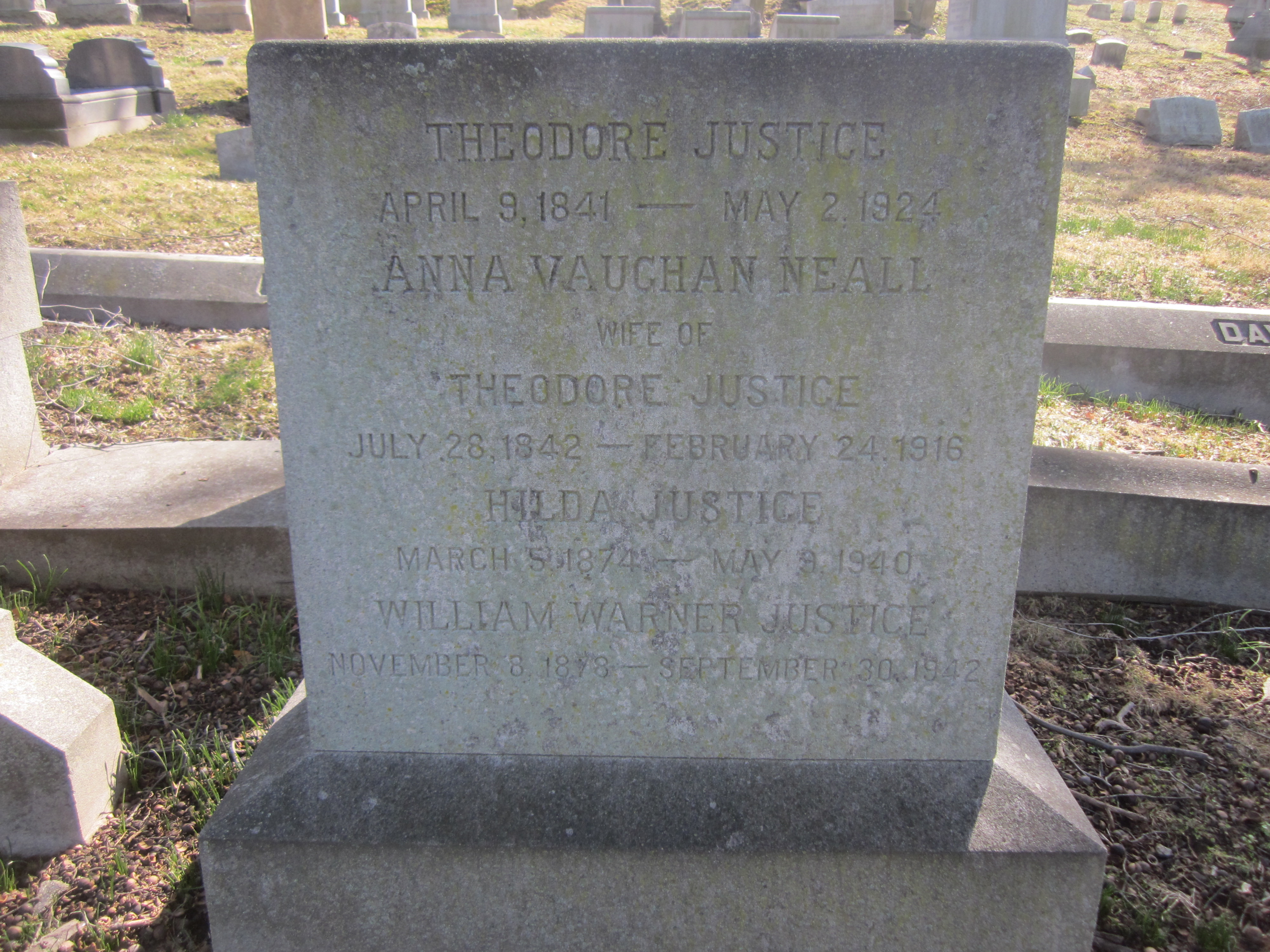 Hilda Justice (March 5, 1874 - May 5, 1940) was born on March 5, 1874, into a prominent and historic Philadelphia family. She was the daughter of
Theodore Justice, a successful wool merchant born in 1841, and Anna Vaughan Neall Justice, born in 1842. Through her mother, Hilda was descended from
deep Quaker roots, including the noted abolitionist and reformer Warner Mifflin. Growing up in a household of substantial wealth alongside her brother,
William Warner Justice, she spent her early years immersed in the refined social and intellectual circles of Philadelphia.
Hilda Justice (March 5, 1874 - May 5, 1940) was born on March 5, 1874, into a prominent and historic Philadelphia family. She was the daughter of
Theodore Justice, a successful wool merchant born in 1841, and Anna Vaughan Neall Justice, born in 1842. Through her mother, Hilda was descended from
deep Quaker roots, including the noted abolitionist and reformer Warner Mifflin. Growing up in a household of substantial wealth alongside her brother,
William Warner Justice, she spent her early years immersed in the refined social and intellectual circles of Philadelphia.
Demonstrating a early dedication to her family’s legacy, Hilda pursued historical research and writing as a young woman. In 1905, she compiled and
published Life and Ancestry of Warner Mifflin: Friend - Philanthropist - Abolitionist, a comprehensive biographical work that documented the life of her
notable Quaker ancestor and secured her place as a published historian.
As she matured, Hilda turned her interests toward agriculture, gardening, and environmental design. She became an early student at the
Pennsylvania School of Horticulture for Women in Ambler, Pennsylvania—an institution founded in 1911 that was pioneering for its time, providing women
with rigorous education in horticulture, land management, and landscape architecture. Hilda remained a dedicated supporter of the school throughout her
adult life, contributing to its mission of expanding professional pathways for women in agricultural science.
In the 1920s, Hilda established a permanent home in the West Mount Airy neighborhood of Philadelphia. She acquired a parcel of land carved directly
from Cogslea, the famous estate and artistic commune managed by the artist Violet Oakley and her circle. The
land became available while Oakley and her life partner, Edith Emerson, were traveling extensively abroad
following the completion of Oakley’s major mural commissions for the Pennsylvania State Capitol. Hilda commissioned the acclaimed Philadelphia architect
Robert Rodes McGoodwin to design a home for her on the site.
The resulting residence, located at 627 St. Georges Road, became a key site within Philadelphia's queer and women's history. As an unmarried heiress
who possessed complete financial independence, Hilda lived at the St. Georges Road property for the remainder of her life. She shared her home over a
long period of years with a female companion and tenant, reflecting the independent living arrangements and romantic friendships typical among affluent
single women of the Arts and Crafts era near Cogslea.
Hilda Justice passed away on May 5, 1940, at the age of sixty-six, and was laid to rest in the family plot at Laurel Hill East Cemetery in
Philadelphia. Following her death, her legacy was honored by the Pennsylvania School of Horticulture for Women. In 1951, the institution constructed the
Hilda Justice Memorial Library in recognition of her contributions to the school and its community. Today, as part of the Temple University Ambler
Campus, the structure is known as the Hilda Justice Building and houses the Hilda Justice Artifacts Collection, preserving the century-long history of
pioneering women in horticulture, land stewardship, and landscape design.
References:
- Life and Ancestry of Warner Mifflin: Friend - Philanthropist - Abolitionist, compiled and written by Hilda Justice (published in 1905).
- Temple University Ambler Campus Archives (Ambler Arboretum): Records detailing the history of the Pennsylvania School of Horticulture for Women (PSHW), her role as an early student, and the construction of the Hilda Justice Memorial Library in 1951 (now the Hilda Justice Building housing the Hilda Justice Artifacts Collection).
- Family Ancestry & Vital Statistics: Genealogical records tracing the family tree of Daniel Neall, Sarah Mifflin, Anna Vaughan Neall, Theodore Justice, and their children (Hilda Justice and William Warner Justice).
- Laurel Hill East Cemetery: Burial records and headstone memorial entries for Hilda Justice (March 5, 1874 – May 5, 1940) and her immediate family members in Philadelphia, Pennsylvania.
- Property & Architectural Documentation: Historical and architectural records for 627 St. Georges Road, West Mount Airy, Philadelphia, PA 19119, documenting its design by architect Robert Rodes McGoodwin during the 1920s on parcel land originally associated with the Cogslea estate of Violet Oakley and Edith Emerson.
Support this project
This website is a passion project researched, developed, and funded entirely by me. If you find the content valuable and would like to help support the ongoing research and hosting costs, any contribution is deeply appreciated.
Thank you for keeping this independent resource alive!
My books on Amazon: Elisa Rolle's books
BACK TO HOME PAGE