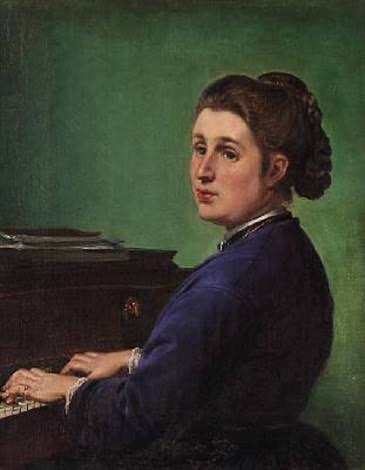
 Helena Augusta Nyblom (née Roed, December 7, 1843 - October 9, 1926) was a prominent Danish-Swedish author, cultural critic, poet, and pianist best remembered today for her
lyrical poetry and progressive literary fairy tales.
Helena Augusta Nyblom (née Roed, December 7, 1843 - October 9, 1926) was a prominent Danish-Swedish author, cultural critic, poet, and pianist best remembered today for her
lyrical poetry and progressive literary fairy tales.Queer Places:
Östra Ågatan 65, 753 22 Uppsala, Sweden
Uppsala gamla kyrkogård, Villavägen 1, 751 08 Uppsala, Sweden
Helena Augusta Nyblom (née Roed, December 7, 1843 - October 9, 1926) was a prominent Danish-Swedish author, cultural critic, poet, and pianist best remembered today for her
lyrical poetry and progressive literary fairy tales.
Born in Copenhagen to Jørgen Roed, a celebrated painter and art professor, Helena grew up in an intellectually vibrant household that served as a salon for Denmark's elite artists and musicians. She studied illustration and piano, developing a sharp artistic sensibility.
In 1864, she married Swedish literary scholar Carl Rupert Nyblom and moved to Sweden. When he became a professor at Uppsala University, their home became a famous cultural hub for Scandinavian writers, artists, and composers (including Prince Eugen and Wilhelm Peterson-Berger).
During her years as a married woman in Uppsala her home address was Östra Ågatan 65. The house itself is historically known as Vershuset ("The Verse House"), a name it earned because it served as the vibrant, poetry-filled cultural salon. The building still sits right along the eastern bank of the Fyris River (Fyrisån) in central Uppsala.
Facing chronic financial struggles while raising six children, Nyblom began writing professionally. She published novels and poetry, but achieved massive popular success in the late 1890s with her fairy tales (Det var en gång). Illustrated by artists like John Bauer, her tales were notable for breaking traditional passive stereotypes by featuring strong, independent female protagonists.
In 1895, she caused a public stir by converting to Roman Catholicism. After her husband's retirement, she moved to Stockholm, where she continued writing until her death in 1926.
In the study of historic LGBTQ+ relationships and queer networks in late 19th-century Sweden, Helena Nyblom is frequently examined through her intense, emotionally charged romantic friendships (vänskapsband) with other women, most notably Anna Hamilton-Geete.
Anna Hamilton-Geete was an accomplished translator (who introduced authors like Mark Twain to Swedish readers) and the maternal aunt of the famously queer modernist writer Agnes von Krusenstjerna.
Helena and Anna shared a passionate, lifelong bond that is deeply documented in their letters, later compiled by Helena’s son Holger in the 1950 book Två väninnor (Two Female Friends).
In the 19th century, "romantic friendships" between women allowed for intense declarations of love, emotional codependency, and devotion that mirrored romantic partnerships, even while both women were married to men. Helena described Anna as extraordinarily gifted and witty, though the relationship suffered periods of strain due to the jealousy and mistrust of Anna's mother, Agnes Geijer-Hamilton.
When Anna married a provincial doctor in 1876 and moved away from the Uppsala cultural circle, she famously referred to it as her "spiritual exile". Her correspondence with Helena remained an emotional lifeline where they could bypass traditional marital boundaries and share deep artistic and personal intimacy.
While Helena Nyblom lived a conventional heterosexual life on the surface (bearing six children), her network was foundational to early Swedish queer literature.
Through her intense relationship with Anna Hamilton-Geete, Nyblom became a massive influence on Anna’s niece, Agnes von Krusenstjerna. Krusenstjerna grew up witnessing the rich, emotionally complex internal worlds of these older women. She would later break societal taboos in the 1930s by explicitly writing about lesbian relationships, female sexuality, and psychological breakdowns in her landmark Tony trilogy—a lineage of queer expression that historians trace directly back to the intimate circle of Helena and Anna.
Helena Nyblom is buried at the Uppsala Old Cemetery (Uppsala gamla kyrkogård) in Uppsala, Sweden. She shares the family grave plot with her husband, Carl Rupert Nyblom.
References:
Support this project
This website is a passion project researched, developed, and funded entirely by me. If you find the content valuable and would like to help support the ongoing research and hosting costs, any contribution is deeply appreciated.
Thank you for keeping this independent resource alive!
My books on Amazon: Elisa Rolle's books