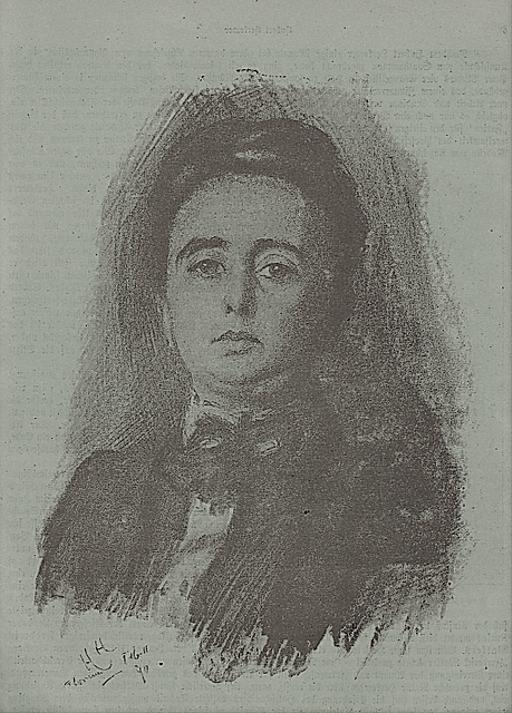
 Helen Zimmern (March 25, 1846 - January 11, 1934) was born in Hamburg, Germany, on March 25, 1846, into a cultured Jewish family. Following the political upheavals of 1848,
her family emigrated to Great Britain in 1850 for religious and political reasons, eventually settling in London where Helen grew up immersed in English cultural life. She
received her education through private tutors and a finishing school in Bayswater, mastering multiple languages and laying the groundwork for a prolific literary career.
Upon reaching adulthood, she officially took out British naturalization.
Helen Zimmern (March 25, 1846 - January 11, 1934) was born in Hamburg, Germany, on March 25, 1846, into a cultured Jewish family. Following the political upheavals of 1848,
her family emigrated to Great Britain in 1850 for religious and political reasons, eventually settling in London where Helen grew up immersed in English cultural life. She
received her education through private tutors and a finishing school in Bayswater, mastering multiple languages and laying the groundwork for a prolific literary career.
Upon reaching adulthood, she officially took out British naturalization.
Zimmern established herself as a formidable writer and critic during the late Victorian era, contributing critical essays and reviews to prominent periodicals such as The
Examiner, The Athenaeum, Blackwood's Magazine, and Fraser's Magazine. Her early work heavily focused on introducing German philosophy and literature to the British public,
highlighted by her comprehensive biographies of Arthur Schopenhauer in 1876 and Gotthold Ephraim Lessing in 1878. Her biography of Schopenhauer brought her wider European
recognition, leading to invitations that placed her in direct contact with major continental intellectuals, including a fateful meeting with the philosopher
Friedrich Nietzsche in Sils Maria, Switzerland, in 1886. Impressed by her intellect and linguistic fluency, Nietzsche
personally selected Zimmern to be the very first translator of Beyond Good and Evil into English, cementing her reputation as an elite cultural bridge between nations.
In the late 1880s, Zimmern relocated permanently to Florence, Italy, where she transitioned into a vibrant hub of Anglo-Italian cultural exchange. Operating from Italy,
she served as a foreign correspondent for publications like the Corriere della Sera, edited the English-language weekly Florence Gazette, and authored several influential
books detailing Italian art, politics, and society for English-speaking readers, including The Italy of the Italians and The New Italy. Her Florentine residence placed her
at the center of a dense expatriate and intellectual network, linking her directly to prominent literary figures of the era.
Within this sophisticated expatriate circles of late-nineteenth and early-twentieth-century Italy, Zimmern formed close personal and professional connections with
pioneering queer intellectuals, most notably the Anglo-American author Vernon Lee (the pen name of Violet Paget). Vernon Lee was a
central figure in European aestheticism and lived openly within a long-term lesbian relationship with
Kit Anstruther-Thomson, presiding over a prominent literary salon in Florence. Zimmern moved within these same
progressive intellectual circles that redefined female independence, artistic criticism, and alternative social networks outside the rigid bounds of Victorian domesticity.
Remaining unmarried throughout her life, Zimmern embodied the archetype of the independent, transnational professional woman. She spent her final decades in Italy, shifting
her political focus during World War I to fiercely defend Italian democratic values against German expansionism, before passing away in Florence on January 11, 1934, leaving
behind a legacy as a master translator and cultural mediator.
References:
- C. A. Creffield, "Zimmern, Helen (1846–1934)", Oxford Dictionary of National Biography (Oxford University Press, 2004)
- Caterina Del Vivo, "Helen Zimmern: Corriere di Londra, 1884–1910" (Milan: Fondazione Corriere della Sera, 2014)
- Isidore Singer and Joseph Jacobs, "Zimmern, Helen", Jewish Encyclopedia (1906)
- Frances Hays, "Zimmern, Helen", Women of the Day: A Biographical Dictionary of Notable Contemporaries (London: Chatto and Windus, 1885)
- George Washington Moon, "Men and Women of the Time: A Dictionary of Contemporaries", 13th rev. ed. (London: G. Routledge, 1891)
- Hilary Fraser, "Women and the Modelling of Victorian Sculptural Discourse", Visual Resources: An International Journal of Documentation 33, no. 1/2 (2017): 74–93
Support this project
This website is a passion project researched, developed, and funded entirely by me. If you find the content valuable and would like to help support the ongoing research and hosting costs, any contribution is deeply appreciated.
Thank you for keeping this independent resource alive!
My books on Amazon: Elisa Rolle's books
BACK TO HOME PAGE