Queer Places:
Dean Cemetery,
Edinburgh, City of Edinburgh, Scotland
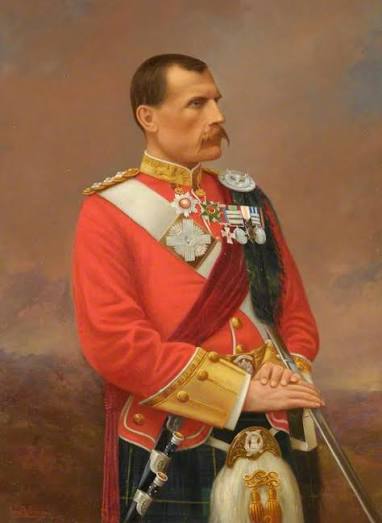 Major-General Sir Hector Archibald Macdonald (March 4, 1853 – March 25, 1903)—widely known as "Fighting Mac"—was a celebrated Victorian-era British military hero. His life
story is a rare example of a nineteenth-century soldier rising from the very bottom of the social ladder to high military command purely through exceptional merit.
Major-General Sir Hector Archibald Macdonald (March 4, 1853 – March 25, 1903)—widely known as "Fighting Mac"—was a celebrated Victorian-era British military hero. His life
story is a rare example of a nineteenth-century soldier rising from the very bottom of the social ladder to high military command purely through exceptional merit.
Macdonald was born on March 4, 1853, in Rootfield on the Black Isle of Ross-shire, Scotland, the son of a crofter and stonemason. He left school early to work as a
draper's apprentice.
In 1870, he joined the local rifle volunteers before enlisting as a private soldier in the 92nd Gordon Highlanders in 1871.
Macdonald quickly distinguished himself through raw courage and tactical brilliance. During the Second Afghan War (1878–1880), his exceptional leadership under fire
earned him a choice between a Victoria Cross or an officer's commission; he chose the commission, shattering rigid class barriers of the British Army. He fought bravely at
Majuba Hill during the First Boer War (1881), where he was captured and later had his sword returned by the Boers in recognition of his gallantry.
His defining moment came under Lord Kitchener during the reconquest of the Sudan. At the Battle of Omdurman (1898), Macdonald expertly maneuvered his Egyptian brigade
under intense pressure, saving the British forces from a surprise flank attack and cementing his status as a national imperial hero.
During the South African War (1899–1902) he commanded the Highland Brigade and was eventually knighted (KCB), rising to the rank of Major-General.
In May 1902, Macdonald was appointed General Commanding the troops in Ceylon (modern-day Sri Lanka). Less than a year later, his career met a tragic and dramatic end
linked to sexuality, power, and imperial governance.
Rumors and formal complaints surfaced accusing Macdonald of engaging in sexual offenses. While historical summaries often broadly frame the controversy as a charge of
"homosexual practices" or a scandal involving "young boys", archival investigation into the primary complaints reveals that local youths and teenagers—including the sons of
prominent local families and British-Ceylonese residents—disclosed sexual relationships and abuse by the General.
The Governor of Ceylon, Sir West Ridgeway, was informed of the mounting allegations. Rather than quietly managing or burying the crisis locally, the matter was escalated
back to the War Office in London. Under immense pressure, the War Office ordered Macdonald to return home to face a formal court of inquiry.
While traveling back to London via Paris to face the investigation, Macdonald checked into the Hotel Regina. On March 25, 1903, before the inquiry could convene, he shot
himself. He was 50 years old.
Macdonald's suicide sent shockwaves through Great Britain and Scotland, where he was heavily idolized. Unwilling to accept the nature of the scandal, many contemporaries
and modern-day Scottish nationalists propagated conspiracy theories, arguing that "Fighting Mac" was the victim of a malicious upper-class English establishment frame-up,
motivated by class snobbery against a self-made Highlander.
Modern historical analysis of the primary records indicates that while imperial authorities were heavily preoccupied with maintaining secrecy and protecting the prestige
of the British military machinery, the underlying crisis stemmed directly from credible disclosures made by teenage boys regarding sexual abuse, making his case a notable
intersection of Victorian military celebrity, imperial power dynamics, and the policing of male sexuality.
References:
Other references:
- https://www.gtv.blue/hector-archibald-macdonald/
- Dictionary of National Biography (DNB) – 1912 Supplement: Contains the formal post-death biographical entry detailing his military service, rise through the ranks, and achievements.
- Encyclopædia Britannica: Provides standardized historical summaries regarding his Victorian-era military commands and the circumstances of his death in Paris.
- Coates, T.F.G. (1900): Sir Hector Macdonald: The Story of a Scots Hero
- Campbell, David (1904): Major General Hector A. Macdonald, C.B., D.S.O., A.D.C.: A Biographical Sketch
- Pratt, Michael (Melville): Modern historical analyses and regional Scottish histories discussing the social impact of his rise and subsequent downfall in the Highlands.
- The London Gazette: Official military dispatches documenting his promotions, mentions in despatches, and decorations (including the Distinguished Service Order and Companion of the Order of the Bath).
- The Times (London): Contemporary newspaper archives from March and June 1903 covering the Ceylon command controversy, the War Office inquiry, his suicide at the Hôtel Régina, and the subsequent government commission reports.
- British Army Service Records: Archived personnel files held at The National Archives (Kew, London), detailing his enlistment in the 92nd Gordon Highlanders and subsequent commission.
Support this project
This website is a passion project researched, developed, and funded entirely by me. If you find the content valuable and would like to help support the ongoing research and hosting costs, any contribution is deeply appreciated.
Thank you for keeping this independent resource alive!
My books on Amazon: Elisa Rolle's books
BACK TO HOME PAGE