Partner Emily Gilmore Alden
Queer Places:
Mount Holyoke College (Seven Sisters), 50 College St, South Hadley, MA 01075
The Evergreens (former Monticello Female College), 5800 Godfrey Rd, Godfrey, IL 62035
Village Cemetery, 1023 Main St, Waldoboro, ME 04572, United States
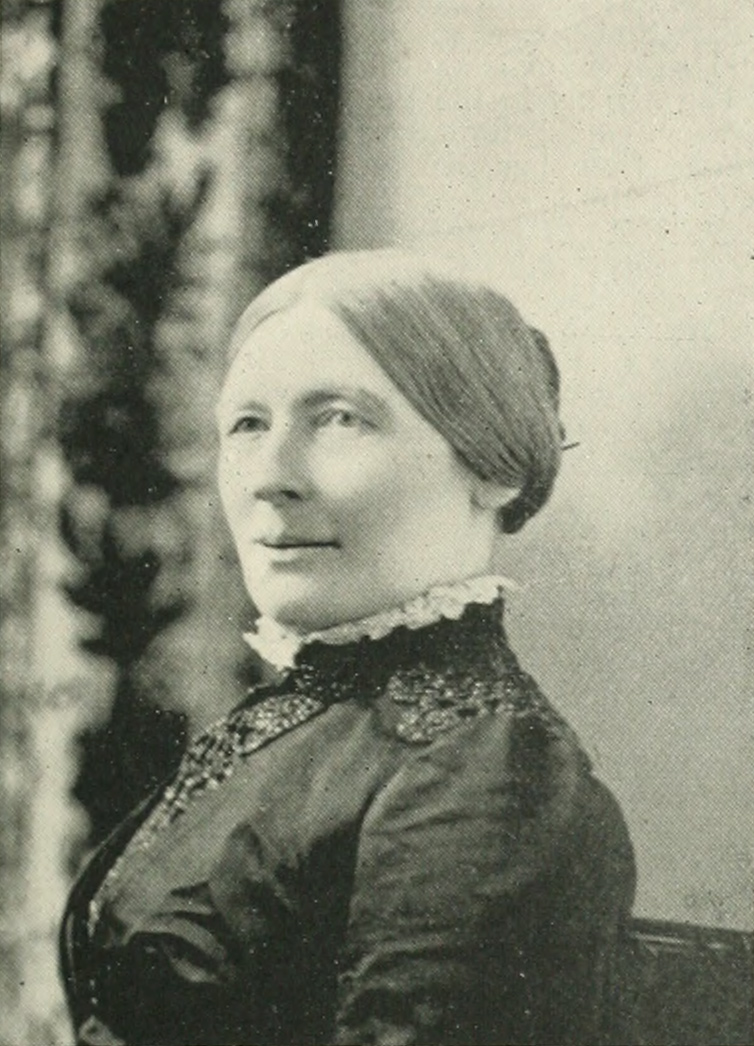 Harriet Newell Haskell (January 14, 1835 – May 6, 1907) was an influential American educator and long-time administrator, best known for her nearly 40-year tenure as the
principal of the Monticello Seminary in Godfrey, Illinois. Harriet Newell Haskell and Emily Gilmore Alden were life-long
companions, educators, and professional partners whose lives were deeply intertwined for over half a century.
Harriet Newell Haskell (January 14, 1835 – May 6, 1907) was an influential American educator and long-time administrator, best known for her nearly 40-year tenure as the
principal of the Monticello Seminary in Godfrey, Illinois. Harriet Newell Haskell and Emily Gilmore Alden were life-long
companions, educators, and professional partners whose lives were deeply intertwined for over half a century.
Born in Waldoboro, Maine, to Bela B. Haskell, a banker and shipbuilder, and his wife, Harriet was raised in a prominent family. She completed her early education in
Maine before attending the Castleton Collegiate Seminary in Vermont. She subsequently enrolled at Mount Holyoke Seminary (now Mount Holyoke College) in Massachusetts,
graduating with honors in 1855. In 1905, she returned to Mount Holyoke for her 50th class reunion, where she was awarded an honorary Doctor of Letters degree. Harriet Newell
Haskell and Emily Gilmore Alden met while attending Mount Holyoke Seminary in the 1850s. They formed a bond that persisted until the end of their lives.
Haskell began her teaching career in Boston at the Franklin School and later served as principal of the high school in her hometown of Waldoboro. She returned to the
Castleton Collegiate Seminary as a teacher and principal between 1860 and 1868.
In 1868, she accepted the position of principal at the Monticello Seminary in Godfrey, Illinois. She would remain in this role for the rest of her life. Haskell and
Alden's professional lives were inseparable. When Haskell became the principal of the Monticello Seminary, Alden joined the faculty as her assistant. For the next 40 years,
Alden remained a central figure at the seminary, serving as a teacher and the school's unofficial "poet laureate," composing annual commencement poems. Under Haskell's
leadership, the institution gained a reputation for academic rigor and strong administration. Notable highlights of her tenure included:
Following the total destruction of the seminary by fire in 1888, Haskell was instrumental in the school's immediate recovery. She organized temporary facilities and
successfully led the fundraising and construction efforts to open a new, modern building by 1890.
Haskell was a proponent of academic standards for women and advocated for the inclusion of sports in their curriculum.
She was known for her firm administrative style and dedication to the school’s high moral and intellectual standards. Beyond their professional roles, Haskell and Alden
shared a home, "The Evergreens", and finances for more than 50 years. Historians and scholars of LGBTQ+ history frequently identify them as a significant example of a
committed same-sex partnership between women in the 19th and early 20th centuries. Their private home, "The Evergreens," which Haskell purchased while at the seminary,
was bequeathed to the college upon her death.
Haskell died at the seminary on May 6, 1907, and was buried in her home state of Maine. Her impact on the institution was so profound that alumnae commissioned the
Harriet Newell Haskell Memorial Gate, designed by architect Theodore Link, to be erected at the campus entrance.
Emily Gilmore Alden was a talented writer and author who often used the pen name "E. G. A." Following Harriet Newell Haskell’s death, Alden authored a tribute
and biography titled Harriet Newell Haskell: A Span of Sunshine Gold (1908). This work serves as a primary, albeit intimate, historical account of Haskell’s life and
character, reflecting the deep devotion Alden held for her partner.
Due to a facial injury she sustained during a Christmas celebration—where her costume's fake beard caught fire—she was famously photographed and painted only from her
right profile in her later years. She is remembered as one of the Midwest's most significant early educators.
In more recent years, researchers have brought the relationship between Haskell and Alden to light as part of the broader history of women's education and LGBTQ+ history
in the United States. Programs—such as those hosted by the Madison County Historical Society—specifically highlight how these two women, neither of whom married men,
built a successful, long-term, and influential life together in the Midwestern academic landscape.
References:
- https://en.wikipedia.org/wiki/Harriet_Newell_Haskell
- https://en.wikisource.org/wiki/Woman_of_the_Century/Harriet_Newell_Haskell
- https://mtholyoke.com/dalbino/photos/women4/hhaskell.html
- https://johnjdunphy.medium.com/a-brief-history-of-monticello-college-in-godfrey-illinois-c2109137d6ff
- https://monticellofound.org/the-heritage/
Support this project
This website is a passion project researched, developed, and funded entirely by me. If you find the content valuable and would like to help support the ongoing research and hosting costs, any contribution is deeply appreciated.
Thank you for keeping this independent resource alive!
My books on Amazon: Elisa Rolle's books
BACK TO HOME PAGE