Queer Places:
La Maison Caillebotte, 8 Rue de Concy, 91330 Yerres, France
École des Beaux-Arts, 14 Rue Bonaparte, 75006 Paris
Cimetière du Père-Lachaise, 6, rue du Repos, Paris 20e, Paris, Île-de-France, France
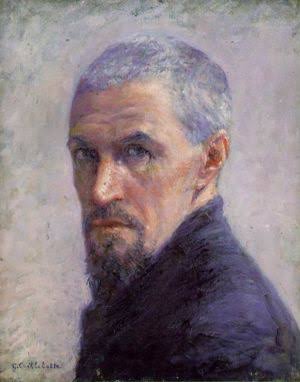 Gustave Caillebotte (August 19, 1848 – February 21, 1894) was a French Impressionist painter, patron, and art collector. While long overshadowed by contemporaries like
Claude Monet and Pierre-Auguste Renoir, Caillebotte is now recognized as a vital figure of 19th-century French realism, celebrated for his dramatic perspectives, modern
urban scenes, and complex depictions of gender and domestic life.
Gustave Caillebotte (August 19, 1848 – February 21, 1894) was a French Impressionist painter, patron, and art collector. While long overshadowed by contemporaries like
Claude Monet and Pierre-Auguste Renoir, Caillebotte is now recognized as a vital figure of 19th-century French realism, celebrated for his dramatic perspectives, modern
urban scenes, and complex depictions of gender and domestic life.
Born into a wealthy Parisian upper-bourgeois family on August 19, 1848. His father made a fortune manufacturing military textiles, leaving Gustave financially
independent for life.
Earned a law degree in 1869 and served in the Seine Mobile Guard during the Franco-Prussian War (1870–1871). He subsequently entered the École des Beaux-Arts in 1873,
studying under academic painter Léon Bonnat.
After inheriting his family’s wealth in the mid-1870s, Caillebotte became the financial engine of the Impressionist movement. He funded their group exhibitions, paid
studio rents, and purchased dozens of masterpieces by Monet, Renoir, Edgar Degas, Camille Pissarro, Paul Cézanne, and Berthe Morisot.
Blended the precise perspective and draftsmanship of academic realism with the light, atmosphere, and modern subject matter of Impressionism.
In his later years, Caillebotte retreated from the central Paris art scene to Petit-Gennevilliers, dedicating himself to horticulture, orchid cultivation, and naval
architecture (designing and racing yachts).
Died of a pulmonary edema on February 21, 1894, at age 45.
In his will, he left his extraordinary personal art collection—nearly 70 Impressionist works—to the French state, naming Renoir as his executor. Despite initial
resistance from academic authorities, the bequest eventually formed the bedrock of France’s national Impressionist collection, now housed in the Musée d'Orsay.
While 19th-century historical records do not provide explicit modern identity labels for Caillebotte, art historians and queer theorists (including Tamar Garb, Abigail
Solomon-Godeau, and Norma Broude) have extensively analyzed his life and work through a queer lens.
Caillebotte stands apart from his Impressionist peers due to his sustained, intimate focus on the male body rather than the traditional female nude.
The Floor Scrapers (Les raboteurs de parquet, 1875): Depicts working-class men scraping a wood floor, torso bare and glistening. Rejected by the official Paris Salon as
"vulgar," scholars frequently point to the painting's homoerotic tension, highlighting the tactile sensuality, muscle definition, and voyeuristic perspective on male labor.
Man at His Bath (Homme au bain, 1884): Shows a man from behind, drying himself in a private domestic bathroom. It subverts the conventional female bather motif,
presenting the male physique as an object of vulnerability, realism, and aesthetic appreciation.
Caillebotte’s urban scenes frequently center on male companionship, flânerie, and homosocial environments:
Works such as Young Man at His Window (1875) and Le Pont de l'Europe (1876) explore bachelorhood, urban detachment, and gaze dynamics between men in public spaces.
His paintings of leisure—boating, rowing, and card-playing—consistently prioritize male bonding and physical camaraderie over traditional romantic pairings.
Caillebotte never married. Throughout much of his adulthood in Paris, he shared an apartment and domestic routine with his brother, composer and photographer
Martial Caillebotte, until Martial married in 1887.
Later in life, he maintained a relationship with Charlotte Berthier, a younger woman to whom he left a annuity in his will. However, he kept his private life largely
discreet, living outside standard 19th-century bourgeois marital expectations.
References:
- https://en.wikipedia.org/wiki/Gustave_Caillebotte
- https://www.britannica.com/biography/Gustave-Caillebotte
- https://www.tuttartpitturasculturapoesiamusica.com/2011/10/gustave-caillebotte-1848-parigi.html
Support this project
This website is a passion project researched, developed, and funded entirely by me. If you find the content valuable and would like to help support the ongoing research and hosting costs, any contribution is deeply appreciated.
Thank you for keeping this independent resource alive!
My books on Amazon: Elisa Rolle's books
BACK TO HOME PAGE