Queer Places:
Cimitero di Montanaro, 10017 Montanaro Metropolitan City of Turin
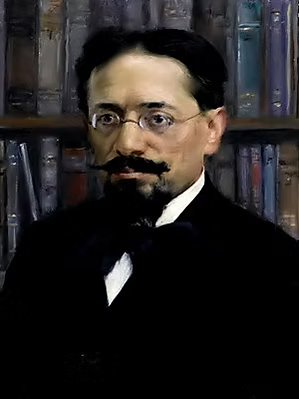 Giovanni Cena (January 12, 1870 - December 7, 1917) was born on January 12, 1870, in Montanaro, Italy, and emerged from humble origins as the son of a
weaver and a farmer. Despite financial hardships, he pursued education in Turin and later entered the seminary in Ivrea in 1886, from which he was
expelled three years later after being found with forbidden books. He successfully continued his academic path at the University of Turin as a student of
the literary figure Arturo Graf. In 1902, Cena relocated to Rome, where he assumed the position of editor-in-chief for the prestigious literary and
cultural review Nuova Antologia. During this period, he became a prominent voice in Italian letters, known both for his poetry and his social novel
Gli ammonitori, published initially in 1903.
Giovanni Cena (January 12, 1870 - December 7, 1917) was born on January 12, 1870, in Montanaro, Italy, and emerged from humble origins as the son of a
weaver and a farmer. Despite financial hardships, he pursued education in Turin and later entered the seminary in Ivrea in 1886, from which he was
expelled three years later after being found with forbidden books. He successfully continued his academic path at the University of Turin as a student of
the literary figure Arturo Graf. In 1902, Cena relocated to Rome, where he assumed the position of editor-in-chief for the prestigious literary and
cultural review Nuova Antologia. During this period, he became a prominent voice in Italian letters, known both for his poetry and his social novel
Gli ammonitori, published initially in 1903.
Beyond his editorial work, Cena dedicated much of his life to social reform, particularly the rehabilitation and literacy of impoverished populations
in the Roman countryside and the Pontine Marshes. In 1904, he formed a vital partnership with Dr. Angelo Celli, founder of the Society for Studies
against Malaria. Alongside Celli, Anna Fraentzel Celli, Alessandro Marcucci, and temporarily Sibilla Aleramo,
Cena fought tirelessly against the neglect of the rural poor. He documented the harrowing living conditions in the marshes and pioneered a revolutionary
educational mission, establishing makeshift schools inside abandoned huts, churches, barns, and disused railway cars. Despite fierce resistance and
hostility from Roman landowners who feared that an educated populace would challenge their subjugation, Cena and his colleagues persevered, eventually
securing municipal support and permanent infrastructure for rural education.
Cena's personal life was deeply intertwined with his literary circles and progressive ideals. Shortly after arriving in Rome, he met the writer
Rina Faccio, fell deeply in love with her, and gave her the pen name Sibilla Aleramo, inspired by Giosuè Carducci's evocations of the Aleramo territory.
Cena heavily encouraged Aleramo's literary career, and together they shared in the social campaigns of the Roman countryside. Reflecting their broader
European cultural connections, Cena and Aleramo also visited the prominent Anglo-Italian intellectual and writer
Vernon Lee, dining together at Lee’s famous Florentine home, Il Palmerino, in 1903. Within these literary and
artistic networks, figures like Lee, Aleramo, and Cena moved through progressive modern circles that frequently challenged traditional Victorian and
turn-of-the-century social norms regarding gender, sexuality, and partnership.
As historical events shifted toward global conflict, Cena remained intensely active in civic duty. When Italy entered World War I, he joined the Civil
Preparation Committee in May 1915, traveled through the marshes, and aided victims of the devastating Avezzano earthquake. Driven by a desire to
understand the realities of combat, he spent weeks in the trenches during the summer of 1915. In Rome, he organized schools for wounded, illiterate
soldiers and founded and directed Il Piccolissimo, a propaganda and educational newsletter for soldiers' families. Giovanni Cena passed away from
pneumonia in Rome on December 7, 1917, leaving a lasting legacy as a poet of the heart, an ardent defender of workers, and a pioneer of rural
education.
Giovanni Cena is buried in the cemetery of Montanaro (in the Canavese area of Piedmont, Italy), which is his birthplace. His burial site features a
notable funereal monument created by the Italian sculptor Leonardo Bistolfi.
References:
- In umbra (Versi) – Torino: Renzo Streglio, 1899.
- Madre (Versi) – Torino: Renzo Streglio, 1900 (second edition).
- Gli ammonitori (Romanzo) – Rome: Nuova Antologia, Series 4, vol. 106, 1903 (reprinted Turin: Einaudi, 1976; Turin, 1978).
- Homo – Rome: Nuova Antologia, post-1905.
- Opere complete di Giovanni Cena (5 volumes) – Turin: L'Impronta, 1928–1929
- Aleramo, Sibilla. Dal mio diario (Rome, 1945) and Diario di una donna (Milan, 1978).
- Brugioni, Bruno. La poesia e il sentimento di G. Cena (Modena: 1907 / 1937).
- Craveri, Piero. "Cena, Giovanni," in Dizionario Biografico degli Italiani (Rome: Istituto dell'Enciclopedia Italiana, Treccani).
- De Rienzo, Giorgio. Camerana, C. e altri piemontesi (Bologna, 1972); editor of Prose critiche (Turin, 1969).
- Lombardo Radice, Giuseppe. Ricordando G. Cena, in Pedagogia di apostoli e di operai (Bari, 1936, pp. 179–201).
- Manturazzo, Santo. Il missionario dell'istruzione: G. Cena (Ivrea, 1970); G. Cena e l'espressionismo sociale (Milan, 1973); and Il tredicesimo apostolo (Milan, 1973).
- Momigliano, Attilio. "La poesia di G. Cena," in Impressioni di un lettore contemporaneo (Milan, 1928, pp. 70 ss.).
- Pancrazi, Pietro. Scrittori d'oggi (Bari, 1946, pp. 267–274) and Scrittori italiani dal Carducci a D'Annunzio (Bari, 1957).
- Petrocchi, Giorgio. Scrittori piemontesi del secondo Ottocento (Torino, 1948, pp. 130 ss.).
- Scialla, Elsa. Una vita come impegno: vita di Giovanni Cena attraverso le lettere (Milan, 1969).
Support this project
This website is a passion project researched, developed, and funded entirely by me. If you find the content valuable and would like to help support the ongoing research and hosting costs, any contribution is deeply appreciated.
Thank you for keeping this independent resource alive!
My books on Amazon: Elisa Rolle's books
BACK TO HOME PAGE