Partner Musa Williams
Queer Places:
2041 5th Ave, New York, NY 10027, USA
2 E 127th St, New York, NY 10035, USA
Lafayette Apartments, 320 Manhattan Ave, New York, NY 10026, USA
The Monterey, 351 W 114th St, New York, NY 10026, USA
Cypress Hills Cemetery, 833 Jamaica Ave, Brooklyn, NY 11208, United States
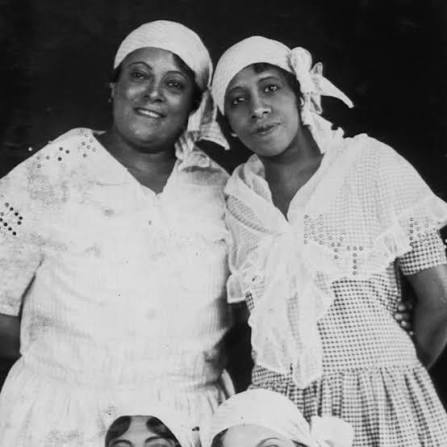 Georgette Harvey (December 31, 1882 - February 17, 1952) was born on December 31, 1882, in St. Louis, Missouri, and grew up singing in church before
launching an extraordinary international stage career. Possessing a deep contralto voice and a commanding physical presence, she made her professional
stage debut in 1905 in an act led by ragtime pioneer Ernest Hogan. Early in her career, Harvey organized and led the Creole Belles, a musical troupe of
singing and dancing Black women that toured extensively across American vaudeville circuits as well as western Europe. Following the group's dissolution,
she spent several years touring as a solo performer, notably spending significant time performing in Russia before returning to the United States around
1921.
Settling in New York City during the height of the Harlem Renaissance, Harvey established herself as a prominent figure in American theater. She made
her Broadway debut in the 1923 musical production Runnin' Wild and went on to appear in 25 Broadway shows over the next quarter-century. Her signature
role came in 1927 when she originated the character of Maria in DuBose Heyward’s play Porgy. She famously reprised the role of Maria in
George Gershwin’s iconic 1935 folk-opera adaptation Porgy and Bess, as well as in multiple subsequent
revivals. Her final Broadway performance was in the 1949 production of Lost in the Stars. Beyond the stage, Harvey screen-tested for the role of Mammy in
Gone with the Wind (1939), appeared in several films including Chloe, Love Is Calling You (1934), and performed alongside
Ethel Waters and Fredi Washington in NBC’s historic broadcast The
Ethel Waters Show (1939). Beyond her performance work, Harvey served as an officer in the Negro Actors Guild of America, which was founded in 1936 to
advocate for fairer representation and better conditions for Black performers in entertainment.
Historians, including Eric K. Washington, highlight Georgette Harvey as one of the key African American LGBTQ theatrical figures of the early-to-mid
20th century. For over two decades, Harvey shared her life and home with her romantic and creative partner, the actress and singer
Musa Williams. Together, the couple formed part of the musical quartet The Four Bon-Bons, which made history in
October 1931 as reportedly the first Black act to perform on television, singing "St. James Infirmary". The two women lived together in several Harlem
residences—most notably at the Lafayette Apartments on Manhattan Avenue—which served as vibrant social hubs for the Black queer artistic community. Their
gatherings regularly hosted leading Harlem Renaissance figures and LGBTQ artists, including singers Ethel Waters,
Alberta Hunter, and Jimmie Daniels, writer
Richard Bruce Nugent, and director Rouben Mamoulian. Harvey
and Williams remained life partners until Harvey's death on February 17, 1952, at the age of 69.
References:
- NYC LGBTQ Historic Sites Project: Provides documentation on the Harlem residences of Georgette Harvey and Musa Williams (including 2041 Fifth Avenue, 2 East 127th Street, and the Lafayette Apartments at 320 Manhattan Avenue).
- Research & Fieldwork by Eric K. Washington: Historical research and site documentation by historian Eric K. Washington (@taggingthepast), detailing Harvey and Williams's relationship, household, and involvement with early television broadcasts as part of The Four Bon-Bons.
- Richard Bruce Nugent Papers & Published Writings: "On Georgette Harvey," in Gay Rebel of the Harlem Renaissance: Selections from the Work of Richard Bruce Nugent, edited by Thomas H. Wirth (Duke University Press, 2002).
- Biographical sketches and manuscripts within the Writers' Program (New York City: Negroes of New York collection) at the Schomburg Center for Research in Black Culture / New York Public Library Archives.
- African American National Biography: Entry on "Georgette Harvey" by Cheryl Black, edited by Henry Louis Gates Jr. and Evelyn Brooks Higginbotham (Oxford University Press / W.E.B. Du Bois Institute).
- Negro Actors Guild of America Archives: Historical newsletters, meeting minutes, and event records detailing Harvey's executive service and involvement alongside fellow Black theater pioneers.
- The New York Times Obituary: "Miss G. Harvey, 69, Actress, Singer" (February 18, 1952, p. 19).
- The Chicago Defender Society Columns: Coverage of Harlem theatrical society and home gatherings hosted by Harvey and Williams (e.g., Bessye Bearden, "New York Society," April 6, 1935).
- Internet Broadway Database (IBDB): Complete performance credits for Georgette Harvey and Musa Williams across original productions (Porgy, Porgy and Bess, Runnin' Wild, Lost in the Stars) and revivals.
- Internet Movie Database (IMDb): Filmography records including Chloe, Love Is Calling You (1934).
Support this project
This website is a passion project researched, developed, and funded entirely by me. If you find the content valuable and would like to help support the ongoing research and hosting costs, any contribution is deeply appreciated.
Thank you for keeping this independent resource alive!
My books on Amazon: Elisa Rolle's books
BACK TO HOME PAGE