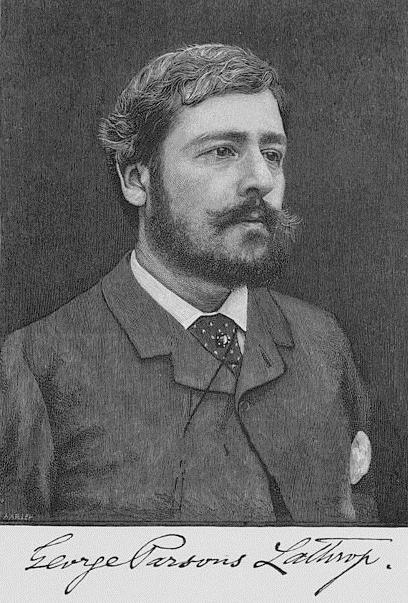
 George Parsons Lathrop (August 25, 1851 – April 19, 1898) was an American poet, novelist, and editor, best known for his role in late-nineteenth-century literary circles and
his marriage to Rose Hawthorne, the daughter of Nathaniel Hawthorne.
George Parsons Lathrop (August 25, 1851 – April 19, 1898) was an American poet, novelist, and editor, best known for his role in late-nineteenth-century literary circles and
his marriage to Rose Hawthorne, the daughter of Nathaniel Hawthorne.Queer Places:
Green-Wood Cemetery, Greenwood Heights, Kings County, New York, USA
George Parsons Lathrop (August 25, 1851 – April 19, 1898) was an American poet, novelist, and editor, best known for his role in late-nineteenth-century literary circles and
his marriage to Rose Hawthorne, the daughter of Nathaniel Hawthorne.
Born in Honolulu, Hawaii, to an American physician, Lathrop was educated in New York and Dresden, Germany.
In 1871, while traveling in Europe, he married Rose Hawthorne. He became an ardent defender and biographer of his famous father-in-law, publishing A Study of Hawthorne (1876) and editing the standard 12-volume Riverside Edition of Nathaniel Hawthorne’s complete works (1883).
Lathrop served as associate editor of the Atlantic Monthly (1875–1877) and later edited the Boston Courier (1879–1881).
He founded the American Copyright League in 1883 to fight for international author protections. Later in life, both he and Rose converted to Roman Catholicism. Following George's death in 1898, Rose became a Catholic nun (Mother Mary Alphonsa) and founded the Dominican Sisters of Hawthorne.
While Lathrop was married to a woman and did not leave explicit records describing a personal queer identity, he operated within a late-19th-century American literary scene defined by close bonds, homosocial networks, and early LGBTQ+ figures.
During Walt Whitman's April 1881 trip to Boston to prepare the James R. Osgood edition of Leaves of Grass, John Boyle O'Reilly—a prominent Irish-American poet, editor, and figure in Boston's bohemian cultural scene—co-arranged an invitation for Whitman to speak at the newly founded St. Botolph Club. Lathrop, an active member of Boston’s literary elite and the St. Botolph Club, helped facilitate the engagement.
Lathrop’s connection to Whitman went back several years before the 1881 talk. In an 1878 letter to Whitman, Lathrop explicitly expressed his deep personal admiration for the poet's work:
"I have confessed to Burroughs my admiration of the spirit you have breathed into the air, to enlarge & stimulate the after-comers, the young writers of America. At times, I have had an intense longing to express my gratitude to you yourself..."
In the same 1878 letter, Lathrop mentioned his disappointment at missing a gathering in Philadelphia with Whitman and the young English writer Edward Carpenter. Carpenter—who traveled to America specifically to visit Whitman—became one of Britain’s foremost early activists for socialist causes and homosexual liberation (authoring The Intermediate Sex). Lathrop's presence in these shared social orbits highlights how intertwined 19th-century literary allies were across the Atlantic.
References:
 The Crimson Letter: Harvard, Homosexuality, and the Shaping of American Culture Paperback – Illustrated, June 1, 2004 by Douglass Shand-Tucci |
Other references:
Support this project
This website is a passion project researched, developed, and funded entirely by me. If you find the content valuable and would like to help support the ongoing research and hosting costs, any contribution is deeply appreciated.
Thank you for keeping this independent resource alive!
My books on Amazon: Elisa Rolle's books