Queer Places:
Sint-Martens-Latem Kerkhof, Mortelputstraat, 9830 Sint-Martens-Latem, Belgium
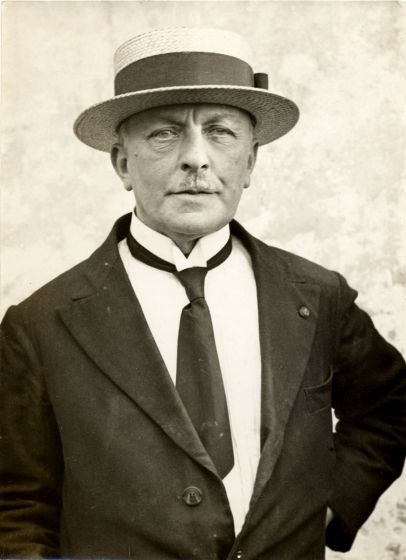 Georges Joannes Leonardus Minne (August 30, 1866 - February 18, 1941) was a prominent Belgian artist and sculptor whose groundbreaking work shifted
sculpture away from traditional allegorical and portrait functions toward the deep depiction of psychological states, inner spiritual conflicts, and
self-discovery.
Georges Joannes Leonardus Minne (August 30, 1866 - February 18, 1941) was a prominent Belgian artist and sculptor whose groundbreaking work shifted
sculpture away from traditional allegorical and portrait functions toward the deep depiction of psychological states, inner spiritual conflicts, and
self-discovery.
Born on August 30, 1866, in Ghent, Belgium, he was the son of architect Fredericus Augustus Minne. He began his formal artistic education studying
painting at the Royal Academy of Fine Arts in Ghent in 1879, later continuing his studies at the Académie Royale des Beaux-Arts in Brussels from 1885
through 1889. During an early visit to Paris in 1886, he met writers Maurice Maeterlinck and Gregore Le Roy, who introduced him to French Symbolism. When
Minne returned to Paris in 1890 and asked Auguste Rodin for permission to work in his studio, Rodin famously
declined, telling him he had nothing to teach him.
By 1891, Minne's rising stature in the art community was recognized when he was elected a member of the influential avant-garde arts group Les XX. The
following year, in 1892, he married Josephine Destanberg, the daughter of a Ghent poet, with whom he later had a son named Frederic Jonkheer Minne. For
the rest of his life, Minne dedicated himself primarily to drawing and sculpting, focusing heavily on nude male adolescents as vehicles for psychological
expression. Between 1910 and 1914, he established his own bronze foundry in Ghent, which was managed by his son. When World War I broke out, Minne fled
to Wales, but he returned to Belgium after the conflict ended and spent time teaching drawing.
Minne is internationally celebrated for his idealized portrayals of human vulnerability and introspection, making him a contemporary of Gustav Klimt
and Egon Schiele whose forms and subject matter closely aligned with the Viennese Secessionists and early Art Nouveau. His most famous masterwork is the
1898 Kneeling Youth series, which initially began as a fountain composed of five adolescent figures. Often dubbed the Narcissus Fountain for its imagery
of young men staring intently at their reflections, it captured profound psychological complexity. The marble originals of this fountain reside at the
Folkwang Museum in Essen, Germany, while a bronze-cast version stands in his hometown of Ghent. Other notable pieces include The Small Relic Bearer, the
pair of Kneeling Youths formerly owned by Adele and Ferdinand Bloch-Bauer that were later restituted to Maria Altmann before entering the Neue Galerie
New York, and a 1898 plaster version acquired by the National Gallery of Victoria in Melbourne. Beyond his secular figures, Minne also contributed
religious works, creating the Sacred Heart sculpture for the altar in the apse of the Basilica of Koekelberg, as well as the bronze Calvary placed
outside the basilica.
Over the course of his distinguished career, Minne received numerous honors, including becoming a member of the Royal Academy of Science, Letters and
Fine Arts of Belgium. In 1931, he was created a baron by Royal Order, and in 1934, he was named a Grand Officer in the Order of the Crown. Georges Minne
passed away on February 18, 1941, in Sint-Martens-Latem, Belgium, and was laid to rest at the Sint-Martens-Latem Kerkhof.
References:
- Van Puyvelde, Leo. George Minne. Brussels: Editions des Cahiers de Belgique, 1930. (Widely recognized as the foundational early monograph and standard historic reference text containing the initial catalogue raisonné of his sculptures and drawings).
- Price, Renée. New Worlds: German and Austrian Art 1890-1940. New York: Neue Galerie, 2001. (Features detailed provenance and analytical essays regarding Minne's connection to the Viennese Secession and the Kneeling Youth sculptures passed through the Bloch-Bauer collection).
- Gaugusch, Georg. Portrait of Adele Bloch-Bauer. New York: Neue Galerie, 2009. (Provides extensive historical and archival documentation concerning the ownership history of Minne's works).
- Kultermann, Udo. "The Fountain of Youth: The Folkwang Fountain by George Minne." Konsthistorik Tidskrift 46, no. 2 (1977): 144–152. (An in-depth scholarly examination of the conceptual development and history behind Minne's masterwork, the Fountain of Kneeling Youths).
- Museum of Fine Arts Ghent (MSK Ghent) & Vlaamse Kunstcollectie. George Minne en de kunst rond 1900 (Exhibition Catalog, 1982), alongside ongoing digital archives and cataloging provided by the [Vlaamse Kunstcollectie online research database](https://georgeminne.vlaamsekunstcollectie.be/).
Support this project
This website is a passion project researched, developed, and funded entirely by me. If you find the content valuable and would like to help support the ongoing research and hosting costs, any contribution is deeply appreciated.
Thank you for keeping this independent resource alive!
My books on Amazon: Elisa Rolle's books
BACK TO HOME PAGE