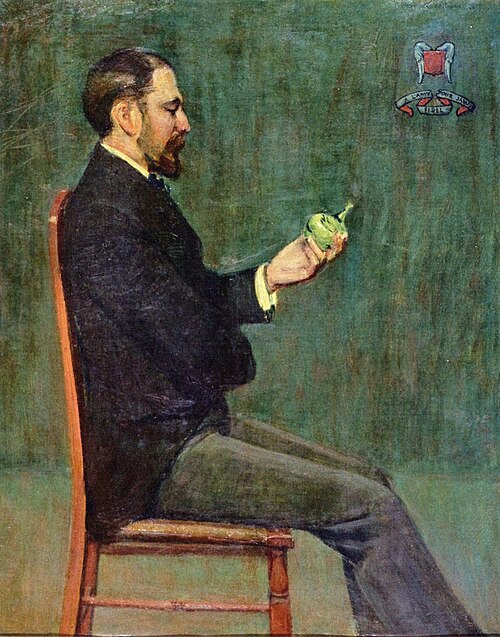
 George Dudley Seymour (October 6, 1859 – January 21, 1945) was a close friend of William Howard Taft, John Singer Sargent,
and Gifford Pinchot, and a cousin of Yale President Charles Seymour.
George Dudley Seymour (October 6, 1859 – January 21, 1945) was a close friend of William Howard Taft, John Singer Sargent,
and Gifford Pinchot, and a cousin of Yale President Charles Seymour.
Queer Places:
Nathan Hale Homestead, 2299 South St, Coventry, CT 06238, United States
Grove Street Cemetery, 227 Grove St, New Haven, CT 06511, United States
George Dudley Seymour (October 6, 1859 – January 21, 1945) was a close friend of William Howard Taft, John Singer Sargent,
and Gifford Pinchot, and a cousin of Yale President Charles Seymour.
He was born in Bristol, Connecticut, on October 6, 1859, the son of Henry Albert Seymour and Electa Churchill. He began his education in local public schools before graduating from the Hartford High School in 1878. He then moved to Washington, D.C., where he studied law in his brother's office and attended Columbian University (now George Washington University), earning his LL.B. in 1880 and his LL.M. in 1881. After briefly practicing law in Washington, he relocated to New Haven, Connecticut, in 1883, where he established a successful career specializing in patent law as part of the firm Seymour, Earle, and Nichols.
Beyond his legal practice, Seymour dedicated much of his life to civic improvement, historic preservation, and antiquarian research. He became a fervent proponent of the City Beautiful movement in New Haven, earning the moniker "Father of the City Beautiful" for his work inspiring municipal developments, public buildings, and the New Haven City Planning Committee. He was widely recognized as the foremost authority on Revolutionary War hero Nathan Hale, extensively researching his life, spearheading a campaign for a statue of Hale at Yale University, and purchasing and restoring the Nathan Hale Homestead in Coventry, Connecticut, which he later gifted to preservation societies. His extensive civic and cultural involvements included serving as a trustee of the Wadsworth Atheneum, chairman of the State Commission of Sculpture, and vice president of the American Federation of Arts. He maintained close personal and professional circles within elite artistic, political, and antiquarian networks, including his enthusiastic and loyal membership in the exclusive Horace Walpole Society, to which he was elected in 1918. He received an honorary Master of Arts degree from Yale University in 1913 and an honorary doctorate from George Washington University in 1921. Seymour passed away on January 21, 1945, in New Haven, Connecticut, leaving no close relatives, and was buried in the Grove Street Cemetery.
Regarding LGBTQ historical connections, traditional biographical accounts of George Dudley Seymour focus entirely on his public career, civic planning, and patriotic preservation work without documenting contemporary disclosures or modern consensus regarding a non-heteronormative identity. However, his life and personal circles—frequently intersecting with elite homosocial networks, elite boarding and university clubs like the Elizabethan Club at Yale, and homosocial antiquarian fellowships such as the Horace Walpole Society—are frequently studied by historians exploring the homosocial structures and private domestic arrangements characteristic of prominent bachelors of the Progressive Era.
References:
Support this project
This website is a passion project researched, developed, and funded entirely by me. If you find the content valuable and would like to help support the ongoing research and hosting costs, any contribution is deeply appreciated.
Thank you for keeping this independent resource alive!
My books on Amazon: Elisa Rolle's books