Queer Places:
Albrechtsberg Palace, Bautzner Str. 130, 01099 Dresden-Loschwitz, Germany
Waldfriedhof Bad Weißer Hirsch, Am Heiderand 8-10, 01324 Dresden-Weißer Hirsch, Germany
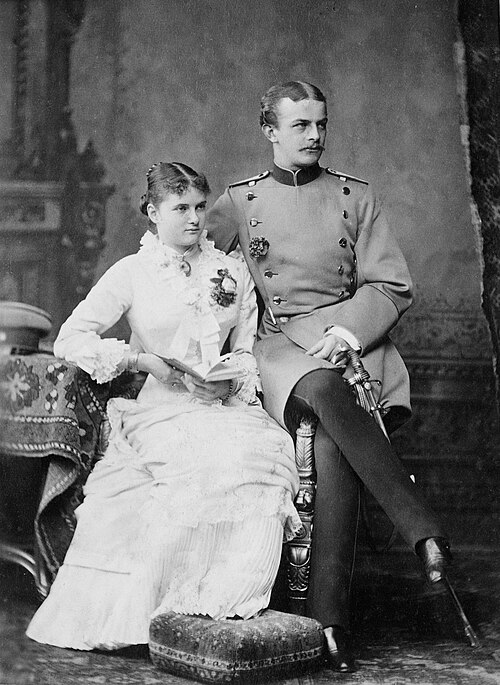 Count Frederick of Hohenau (born Friedrich Wilhelm Bernhard Graf von Hohenau, May 21, 1857 - April 15, 1914) was a German nobleman of the Prussian royal lineage who became a
central figure in the high-society circles and imperial court scandals of the German Empire under Kaiser Wilhelm II.
Count Frederick of Hohenau (born Friedrich Wilhelm Bernhard Graf von Hohenau, May 21, 1857 - April 15, 1914) was a German nobleman of the Prussian royal lineage who became a
central figure in the high-society circles and imperial court scandals of the German Empire under Kaiser Wilhelm II.
Born in Schloss Albrechtsburg near Dresden, Frederick was the son of Prince Albrecht of Prussia and his second, morganatic wife, Rosalie, née von Rauch. Because his
parents' marriage was morganatic, Frederick and his siblings were excluded from direct membership in the royal House of Hohenzollern and were instead granted the title Count
(Graf) of Hohenau. Through his father, he was a grandson of King Frederick William III of Prussia and Queen Luise, making him a cousin to Emperor Wilhelm II. Following the
death of his mother, he and his older brother, William, inherited Schloss Albrechtsburg, which served as his primary residence.
On June 21, 1881, Frederick married Charlotte von der Decken in Berbisdorf. The couple had four sons: Albrecht, Wilhelm (who became an Olympic equestrian), Friedrich
Karl, and Friedrich Franz. Despite his marriage, Frederick lived a private and public life deeply intertwined with the homosocial and homosexual subcultures of the
Wilhelmine aristocracy.
Frederick is historically notable for his involvement in two of the most significant and disruptive political-social scandals of the German Empire: the Kotze Affair of
the 1890s and the Liebenberg Circle. The Liebenberg Round Table was an intimate circle of intellectuals, aristocrats, and politicians surrounding Kaiser Wilhelm II, led by
Philipp, Prince of Eulenburg. This group was heavily scrutinized for its alternative social dynamics and progressive
or aesthetic leanings, which stood in stark contrast to the rigid militarism of the Prussian court.
The primary LGBTQ links and historical context surrounding Frederick's life center on his sexuality and the rigid criminalization of homosexuality under Paragraph 175 of
the German Imperial Penal Code. In 1901, Frederick and Friedrich Botho von Eulenburg (a brother of Prince Philipp)
were forced to resign from their military and state service positions. This forced retirement occurred because of their homosexual inclinations, which had become a liability
under the intensifying scrutiny of the imperial court and military high command.
While the exposure of same-sex desires among the Kaiser's confidants culminated later in the infamous Harden-Eulenburg Affair of 1907–1909, Frederick’s forced resignation
in 1901 marked one of the earlier systemic purges of gay and bisexual aristocrats from high-ranking official duties by the imperial administration. His life reflects the
precarious intersection of high aristocracy and marginalized queer existence in late 19th- and early 20th-century Germany, where same-sex desires were heavily policed yet
actively practiced within elite circles. Frederick of Hohenau died on April 15, 1914, just months before the outbreak of the First World War.
References:
Other references:
- John C. G. Röhl, Wilhelm II.: der Aufbau der persönlichen Monarchie, 1888-1900 (Munich: C. H. Beck, 2001) — Offers extensive documentation regarding the inner dynamics of the Prussian court, the personal circles surrounding Kaiser Wilhelm II, and early administrative pressures on figures linked to court scandals.
- John C. G. Röhl, Kaiser, Hof und Staat: Wilhelm II. und die deutsche Politik (Munich: C. H. Beck, 2002) — Details the structural realities of the imperial court, tracing the systemic political and social environment that led to the marginalization or forced resignation of figures like Frederick of Hohenau.
- Wolfgang Wippermann, Skandal im Jagdschloss Grunewald. Männlichkeit und Ehre im deutschen Kaiserreich (Darmstadt: Primus Verlag, 2010) — Examines the intersection of male honor, militarism, and homosocial/homosexual subcultures within the Wilhelmine aristocracy, providing critical context on the policing of sexuality under Paragraph 175.
- Helga Neumann, Maximilian Harden (1861-1927) (Würzburg: Königshausen & Neumann, 2003) — Discusses the prominent journalist's role in uncovering high-society scandals and the environment surrounding the Liebenberg Circle purges.
- Thora von der Decken (ed.), Stammtafeln der Familie von der Decken (Stade: Heimberg, 1936) — Provides genealogical framework, lineage details, and marital documentation concerning Charlotte von der Decken and her integration into the Hohenau branch.
- Marquise de Fontenoy, The Secret Memoirs of the Courts of Europe: William II, Germany; Francis Joseph, Austria-Hungary (Project Gutenberg historical text collection) — Contemporary observations and historical memoirs tracking high-society dynamics, rumors, and friction points involving the extended imperial family and court personages such as Countess "Fritz" von Hohenau during the 1890s.
Support this project
This website is a passion project researched, developed, and funded entirely by me. If you find the content valuable and would like to help support the ongoing research and hosting costs, any contribution is deeply appreciated.
Thank you for keeping this independent resource alive!
My books on Amazon: Elisa Rolle's books
BACK TO HOME PAGE