Partner Leonard Borwick
Queer Places:
47 Phillip St, Sydney NSW 2000, Australia
Glenyarrah, 11 Gladswood Gardens, Double Bay NSW 2028, Australia
Eton College, Windsor SL4 6DW, United Kingdom
University of Oxford, Oxford, Oxfordshire OX1 3PA
Bisham Grange, Temple Lane, Bisham, Marlow SL7 1RS, United Kingdom
Martinsart British Cemetery, 7 Rte d'Albert, 80300 Mesnil-Martinsart, France
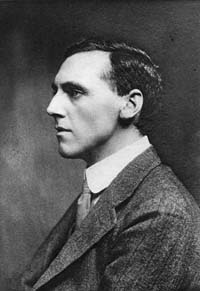 Frederick Septimus Kelly DSC (May 29, 1881 – November 13, 1916) was a remarkable Australian-British polymath whose short life encompassed extraordinary
achievements as a world-class classical musician, an Olympic gold medalist rower, and a decorated war hero.
Frederick Septimus Kelly DSC (May 29, 1881 – November 13, 1916) was a remarkable Australian-British polymath whose short life encompassed extraordinary
achievements as a world-class classical musician, an Olympic gold medalist rower, and a decorated war hero.
Born at 47 Phillip Street in Sydney, Australia, he was the fourth son and seventh child of Irish-born woolbroker Thomas Hussey Kelly and Mary Anne
Dick Kelly. Raised at the family home, Glenyarrah, in Double Bay, Kelly received his initial education at Sydney Grammar School before traveling with his
family to England to attend Eton College. At Eton, his extraordinary talents in both music and athletics rapidly emerged. He studied music under Charles
Harford Lloyd and demonstrated his physical prowess by stroking the school eight to victory in the Ladies' Challenge Plate at the Henley Royal Regatta in
1899.
Kelly matriculated to Balliol College, Oxford, after winning a Lewis Nettleship musical scholarship in 1899. At Oxford, where he earned a Bachelor of
Arts in 1903 and later a Master of Arts in 1912, he was mentored by Donald Tovey and supported as a protégé of Ernest Walker. While pursuing his studies,
Kelly rose to national fame as an amateur sculler. He won the Diamond Challenge Sculls at Henley in 1902 against Raymond Etherington-Smith, rowed in the
four seat for Oxford in the 1903 Boat Race, and won the Diamond Sculls again that summer by defeating Julius Beresford. He also secured the Wingfield
Sculls, the Amateur Championship of the Thames, beating Arthur Cloutte in his sole appearance in the event. After graduating, Kelly joined the
prestigious Leander Club, contributing to their Grand Challenge Cup victories at Henley in 1903, 1904, and 1905, as well as the Stewards' Challenge Cup
in 1906. He captured a third Diamond Sculls title in 1905 over Harry Blackstaffe. His rowing career culminated at the 1908 London Olympic Games, where he
won a gold medal for Great Britain as part of the Leander veteran eight. Contemporaries lauded his flawless technique, praising his natural sense of
poise and rhythm and often describing him as the greatest amateur stylist in rowing history.
Alongside his athletic feats, Kelly pursued a brilliant musical career. After graduating from Oxford with fourth-class honors in history, he moved to
Germany to study composition with Iwan Knorr and piano with Ernst Engesser at the Hoch Conservatory in Frankfurt. During his time in Frankfurt, Kelly
formed a deep, lifelong bond with Leonard Borwick, widely considered England's premier pianist of the era.
Borwick became Kelly's life partner, personal confidant, and artistic collaborator. Their personal and creative relationship became a central pillar of
Kelly's adult life, anchored at Bisham Grange—Kelly's home near Marlow, Buckinghamshire, which he shared with his sister Mary (Maisie). Despite personal
struggles in 1907 with a facial tic and physical ailments in his hands and arms, for which he underwent hypnotherapy under London specialist Dr. J. Milne
Bramwell, Kelly established himself among Europe's elite musical circles. He performed alongside legendary cellist Pablo Casals and helped organize
Maurice Ravel's London debut concert at Bechstein Hall in December 1913, where Kelly himself performed Scriabin
piano works and James Friskin's Phantasy piano quintet. In 1911, he returned briefly to Sydney, delivering three solo recitals, performing Beethoven's
Piano Concerto No. 4 with the Sydney Symphony Orchestra, conducting a chamber performance featuring Melba's flautist John Lemmone, and showcasing his own
composition, Serenade for Flute and Small Orchestra, Op. 7. Upon returning to London, he performed major concertos by Beethoven, Schumann, Mozart, and
Brahms with the London Symphony Orchestra.
The onset of the First World War in September 1914 dramatically altered Kelly's trajectory. He was commissioned as an officer in the Royal Naval
Volunteer Reserve, joining the Hood Battalion of the Royal Naval Division. His unit included a remarkable circle of intellectual soldier-friends—among
them poet Rupert Brooke, critic and composer William Denis Browne, Arthur "Ock" Asquith, Charles Lister,
Patrick Shaw-Stewart, and Bernard Freyberg—a group collectively known as the "Latin Club." Kelly participated in the early, unsuccessful defense of
Antwerp before sailing for the Dardanelles in early 1915. During the Gallipoli campaign, he forged a profound personal closeness with Rupert Brooke. When
Brooke contracted severe blood poisoning and died off the island of Skyros on April 23, 1915, Kelly was among the intimate circle that buried the poet at
night in an olive grove. Kelly meticulously sorted Brooke's belongings, copied his final notebook to preserve his written work for his family, and began
composing his famous masterpiece, Elegy for String Orchestra: "In Memoriam Rupert Brooke", while recovering from a gunshot wound in his tent at base
camp. Kelly returned to active duty at Gallipoli in July 1915, was promoted to Lieutenant, and was awarded the Distinguished Service Cross (DSC) for
conspicuous gallantry.
Following the evacuation of Gallipoli, Kelly was deployed to the Western Front in France as a Lieutenant Commander. He continued composing amidst the
harsh realities of trench warfare, finishing his final work, the Somme Lament, in piano score in October 1916. On November 13, 1916, during the final
days of the Battle of the Somme, Kelly was killed in action at Beaucourt-sur-l'Ancre at the age of 35 while leading his men in a charge against a German
machine-gun position. His soldiers braved enemy fire to retrieve his body from No Man's Land, ensuring he became one of the few composers fallen on the
Somme to have an identified burial site. He was laid to rest at Martinsart British Cemetery in Mesnil-Martinsart, Picardie, France.
Kelly's artistic legacy endured through the devoted efforts of his surviving partner, family, and peers. At a high-profile memorial concert held at
London's Wigmore Hall on May 2, 1919, Leonard Borwick performed several of Kelly's piano compositions, singer Muriel Foster performed his songs, and
Frank Bridge conducted the Elegy for String Orchestra. Memorials were erected in his home village of Bisham and honored by fellow musicians like Charles
Harford Lloyd and Ernest Truman. Kelly left behind a significant catalogue of romantic and early-modernist compositions, including 12 Studies (Op. 9), 24
Monographs (Op. 11), his Violin Sonata "Gallipoli" (1915), the Serenade for Flute, a Piano Trio (1905), and early chamber works. His extensive diaries,
musical manuscripts, and personal papers are preserved in the National Library of Australia.
References:
- National Library of Australia (NLA) Papers and Manuscripts: MS 6050: Diaries of Frederick Kelly, 1907 Oct. – 1916 Nov. (Eight diaries detailing his work as a pianist and composer, rowing accomplishments, Olympic training, and service in World War I).
- MS Acc13.201: Diary of Frederick Septimus Kelly, 1905–1916.
- MS 3095: Music Manuscripts of F.S. Kelly, 1893–1926.
- MS 10144: Papers of Frederick Septimus Kelly, 1916 (Includes the original manuscript score for the "Gallipoli" Violin Sonata composed for Jelly d'Arányi).
- Radic, Thérèse (Ed.). Race Against Time: The Diaries of F.S. Kelly. Canberra: National Library of Australia, 2004. (A published compilation and selective edition of Kelly's personal diaries with biographical annotations).
- The Dictionary of National Biography (DNB): Biographical entries on First World War figures and fallen service members.
- Balliol College Archives & Records (Oxford): Academic and musical records relating to Kelly’s Nettleship scholarship and studies under Donald Tovey and Ernest Walker.
- Eton College Archives: Records of Kelly's early musical studies under Charles Harford Lloyd and rowing career (Ladies' Challenge Plate, 1899).
- Henley Royal Regatta & Leander Club Archives: Official rowing records documenting Kelly's victories in the Diamond Challenge Sculls (1902, 1903, 1905), the Grand Challenge Cup, and the Stewards' Challenge Cup.
- Official Olympic Games Reports (1908): Documentation of the 1908 London Summer Olympics gold medal eights competition.
- Commonwealth War Graves Commission (CWGC): Service records and burial registry entries for Lieutenant Commander F.S. Kelly, DSC, RNVR (Hood Battalion, Royal Naval Division), buried at Martinsart British Cemetery, France.
Support this project
This website is a passion project researched, developed, and funded entirely by me. If you find the content valuable and would like to help support the ongoing research and hosting costs, any contribution is deeply appreciated.
Thank you for keeping this independent resource alive!
My books on Amazon: Elisa Rolle's books
BACK TO HOME PAGE