Queer Places:
9 Pembroke Square, London W8 6PA, UK
Reigate Cemetery, Reigate RH2 7RN, United Kingdom
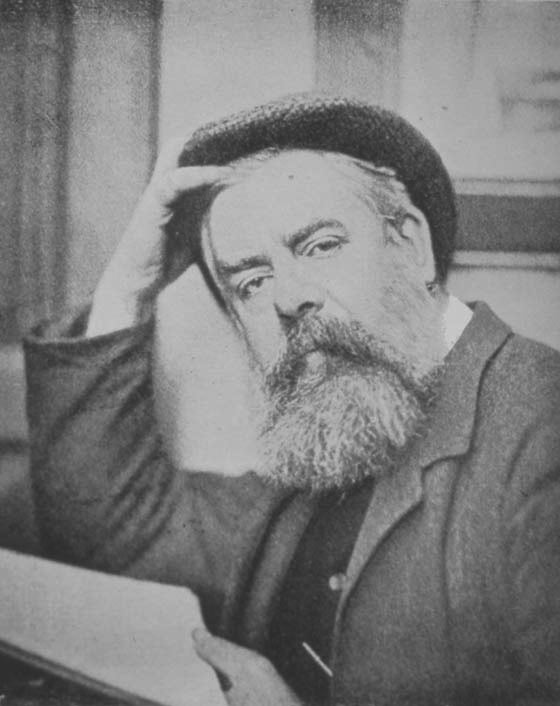 Frederick Hollyer (17 June 1838 – 21 November 1933) was a preeminent English photographer and engraver, celebrated for his instrumental role in establishing photography as a
recognized fine art. He is best remembered for his meticulously crafted photographic reproductions of works by the Pre-Raphaelite Brotherhood, particularly those of his close
collaborators Edward Burne-Jones and George Frederic Watts.
Frederick Hollyer (17 June 1838 – 21 November 1933) was a preeminent English photographer and engraver, celebrated for his instrumental role in establishing photography as a
recognized fine art. He is best remembered for his meticulously crafted photographic reproductions of works by the Pre-Raphaelite Brotherhood, particularly those of his close
collaborators Edward Burne-Jones and George Frederic Watts.
Frederick Hollyer was the youngest son of Samuel Hollyer, a fine art publisher and engraver. He married Mary Anne Armstrong (1838–1913). His eldest son, Frederick Thomas
Hollyer, eventually took over the family studio upon his father's retirement in 1913.
While Hollyer experimented with albumen and carbon prints, he became renowned for his mastery of the platinotype (platinum print) process. This method was prized for its
extraordinary tonal range and longevity, which allowed him to "translate" the textures and nuances of paintings and drawings into photographic form with exceptional
fidelity.
The studio of Frederick Hollyer was located at 9 Pembroke Square in Kensington, London. This residence and studio sbecame a cultural hub for the Aesthetic movement. His
practice was unique for its time; he often worked closely with artists like Burne-Jones, photographing their works at various stages of completion. These prints frequently
served as tools for the artists to assess their progress and consider modifications.
Hollyer’s work was so influential in popularizing Pre-Raphaelite art that The Times famously remarked he had done as much for the artists' popularity as John Ruskin had
done with his writing.
A Fellow of the Royal Photographic Society, he was also a member of the Linked Ring, an influential group that promoted artistic photography in opposition to more rigid,
traditional standards.
Hollyer maintained a long-standing professional and personal association with the artist Simeon Solomon. Hollyer produced and
sold numerous high-quality platinotype copies of Solomon’s delicate drawings and paintings, helping to sustain interest in Solomon’s work even as the artist faced increasing
social and personal hardship.
Historical archives (notably those documented by researchers like Brian Reade) contain a letter from Solomon to Hollyer, dated circa 1886. In this letter, Solomon
recounts his "delightful day" with the poet and eccentric Count Eric Stenbock, remarking on the "most singular" kindness Stenbock
had shown him. Solomon, who had fallen into obscurity and struggle following his 1873 arrest, moved in the same social circles as Stenbock, a prominent collector and admirer
of Solomon's work.
Hollyer died at his son's home in Blewbury, England, at the age of 95.
References:
Other references:
- https://en.wikipedia.org/wiki/Frederick_Hollyer
- https://www.artsy.net/artist/frederick-hollyer
- https://kids.kiddle.co/Frederick_Hollyer
Support this project
This website is a passion project researched, developed, and funded entirely by me. If you find the content valuable and would like to help support the ongoing research and hosting costs, any contribution is deeply appreciated.
Thank you for keeping this independent resource alive!
My books on Amazon: Elisa Rolle's books
BACK TO HOME PAGE
